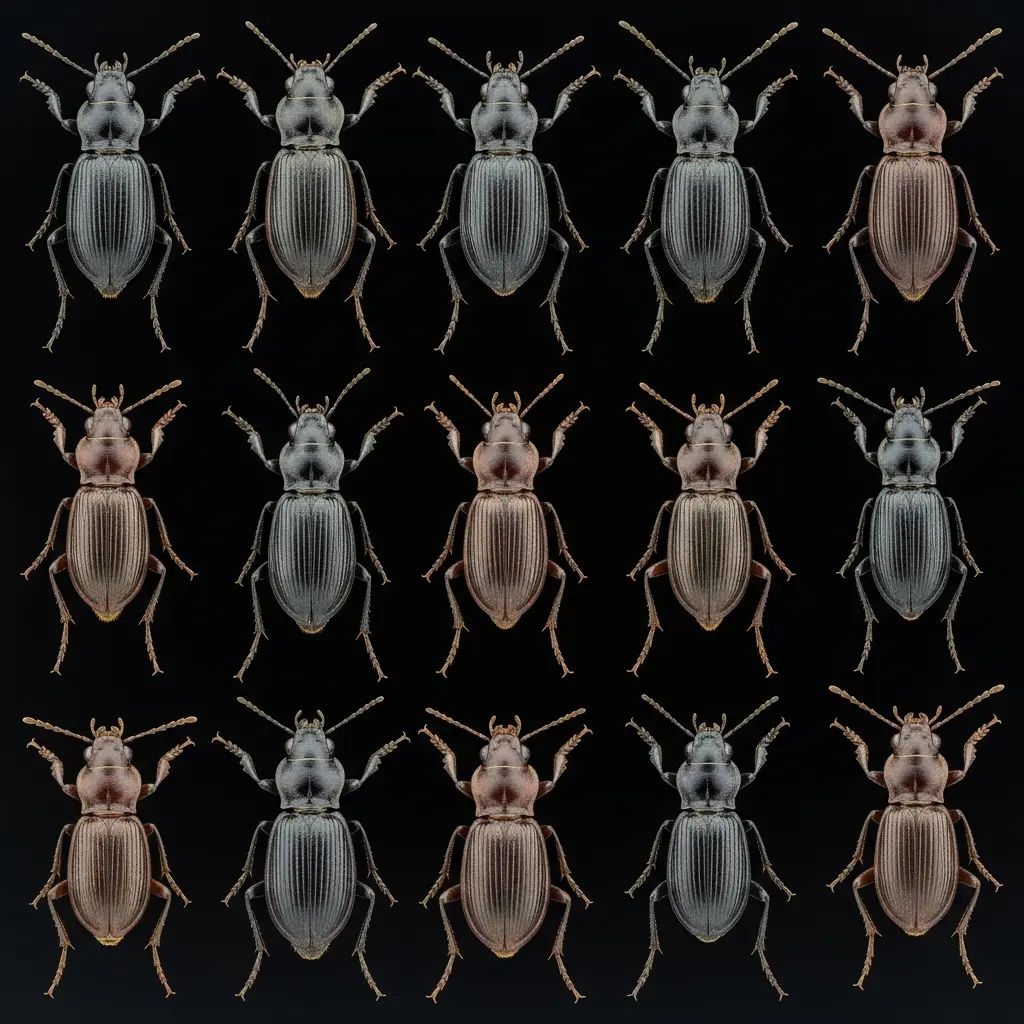
Ground beetles, vital indicators of ecosystem health, have long been overlooked in large-scale ecological studies due to a significant lack of accessible data on invertebrate traits. S M Rayeed, alongside Mridul Khurana from Virginia Tech, Alyson East from The University of Maine, and Isadora E. Fluck et al., have begun to rectify this imbalance with the creation of a comprehensive continental-scale dataset of ground beetle specimens. This research details the digitisation of over 13,200 carabid beetles collected by the National Ecological Observatory Network, utilising high-resolution imaging and validated morphological trait measurements. The resulting dataset not only broadens research access to these important bioindicators, but also establishes a reliable foundation for automated species identification and trait-based ecological analysis, ultimately supporting advancements in biodiversity monitoring and conservation efforts. Digitally measured traits, accurate to sub-millimeter precision, offer a powerful new resource for understanding insect biodiversity across the United States and Hawaii.
This work addresses a critical gap in ecological data, as global trait databases are heavily biased towards vertebrates and plants, severely limiting comprehensive analyses of invertebrate groups like ground beetles. By employing high-resolution imaging, the scientists established a foundation for automated trait extraction, enabling broader access and large-scale ecological studies previously hindered by the limitations of physical specimens.
The study unveils a novel approach to morphological trait measurement, focusing on digitally assessing elytra length and width, key characteristics for species identification and ecological analysis. Validated against traditional manual measurements, the digital extraction method achieves sub-millimeter precision, ensuring the reliability of data for both ecological modelling and advanced computational studies. This level of accuracy is crucial for understanding subtle variations within species and their responses to environmental changes, offering a powerful tool for monitoring biodiversity shifts. The team’s methodology establishes a new standard for digitizing invertebrate specimens, paving the way for more efficient and accurate ecological research.
This breakthrough reveals a multimodal dataset combining high-resolution images with validated morphological measurements, directly addressing the under-representation of invertebrates in existing trait databases. The researchers successfully applied artificial intelligence techniques to automate trait extraction, creating a scalable solution for analyzing large collections and unlocking previously inaccessible data. Experiments show that this automated process maintains a high degree of accuracy, facilitating the development of AI-driven tools for species identification and trait-based research. The resulting dataset supports advancements in biodiversity monitoring, conservation efforts, and a deeper understanding of ecosystem functioning.
The work opens new avenues for investigating the ecological roles of ground beetles, from their impact on pest populations and nutrient cycling to their sensitivity to climate variability. By linking measurable traits to ecological processes, the research establishes a foundation for predicting species responses to global change and informing conservation strategies. This continental-scale dataset not only enhances our understanding of North American carabid biodiversity but also provides a model for digitizing and analyzing invertebrate collections worldwide, fostering a more holistic and comprehensive approach to ecological research.
Carabid Beetle Digitisation and Trait Measurement
Ground beetles, crucial bioindicators of ecosystem health, have been historically underrepresented in global trait databases despite their ecological significance. The study pioneered a high-resolution imaging workflow, capturing detailed images of each specimen to facilitate broader research access and computational analysis, moving beyond reliance on physical collections. This innovative approach enabled the digital measurement of elytral length and width, key morphological traits, for each beetle, establishing a foundation for automated trait extraction techniques.
Researchers employed a rigorous protocol for image acquisition, ensuring reproducibility for both manual and computational analysis. Specimens were imaged using high-resolution cameras, and the resulting images were then processed using custom software to extract measurements of elytral dimensions. The team engineered a validation process, comparing digitally extracted measurements against those obtained using traditional manual calipers, achieving sub-millimeter precision and establishing transparent error rates. This meticulous validation is critical, as many existing trait databases lack reported validation procedures, hindering data reliability.
The study harnessed data collected through NEON’s standardised pitfall trapping methods, a continental-scale observatory providing long-term ecological data. Unlike previous NEON carabid studies focused on species richness or DNA barcoding, this work prioritised detailed morphological characterisation. Scientists developed a multimodal dataset integrating high-resolution images with validated digital trait measurements, overcoming limitations of existing datasets which often lack resolution or comprehensive documentation. This approach enables researchers to investigate intraspecific variation and species-level responses to environmental change.
This methodological innovation directly supports the development of automated species identification tools and trait-based research, addressing the longstanding “invertebrate gap” in ecological databases. By linking measurable morphological characteristics to ecological processes, the work facilitates studies on community assembly, ecosystem functioning, and responses to global change. This work addresses a significant gap in ecological databases, which historically favour vertebrate and plant data over invertebrate representation. The research team employed high-resolution imaging to create a digitally accessible resource, enabling broader analysis of these crucial bioindicators of ecosystem health. By transforming physical collections into a computational format, scientists unlock new avenues for understanding biodiversity shifts driven by environmental change.
Experiments revealed that digital measurements of elytral length and width, key morphological traits, achieve sub-millimeter precision when validated against manual caliper measurements. The team meticulously documented error rates, addressing a common limitation in trait databases where validation is often absent. Measurements confirm that this dataset provides high-quality images and trait data for North American carabids, surpassing the limitations of existing low-resolution or regionally focused datasets. This level of precision is particularly valuable for ecological studies where data sets are often small and heterogeneous, enhancing the effectiveness of analytical techniques.
Results demonstrate the integration of morphological data with NEON’s extensive environmental and climatic datasets, allowing researchers to investigate trait-environment interactions across diverse ecosystems. Scientists recorded quantifiable intraspecific variation in carabid traits, complementing existing NEON data on plants, mammals, and fish, and facilitating cross-taxon analyses of functional diversity. The standardised format and comprehensive metadata ensure seamless integration with global biodiversity platforms, enhancing accessibility and reusability for the wider scientific community. The breakthrough delivers a robust foundation for interdisciplinary research at the intersection of computer vision and biology, enabling applications such as automated trait extraction and species identification. Tests prove the dataset’s potential for real-time environmental monitoring, conservation planning, and ecological forecasting. Through high-resolution imaging and automated trait extraction, the study successfully quantified elytral length and width with sub-millimeter precision, creating a resource for large-scale ecological analysis. The resulting dataset substantially improves invertebrate representation within broader trait databases, facilitating more comprehensive biodiversity assessments. The significance of this work lies in its potential to advance ecological understanding of ground beetles, important bioindicators of ecosystem health.
By enabling automated species identification and trait-based research, the study supports investigations into community assembly, ecosystem functioning, and species responses to environmental change. The authors acknowledge limitations stemming from the focus on elytral measurements, noting that a more complete morphological characterisation would require further investigation. Future research could expand the range of measured traits and explore the application of these digital resources to other invertebrate groups, ultimately contributing to a more holistic understanding of biodiversity patterns.
🗞 A continental-scale dataset of ground beetles with high-resolution images and validated morphological trait measurements
🧠 ArXiv: https://arxiv.org/abs/2601.10687