

The pursuit of faster and more efficient optical memory technologies drives ongoing research into coherent control of light, and a team led by Yuta Kochi, Yutaro Kinoshita, and Masanari Watanabe at Keio University now demonstrates a significant advance in this field. They investigate photon echo techniques, which show promise for optical data storage, but are often limited by the bandwidth of available materials. The researchers overcome this challenge by utilising indium arsenide quantum dots, materials exhibiting exceptionally broad spectral ranges and ultrafast dynamics, and achieve a 3. 2-fold increase in echo efficiency through a technique called adiabatic rapid passage. This breakthrough establishes a robust method for coherent control within these quantum dot ensembles, paving the way for potential applications in ultrafast and broadband optical technologies operating in the terahertz spectral region.
In conventional platforms, such as rare-earth-ion-doped crystals, achieving high performance is hindered by limited bandwidths. Semiconductor quantum dot (QD) ensembles, featuring terahertz-scale inhomogeneous broadening and sub-picosecond dynamics, provide an attractive alternative for ultrafast applications. However, achieving coherent control across such broad spectral ranges remains challenging due to detuning and spatial field inhomogeneities, which reduce photon-echo efficiency.
Robust Chirped Pulse Control of Quantum Dots
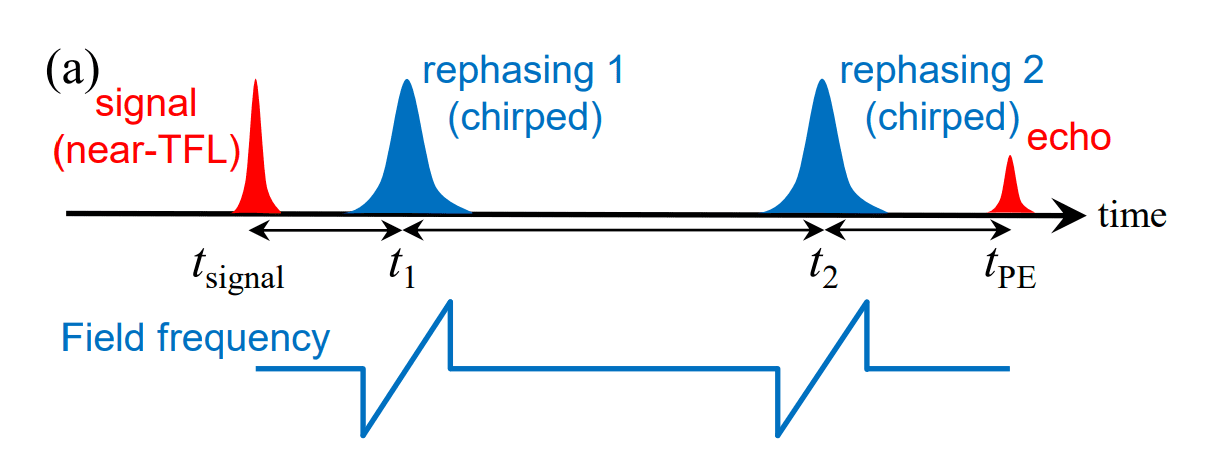
This research details a new approach to controlling quantum dots (QDs) using chirped optical pulses and adiabatic rapid passage (ARP). The central idea is to manipulate the quantum state of QDs with high precision by carefully shaping the frequency of laser pulses over time. ARP allows for efficient and lossless transfer of population between quantum states, even when imperfections are present. The team demonstrates that this technique significantly improves the robustness of quantum state control in QDs, a crucial step towards practical applications. By varying the frequency of the pulses, known as chirping, the researchers overcame limitations of standard ARP and enhanced the efficiency and fidelity of state transfer.
This work focuses on controlling exciton states, electron-hole pairs that are fundamental to the optical properties of QDs. The research achieves high-fidelity transfer of population between quantum states, essential for creating reliable quantum devices. Maintaining adiabaticity, slowly changing the pulse parameters, is critical for ensuring efficient and lossless state transfer. The team specifically focused on indium arsenide (InAs) quantum dots, a promising material for quantum technologies due to their excellent optical properties. This work has implications for various quantum technologies, including single-photon sources for secure communication, quantum memories for storing quantum information, and quantum computing based on QDs.
The experiments utilize high-density InAs quantum dots grown on substrates using strain-compensation techniques. Laser pulses excite and manipulate the QDs, and the emitted light is measured to characterize the quantum states. Researchers use techniques to generate chirped laser pulses with precisely controlled frequency variations. Theoretical modeling, supported by quantum mechanical simulations, helps understand the dynamics of the QDs and optimize the pulse shapes. Numerical simulations model the interaction between the laser pulses and the QDs, predicting optimal pulse shapes for high-fidelity state control.
Accurate refractive index data for the materials involved is crucial for accurate modeling and simulation. The research addresses challenges such as dephasing, the loss of coherence in the QDs, by optimizing pulse shapes and controlling the environment. The team also focuses on developing techniques robust to noise and imperfections in the experimental setup. Scalability, the ability to control a large number of QDs, is a key challenge for quantum technologies, and this research explores multiplexing, controlling multiple QDs simultaneously, using parallel laser driving. Future research will focus on further optimizing the pulse shapes and experimental parameters to achieve even higher fidelity and robustness.
Adiabatic Passage Boosts Quantum Dot Coherence
This research demonstrates a significant advance in coherent control of quantum dot ensembles, achieving enhanced photon echo efficiency through the application of adiabatic rapid passage (ARP). Scientists successfully implemented ARP in a dense ensemble of indium arsenide quantum dots, overcoming challenges posed by the material’s exceptionally broad spectral linewidth. By carefully shaping control pulses to satisfy adiabatic conditions across the ensemble, the team achieved a 3. 2-fold increase in photon echo intensity, comparable to levels observed in more conventional rare-earth ion-doped crystals.
These findings establish ARP as a robust and scalable technique for manipulating quantum coherence in these semiconductor systems, even with the presence of spectral detuning and field inhomogeneity. Numerical simulations validated the experimental observations, confirming the underlying physical mechanisms responsible for the observed enhancement. The team also demonstrated that this control preserves femtosecond temporal widths, crucial for ultrafast applications. Future work will focus on optimizing the excitation beam profile and improving mode matching to further enhance signal generation, paving the way for scalable, high-speed quantum memory devices and advanced nonlinear optical technologies.
👉 More information
🗞 Enhancement of femtosecond photon echo signals from an inhomogeneously broadened InAs quantum dot ensemble using chirped pulses
🧠 ArXiv: https://arxiv.org/abs/2510.21125