Frequency comb spectroscopy offers a powerful means of identifying molecules through their unique spectral fingerprints, but applying this technique to real-world gas sensing has proven difficult due to the need for strong signal returns. Dongxu Zhu, Zhuoren Wan, and Xiaoshuai Ma, alongside colleagues at their institutions, now demonstrate a significant advance by developing a mode-programmable comb spectroscopy system capable of sensing without relying on cooperative reflectors. This innovative approach utilises a high-sensitivity detector and cleverly encodes individual comb modes, allowing for broadband spectral acquisition even through highly scattering environments and from non-reflective targets. The team achieves picometer-level resolution, a wide bandwidth, and remarkable single-photon sensitivity, establishing a new platform with potential for applications ranging from remote environmental monitoring to the detection of hazardous leaks and explosive threats.
Single-Photon Dual-Comb Spectroscopy for Sensitivity
This research introduces a groundbreaking spectroscopic technique that dramatically enhances sensitivity and versatility in analyzing materials. Scientists developed a single-photon counting dual-comb spectroscopy (DC-SPCS) system, combining broad spectral coverage, high resolution, and extremely sensitive single-photon detection. This innovative system reconstructs detailed spectra from limited measurements using computational imaging, enabling analysis even with minimal sample availability and in challenging conditions like turbulent atmospheres or long distances. The technique proves particularly valuable for remote sensing applications, potentially facilitating measurements from drones or satellites. The system achieves unprecedented sensitivity by detecting individual photons, covers a wide range of wavelengths for comprehensive analysis, and delivers high-resolution spectral information. Its capabilities extend to analyzing non-cooperative targets, and it significantly improves signal-to-noise ratios through compressive sensing, making it suitable for diverse applications including environmental monitoring, industrial process control, medical diagnostics, security, agriculture, and advanced remote sensing.
Mode-Programmable Combs for Gas Detection
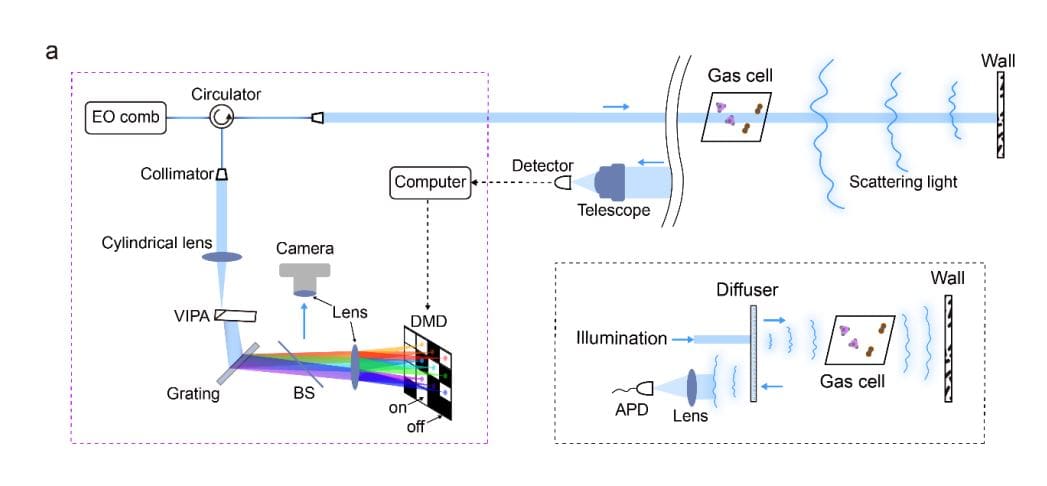
Scientists have developed a novel spectroscopic sensing technique that overcomes traditional limitations in detecting gases, which often require reflective surfaces or controlled returns. This research pioneers mode-programmable computational comb spectroscopy, enabling broadband, high-resolution measurements with a single-pixel detector, even when analyzing difficult targets. The technique utilizes a mode-programmable frequency comb, allowing researchers to precisely select and encode individual comb modes for spectroscopic sensing, effectively tailoring the spectral probe to the specific sample. The method encodes individual comb modes using a two-dimensional disperser and a high-speed digital micromirror device, providing precise control over the spectral information.
This encoding process creates a unique ‘fingerprint’ for each comb mode, enabling the reconstruction of a complete spectrum from the single-pixel detector’s signal. The system achieves picometer-level spectral resolution and a 10-nanometer bandwidth, significantly expanding the range of detectable gases and improving measurement accuracy. Researchers demonstrated exceptional sensitivity, detecting signals as weak as one in ten thousand photons per pulse, a crucial advancement for remote sensing and detection in low-light conditions. Furthermore, the team implemented compressed spectral acquisition with minimal sampling, achieving accurate reconstructions with reduced data acquisition time and processing requirements. This innovative approach allows for measurements through highly scattering media and from non-cooperative targets, opening new possibilities for applications like remote environmental monitoring, industrial leak localization, and explosive threat detection.
Single-Photon Detection via Mode-Programmable Combs
This work presents a breakthrough in frequency comb spectroscopy, establishing a powerful platform for non-cooperative gas sensing. Scientists achieved broadband, high-resolution measurements using a mode-programmable comb and a single-pixel detector, overcoming limitations of conventional techniques that require cooperative reflectors or controlled returns. The core of this advancement lies in the ability to encode individual comb modes, enabling spectral acquisition without relying on coherent detection, and facilitating measurements through highly scattering media. Experiments demonstrate picometer-level spectral resolution and a 10-nanometer bandwidth.
Crucially, the system achieves single-photon sensitivity, detecting signals down to extremely low light levels, and enables compressed spectral acquisition with minimal sampling while maintaining accurate reconstructions. This compressed sensing capability significantly reduces the number of measurements needed, streamlining data collection. The experimental setup utilizes an electro-optic comb, a two-dimensional disperser, and a digital micromirror device to spatially control and encode comb modes. Researchers successfully demonstrated the ability to manipulate the comb in a mode-by-mode manner, achieving high contrast between encoded and suppressed modes. Tests confirmed faithful reproduction of designed patterns, and the corresponding encoded spectrum spanned a significant range. The team encoded numerous comb modes simultaneously, verifying the system’s capacity for programmable spectral encoding and paving the way for non-cooperative measurements and diverse gas-sensing applications.
Broadband Spectroscopy Through Scattering Media Achieved
This research demonstrates a new approach to frequency comb spectroscopy, overcoming limitations that previously required cooperative reflectors or controlled returns for effective gas sensing. Scientists have developed a technique utilizing a mode-programmable comb and a sensitive single-pixel detector to achieve broadband, mode-resolved spectral acquisition, even through highly scattering media and from non-cooperative targets. The method attains picometer-level spectral resolution and a 10-nanometer bandwidth, while maintaining sensitivity down to extremely low light levels. These advancements establish a powerful platform for diverse gas-sensing applications, including remote environmental monitoring, the localization of industrial leaks, and the detection of explosive threats.
The team highlights the potential for integration with drone and satellite-based sensing platforms, significantly enhancing their spectral analysis capabilities for widespread monitoring of pollutants and greenhouse gases. Researchers note that combining this technique with sensitivity-enhancing methods, such as cavity-enhanced or photoacoustic spectroscopy, could further improve its performance for trace gas analysis. This innovative spectroscopic technique, combining high resolution, broad bandwidth, and non-cooperative sensing, positions itself as a valuable tool for a wide range of gas sensing applications and opens new possibilities for remote sensing technologies.
👉 More information
🗞 Mode-programmable comb spectroscopy enabling non-cooperative computational sensing with single-photon sensitivity
🧠 ArXiv: https://arxiv.org/abs/2511.16365