The pursuit of efficient and secure communication underpins modern technology, and researchers continually seek ways to push the boundaries of what is possible. Osamu Hirota from Quantum ICT Research Institute, Tamagawa University, and colleagues now present a significant advance in this field, developing a new theoretical framework that extends Shannon’s information theory to the quantum realm. This work addresses limitations in applying conventional Shannon theory to real-world communication systems, offering a path towards surpassing existing performance benchmarks without sacrificing efficiency or security. The team demonstrates this potential by introducing a perfect secure cipher, a breakthrough that overcomes a long-standing impossibility theorem within the field, and establishes a foundation for designing next-generation communication, cipher and sensor technologies.
Quantum Information Limits and Reliable Transmission
This collection of research comprehensively explores the boundaries of quantum information and communication theory, investigating how much information can be reliably transmitted through noisy quantum channels. Studies delve into optimal strategies for detecting signals in quantum noise and accurately estimating quantum parameters, alongside methods for estimating quantum system states based on noisy measurements, laying the groundwork for advanced quantum technologies. A significant focus lies on entangled states and their application in quantum key distribution, a method for secure communication. Researchers extensively investigated quantum noise stream ciphers, a novel cryptographic technique utilizing quantum noise, detailing both the theoretical development and practical experimental demonstrations of this technology, alongside research into quantum digital to analog conversion, a crucial component of this approach.
The collection also addresses challenges in long-distance quantum communication and acknowledges the need for cryptographic algorithms resistant to future quantum computer attacks. Further investigations cover minimum error detection and discrimination of quantum processes, alongside explorations of coherent states and non-classical light, vital for quantum communication and information processing. The research examines the limits of precision in quantum measurement and provides a robust mathematical foundation through operator algebras and entropy, building upon classical information and coding theories. Experimental implementations, such as injection laser noise and demonstrations of quantum noise stream ciphers, bridge the gap between theory and practical application, suggesting a drive towards developing practical and cost-effective quantum communication systems, potentially as an alternative to traditional methods, and highlighting the potential for hybrid quantum-classical cryptographic approaches. This body of work also points towards advancements in quantum signal processing for enhanced communication, quantum metrology for precision measurement, and the development of fault-tolerant quantum communication systems, ultimately providing a comprehensive foundation for further research into secure and efficient quantum communication technologies.
Symmetric Logarithmic Operators for Quantum Estimation
Researchers investigated the limits of information estimation in quantum systems, seeking to determine whether quantum mechanics offers advantages over classical methods. Their work centers on refining estimation theory, particularly for non-commutative parameters, quantities that cannot be simultaneously known with perfect precision, and developed a framework based on the symmetric logarithmic differential operator, allowing them to derive estimation operators for simultaneous measurement of these quantities. The study employed a rigorous mathematical approach, beginning with the formulation of single-parameter estimation using the Cramer-Rao bound, a theorem defining the minimum achievable variance for any estimator. Researchers extended this to the quantum realm, demonstrating that for single parameters, the optimum measurement corresponds to standard quantum measurement, revealing no inherent quantum advantage.
To address the more complex scenario of non-commutative parameters, such as quadrature amplitude in optical communication, the team formulated a new theorem defining the estimation bound, expressed as a trace involving the right logarithm derivative. Experiments involved analyzing coherent state signals, commonly used in optical communications and radar. Scientists derived solutions for estimating single parameters of these signals, finding that the optimal estimator corresponds to a homodyne receiver, again demonstrating no quantum advantage. However, when considering simultaneous estimation of non-commutative parameters, the conventional Cramer-Rao bound proved inadequate, leading the team to develop a refined bound, demonstrating that the minimum variance for complex amplitudes is N + 1, where N represents background noise. This result indicates that a set of balanced homodyne receivers performs equivalently to a heterodyne receiver for coherent state signals. Further work involved applying Lie algebra to formulate estimation theory, constructing decision operators based on minimum uncertainty states for non-commuting operators, providing a pathway for controlling quantum states and simultaneously measuring non-commutative quantities.
Perfect Secrecy Beyond Shannon’s Limit
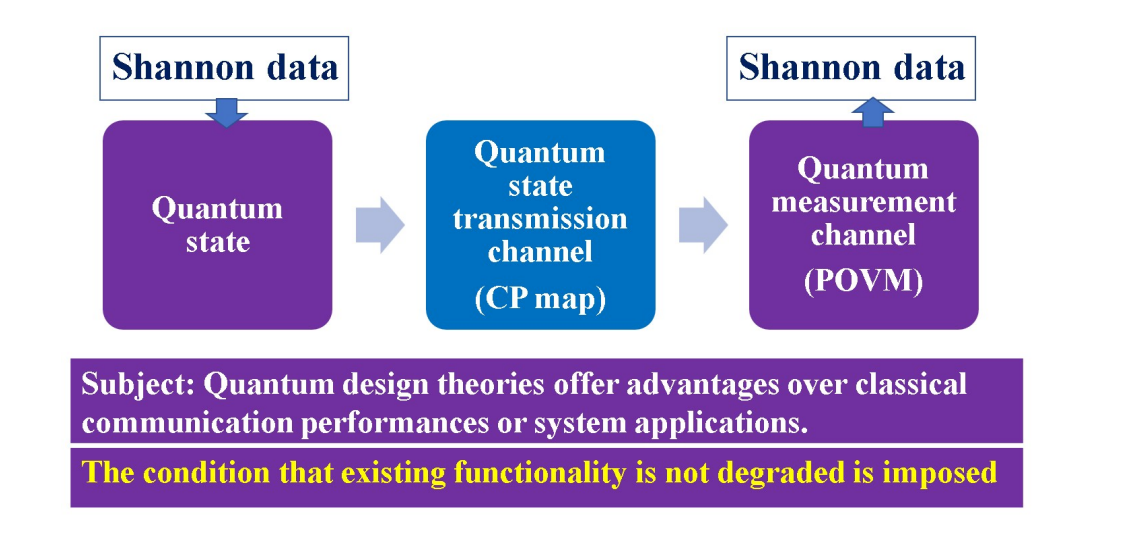
This research presents a theoretical framework addressing limitations in applying Shannon information theory to real-world communication systems, ultimately introducing a perfect secure cipher that overcomes the Shannon impossibility theorem without reducing communication performance. Researchers investigated mutual information, demonstrating that quantum Bayes and minimax decision operators satisfy necessary conditions for maximizing this value when signal states exhibit group covariance. In environments with significant loss or noise, no quantum state surpasses the mutual information achievable with coherent states. For pure state channels, scientists proved a conjecture regarding the extension of the alphabet and decision operators based on entangled measurement, establishing an upper bound on maximum mutual information and capacity using the Holevo information.
This research defines the channel capacity formula for quantum Shannon information transmission systems, confirming that the maximum absolute value of capacity in real environments is provided by coherent states, and completed numerical analysis of this capacity for coherent state signals. Extending this analysis to analog signals with constrained power inputs, the team derived a capacity formula for optical quantum communication in a free space lossy Gaussian channel. This formula, which utilizes coherent states, generally exceeds the Shannon classical capacity achieved with heterodyne receivers. The research establishes a quantum advantage for discrete alphabets, where quantum capacity exceeds classical capacity, and for continuous alphabets, where the Holevo capacity surpasses the Shannon capacity.
This quantum advantage stems from error mitigation effects in quantum decision mechanisms and coding. Scientists explored achieving quantum gain in capacity through decision operators and coding schemes, noting that the quantum gain for discrete alphabets arises from single-shot decision operators, while the gain for continuous alphabets results from both entangled measurement-based decision operators and coding schemes. The team also defined reliability functions and derived an upper bound on the average error probability of pure state codes for quantum channels, furthering the understanding of operational meanings of Shannon’s mutual information and channel capacity.
Quantum Communication Maintains Shannon Limits
This research details advancements in quantum communication theory and its relationship to established Shannon information transmission principles, demonstrating how quantum gain can enhance communication performance, moving beyond limitations inherent in conventional systems. Importantly, this work establishes a theoretical framework compatible with designing modern optical communications systems, suggesting a path towards maintaining and improving current communication capabilities while incorporating quantum effects. The findings address a critical challenge in applying quantum technologies, namely the tendency for new schemes to sacrifice existing performance characteristics. By focusing on maintaining, rather than diminishing, established metrics like communication speed and reliability, this research offers a viable approach to practical implementation. The authors acknowledge that further development is needed, particularly in balancing mathematical formalism with practical physics and electronics, and identify areas for future investigation including refining the operational meaning of key mathematical tools used in the theory, ultimately providing a foundational understanding of the design principles for ultra-high speed quantum optical communication, stream ciphers, and quantum sensors.
🗞 Quantum Shannon Information Theory -Design of communication, cipher and sensor-
🧠 ArXiv: https://arxiv.org/abs/2510.07726