

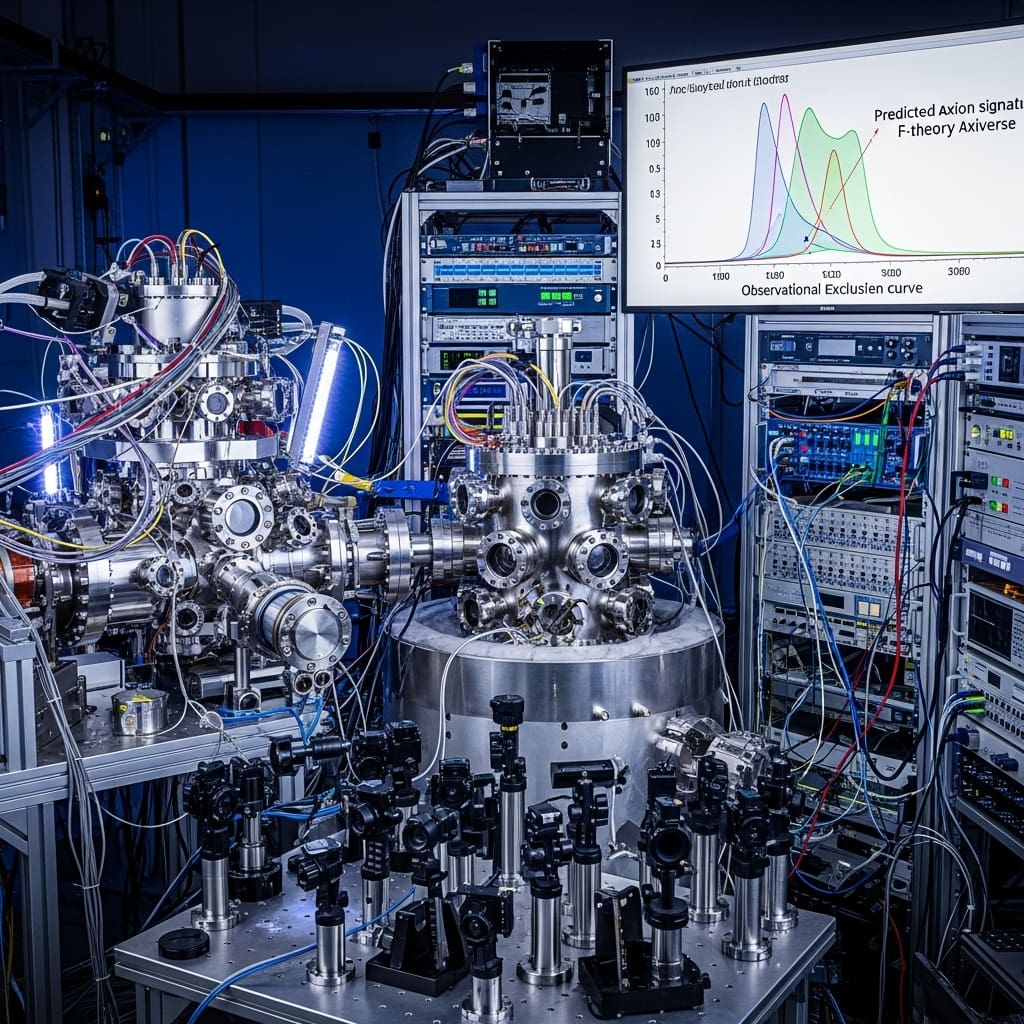
The search for axions, hypothetical particles that could solve fundamental problems in particle physics and constitute dark matter, receives a significant boost from new research exploring a vast landscape of possibilities within F-theory, a branch of string theory. Sebastian Vander Ploeg Fallon from Cornell University, James Halverson from Northeastern University, Liam McAllister from Cornell University, and Yunhao Zhu from Northeastern University, investigate the couplings of numerous axions, up to 181,200 in their models, arising from complex geometrical constructions. Their work reveals a surprising degree of consistency in the properties of these axions, demonstrating that even with enormous numbers, their masses, decay rates, and interactions with other particles exhibit predictable behaviour. This finding is crucial because it suggests that theories with many axions are not necessarily fine-tuned or unrealistic, and it establishes concrete predictions that can be tested with existing experiments, potentially bringing us closer to detecting these elusive particles and understanding the nature of dark matter.
Axion masses, decay constants, and couplings to gauge sectors exhibit remarkable universality across the studied ensembles. The research focuses on scenarios where corrections to theoretical calculations are plausibly controlled, utilising couplings to specific non-Abelian sectors as a proxy for couplings to photons. Notably, axion-photon couplings increase with the number of axions present, and models containing more than 10,000 axions face tension with existing helioscope constraints. Furthermore, under reasonable assumptions regarding charged matter extending beyond the Standard Model, theories with more than 5,000 axions also encounter tension with Chandra measurements of X-ray spectra. This work represents an initial investigation into the phenomenology of quantum gravity theories incorporating thousands of axions.
String Landscape, Moduli and Cosmology Research
This collection represents a comprehensive bibliography spanning string theory, cosmology, algebraic geometry, and related areas. The research focuses on the string landscape, moduli stabilization, and the search for realistic solutions in string theory that can address cosmological puzzles. It connects abstract mathematical structures, such as Calabi-Yau manifolds and toric varieties, to observable phenomena like dark matter, dark energy, and the cosmological constant. A significant portion of the work explores the geometry of the string landscape and seeks ways to identify viable theoretical solutions.
There is also growing emphasis on the statistical properties of the landscape and their implications for cosmology. The references fall into several key categories, including string theory and the landscape, moduli stabilization, the geometry of Calabi-Yau manifolds, flux compactifications, and landscape statistics. Cosmology and astrophysics are also well represented, with research addressing the cosmological constant problem, searching for dark matter and dark energy candidates, and exploring alternative cosmological models based on the concept of cosmological stasis. The bibliography includes significant work in algebraic geometry and topology, particularly concerning toric geometry, Calabi-Yau geometry, and Hodge theory.
Finally, a smaller portion focuses on computational aspects, including the use of optimization algorithms and methods for generating Calabi-Yau manifolds. Potential research directions arising from this bibliography include developing more realistic string compactifications, exploring the statistical properties of the landscape, investigating alternative cosmological models, and applying machine learning and artificial intelligence to accelerate the search for viable solutions. Improving computational methods and connecting string theory to observable phenomena, such as searching for axion-like particles or deviations from general relativity, also represent promising avenues for future research. Ultimately, this bibliography provides a comprehensive overview of a vibrant and active area of research at the intersection of string theory, cosmology, and mathematics.
Largest Axiverse Study Reveals Axion Properties
Scientists have achieved a significant breakthrough in understanding axions, hypothetical particles considered strong candidates for dark matter and solutions to the strong CP problem in particle physics. This work focuses on the F-theory axiverse, a theoretical landscape hosting a potentially vast number of axions, and represents the largest axiverse studied to date, encompassing up to 181,200 axions. Researchers constructed three distinct ensembles of four-dimensional theories derived from explicit Calabi-Yau fourfold topologies, allowing for the study of axions beyond previously established limits. The team computed the masses, decay constants, and couplings of these axions to gauge groups, utilizing geometrically non-Higgsable clusters as proxies for electromagnetic interactions.
Results demonstrate a precise correlation between the axion-photon couplings and the number of axions present. Specifically, the effective axion-photon coupling exhibits a clear relationship with the number of axions, allowing for detailed modeling of axion-photon interactions in F-theory compactifications. Measurements confirm that models with 10,000 axions are already in tension with constraints from helioscope experiments, which search for axions by detecting their conversion into photons. Furthermore, theories with more than 5,000 axions are found to be in tension with Chandra measurements of X-ray spectra, indicating that these models are disfavored by observational data. This work establishes a crucial link between the number of axions and experimental limits, significantly narrowing the parameter space for viable F-theory axiverse models. The study provides a foundation for future investigations into the rich physics of the F-theory axiverse and its potential connection to quantum gravity.
Axion Couplings And Experimental Constraints
This work presents a systematic investigation of axions arising from compactifications of F-theory, a framework extending string theory, and explores the resulting ‘F-theory axiverse’. Researchers computed the couplings of a substantial number of axions, up to 181,200, across multiple ensembles of theoretical compactifications. A key finding is the striking universality observed in axion properties, including their masses, decay constants, and couplings to gauge sectors, despite the vast number of axions considered. Notably, the strength of axion couplings to photons increases with the number of axions present, leading to potential tensions with existing experimental constraints from helioscope experiments and observations of X-ray spectra.
Specifically, models containing approximately 10,000 axions show some conflict with helioscope data, while theories with around 5,000 axions face challenges when compared to Chandra X-ray telescope measurements, assuming the presence of charged matter beyond the Standard Model. The authors acknowledge that these tensions represent areas for further refinement of the models and highlight the need for more precise experimental data. This research constitutes an initial step towards understanding the phenomenology of quantum gravity theories with a large number of axions and provides a foundation for future investigations into the properties and detectability of axions in the F-theory axiverse.
👉 More information
🗞 F-theory Axiverse
🧠 ArXiv: https://arxiv.org/abs/2511.20458

