

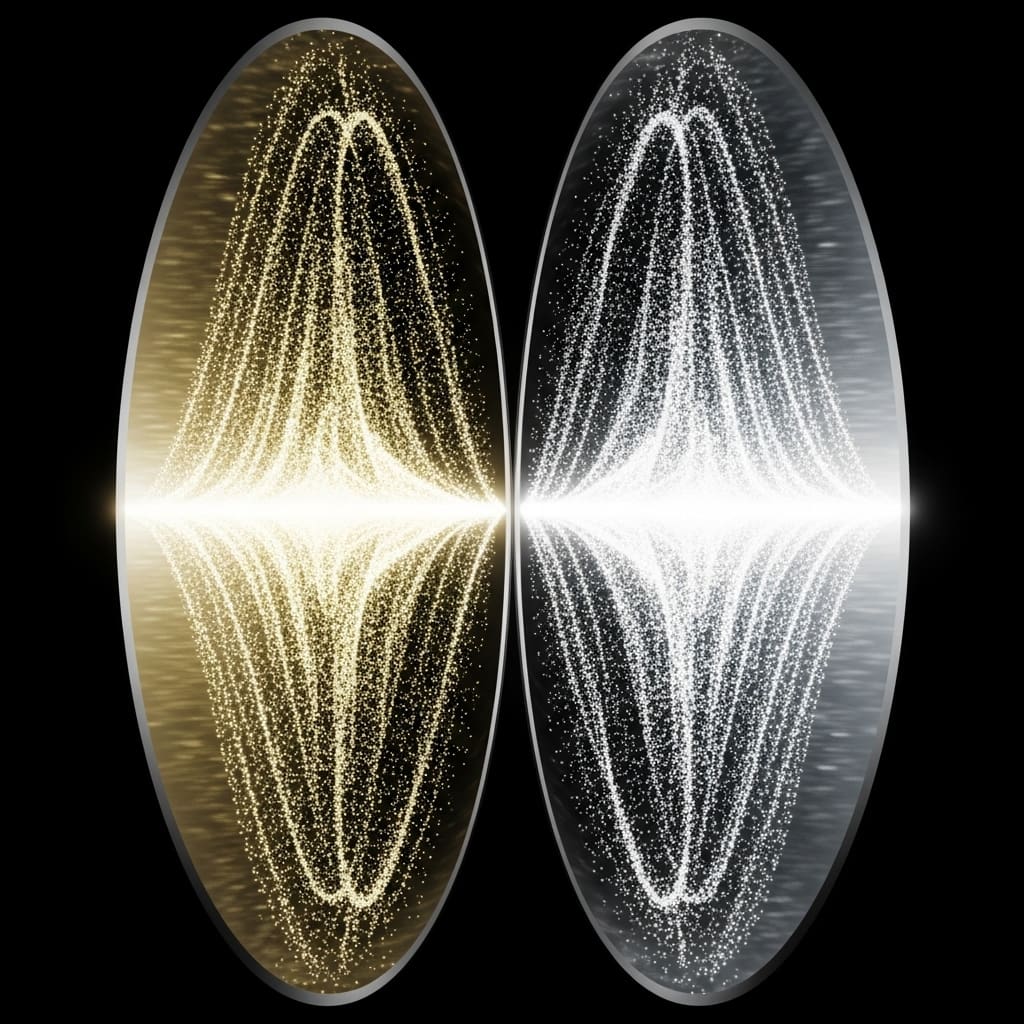
Controlling the behaviour of photons is fundamental to both conventional and quantum technologies. Yifang Xu, Yilong Zhou, and Ziyue Hua, alongside colleagues from the Center for Quantum Information at Tsinghua University, present research demonstrating scalable manipulation of quantum states with a remarkably high number of photons. Their work establishes a new framework , termed “Fock-space” , which applies the well-understood principles of wave optics to photon number, effectively treating it as an additional dimension for control. The team experimentally validates this approach using a superconducting microwave resonator, achieving analogues of classical optical phenomena like propagation, refraction, and interference with up to 180 photons. This breakthrough establishes a clear link between Schrödinger evolution and classical wave behaviour, paving the way for advanced bosonic information processing and the scalable control of quantum systems containing thousands of photons.
Fock Space Optics for Quantum Wave Propagation
Hefei 230026, China; Beijing Academy of Quantum Information Sciences, Beijing, China; Hefei National Laboratory, Hefei 230088, China. The manipulation of distinct degrees of freedom of photons plays a critical role in both classical and quantum information processing. While the principles of wave optics provide elegant and scalable control over classical light in spatial and temporal domains, engineering quantum states in Fock space has been largely restricted to few-photon regimes. This limitation is due to the computational and experimental challenges presented by large Hilbert spaces. This work introduces “Fock-space optics”, establishing a conceptual framework of wave propagation in the quantum domain by treating photons as quantum entities propagating according to established wave optical principles.
The research objective is to extend wave optical techniques to the manipulation of high-dimensional quantum states, specifically those residing in Fock space. The approach involves developing a theoretical formalism that describes the propagation of quantum states through optical elements, analogous to classical wave propagation. This formalism allows for the design of optical systems capable of generating and manipulating complex quantum states with a large number of photons. A key contribution is the demonstration of how established wave optical concepts, such as diffraction and interference, can be directly applied to the quantum realm.
Furthermore, the study details the development of specific optical configurations for generating and manipulating multi-photon states. These configurations are designed to overcome the limitations of traditional methods, which struggle with the exponential increase in complexity as the number of photons increases. The research provides a pathway towards scalable quantum information processing by leveraging the well-established infrastructure and techniques of classical optics. This work establishes a foundation for future investigations into advanced quantum optical systems and their applications in quantum communication and computation.
Photonic Propagation and Manipulation in Superconducting Resonators
Researchers have demonstrated analogues of classical optical phenomena, propagation, refraction, lensing, dispersion and interference, using up to 180 photons within a superconducting microwave resonator. This experimental work establishes a fundamental connection between Schrödinger evolution in a single bosonic mode and classical paraxial wave propagation, effectively treating photon number as a synthetic dimension. The experiment leverages Fock-space, a Hilbert space defined by photon-number eigenstates denoted as |n⟩, to explore quantum states of light. This approach offers a novel pathway for controlling large-scale quantum systems and advancing bosonic information processing.
The methodology centres on utilising a superconducting microwave resonator to manipulate photons and observe their behaviour. By carefully controlling the interactions within the resonator, the team simulated optical effects typically observed with macroscopic light beams. This involved creating and measuring quantum states with varying numbers of photons, ranging up to 180, and observing how these states evolved over time. The observed phenomena directly correspond to classical optical behaviours, validating the theoretical framework linking quantum and classical optics. Experimental procedures focused on mapping intuitive optical concepts onto high-dimensional quantum state engineering.
The researchers did not directly calculate electromagnetic field distributions, which can be computationally demanding, but instead relied on the established principles of geometric ray tracing and wave interference. This allowed for efficient and intuitive design of the quantum system, enabling precise control over the photons. The system’s behaviour was then characterised through measurements of the quantum states, confirming the simulated optical effects. This work builds upon the foundations of Maxwell’s electromagnetic theory and extends the toolbox of optical principles into the quantum realm. Previous quantum control strategies often require intensive computational optimisation, but this approach offers a more intuitive and scalable method for manipulating quantum states. The ability to precisely control states in Fock space is crucial for advancements in quantum communication, sensing, computation and simulation, potentially unlocking quantum-enabled advantages in these fields.
Fock Space Optics Mimics Classical Wave Behaviour
Scientists achieved a breakthrough in quantum photonics by establishing “Fock-space optics”, a framework treating photon number as a synthetic dimension for wave propagation. The research team experimentally demonstrated analogues of classical optical phenomena, interference, within this Fock space, utilizing up to 180 photons. This work reveals a fundamental correspondence between Schrödinger evolution in a single bosonic mode and classical paraxial wave propagation, effectively translating established optical principles into the quantum realm. Experiments were conducted using a superconducting microwave resonator, allowing precise manipulation and observation of these high-photon number states.
The study meticulously mapped intuitive optical concepts onto high-dimensional quantum state engineering, opening avenues for scalable control of large quantum systems. Measurements confirm that the quantum evolution equation, governing a single bosonic mode, directly corresponds to the paraxial wave equation that describes classical beam propagation. This duality allows for the direct application of centuries-old optical principles to the engineering of quantum states in Fock space, validating the functionality of key optical tools at a quantum level. Data shows the successful implementation of these principles with a resonator capable of supporting up to 180 photons, a significant leap beyond previous limitations.
Results demonstrate the ability to manipulate quantum states in Fock space with unprecedented scale and efficiency. The team calibrated a qubit frequency to resolve photon-number-splitting peaks of coherent states, establishing a “Fock-space camera” for detecting population along the photon-number axis. This calibration, detailed in accompanying figures, allowed for precise observation of photon distribution and verification of the implemented optical analogues. The breakthrough delivers an intuitive and scalable pathway for manipulating massive quantum excitations, paving the way for advancements in bosonic quantum information processing and potentially enabling the realization of quantum technologies requiring large numbers of photons.
This research establishes a profound mathematical duality, enabling the translation of optical principles refined over three centuries to quantum state engineering. Tests prove that weak coherent driving of a superconducting cavity directly maps quantum dynamics onto classical optical propagation, validating the basic tools of optics in a synthetic dimension. Measurements confirm the successful demonstration of propagation, refraction, lensing, dispersion, and interference, all within the Fock space, and with photon numbers reaching 180, significantly exceeding previous experimental constraints.
👉 More information
🗞 Principles of Optics in the Fock Space: Scalable Manipulation of Giant Quantum States
🧠 ArXiv: https://arxiv.org/abs/2601.10325


