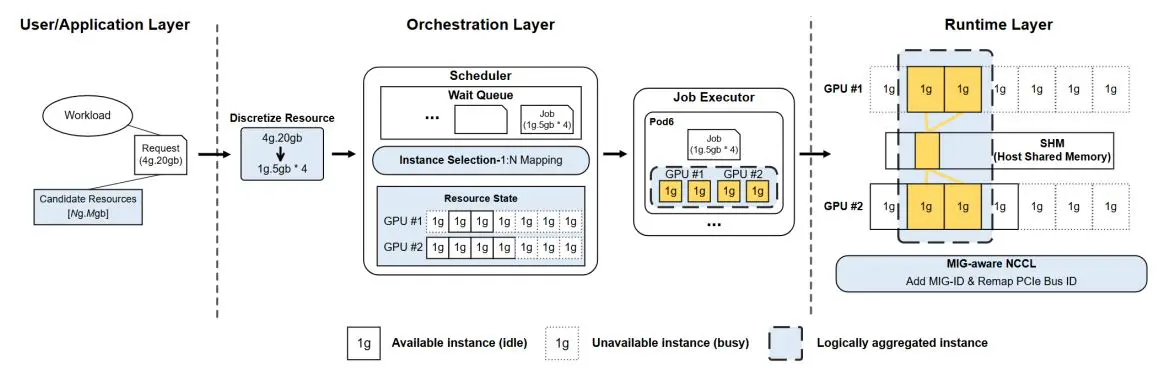
Modern GPU clusters frequently experience underutilization, prompting the development of technologies that allow efficient sharing of these powerful resources. Myeongsu Kim, Ikjun Yeom, and Younghoon Kim, from SungKyunKwan University and Ajou University, address this challenge with Flex-MIG, a novel software framework designed to optimise the use of Multi-Instance GPUs (MIG). The team overcomes limitations inherent in MIG’s rigid hardware and traditional allocation methods by introducing a flexible, one-to-many allocation model, allowing multiple workloads to share a single MIG instance. This innovative approach eliminates the need for reconfiguration, reduces fragmentation, and ultimately improves overall cluster efficiency, demonstrated by a makespan improvement of up to 17% across various workloads, revealing the potential of software-coordinated resource management for GPU clusters.
Logically Composable MIGs Boost GPU Efficiency
Researchers have addressed limitations in current Multi-Instance GPU technologies, which often suffer from underutilization and fragmentation in multi-tenant environments. They present Flex-MIG, a software framework that moves away from a one-to-one allocation model to a one-to-many approach, enabling a single job to run across multiple GPU instances. This innovation eliminates the need for time-consuming reconfiguration and allows for logical aggregation of resources, resolving fragmentation and improving overall cluster efficiency. Evaluation of Flex-MIG demonstrates a significant improvement in makespan, achieving up to a 17% reduction compared to existing Dynamic- and Static-MIG configurations, with only a modest increase in per-job overhead.
This means that jobs complete faster and the overall cluster processes more work in a given timeframe. By redefining MIG as a logically composable, software-managed resource layer, the team highlights the potential for substantial gains in the efficiency of multi-tenant GPU clusters. The team validated these findings using a calibrated simulator, ensuring the accuracy and reliability of the results. The authors acknowledge that further research could explore the framework’s performance with a wider range of workloads and cluster configurations, but the current results demonstrate a promising step towards more efficient GPU resource management.
👉 More information
🗞 Flex-MIG: Enabling Distributed Execution on MIG
🧠 ArXiv: https://arxiv.org/abs/2511.09143