Defects in two-dimensional materials, such as tungsten disulphide, profoundly influence their properties and potential applications in areas ranging from electronics to catalysis, so understanding and controlling these imperfections is critical. Weiru Chen, John C. Thomas, and Yihuang Xiong, from Dartmouth College, along with colleagues including Shalini Kumari from The Pennsylvania State University, now present compelling evidence for a particularly stable defect within a single layer of tungsten disulphide. Their work identifies a unique configuration, where two missing sulphur atoms sit directly above one another, as the only energetically favourable arrangement for such defects. This discovery, supported by detailed theoretical calculations and confirmed through scanning tunneling spectroscopy, not only explains the behaviour of these defects but also provides a pathway to intentionally engineer materials with tailored properties for advanced technologies.
Sulfur Vacancies for Quantum Defect Engineering
Researchers are actively exploring defects in two-dimensional materials, specifically monolayer tungsten disulfide and tungsten diselenide, as building blocks for future quantum technologies. This work focuses on sulfur vacancies, missing sulfur atoms within the material’s structure, and their potential to create quantum defects suitable for qubits and single-photon emitters. These vacancies introduce unique energy levels, allowing for precise control of the material’s electronic and optical properties. Scientists are developing methods to engineer and control the creation of these vacancies, even manipulating their location using advanced techniques like scanning tunneling microscopy.
The research aims to harness these defects as qubits, the fundamental units of quantum information, and as sources of single photons essential for secure quantum communication. Understanding the spin characteristics of these defects is crucial for their integration into functional quantum devices. Researchers combine computational modeling, like density functional theory, with experimental techniques to predict and verify the behavior of these defects. High-throughput computational screening helps identify promising defect configurations, guiding experimental efforts. This comprehensive approach is pushing the boundaries of materials science and quantum technology, paving the way for robust and controllable quantum defects.
Stable Divacancy Configuration in Tungsten Disulfide
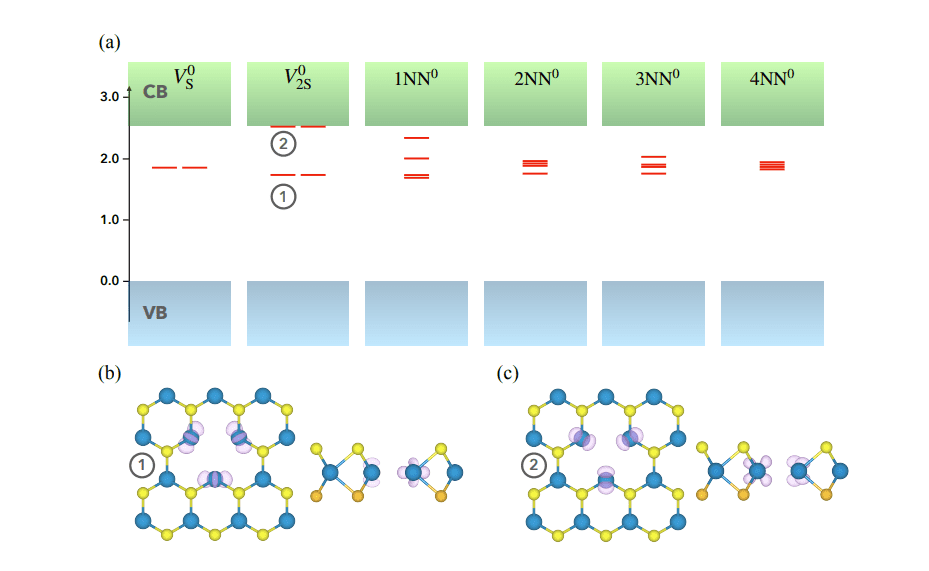
This work presents a significant advance in understanding defects within monolayer tungsten disulfide, a material vital for optoelectronics and quantum information science. Scientists investigated sulfur vacancies, both isolated and paired, using computational modeling and experimental scanning tunneling microscopy and spectroscopy. Results demonstrate that a specific arrangement, where two sulfur vacancies sit directly above each other, exhibits a strong binding energy, confirming its thermodynamic stability and suggesting a natural tendency for its formation at lower temperatures. Detailed electronic structure analysis revealed that the introduction of a second vacancy splits the energy levels, creating a unique signature for the paired defect.
The team calculated the energy of these vacancies under different conditions, revealing that the paired vacancy maintains its favorable binding energy even with variations in the material’s composition. Recent measurements of the emission properties of these vacancies and complexes confirm that only the nearest-neighbor divacancy provides bright and stable optical emission. These findings provide crucial insights into the electronic behavior of defects in two-dimensional semiconductors and offer a pathway for tailoring material properties for advanced technological applications.
Stable Divacancies in Tungsten Diselenide Confirmed
This research successfully identifies and characterizes a stable configuration of sulfur vacancies within monolayer tungsten diselenide, a two-dimensional material with potential applications in advanced electronics and quantum technologies. Through computational modeling, scientists demonstrate that a specific arrangement, where two sulfur vacancies sit directly above each other, exhibits a strong binding energy, indicating its thermodynamic stability. Importantly, this divacancy configuration displays a distinct shift in its electronic structure compared to isolated sulfur vacancies, altering the energy of unoccupied electronic states within the material’s band gap. Confirmation of this predicted behavior arrives through scanning tunneling spectroscopy measurements, which reveal a corresponding energetic shift consistent with the “on-top” divacancy. This agreement between computational prediction and experimental observation strengthens the understanding of defect formation in this material. The finding is significant because sulfur vacancies and their complexes are being explored as potential single-photon emitters, and the stability of the divacancy configuration could be crucial for controlling and optimizing these quantum light sources.
👉 More information
🗞 First principles and scanning tunneling spectroscopical evidences for thermodynamically stable “on-top” sulfur divacancy in monolayer WS
🧠 ArXiv: https://arxiv.org/abs/2509.19121