

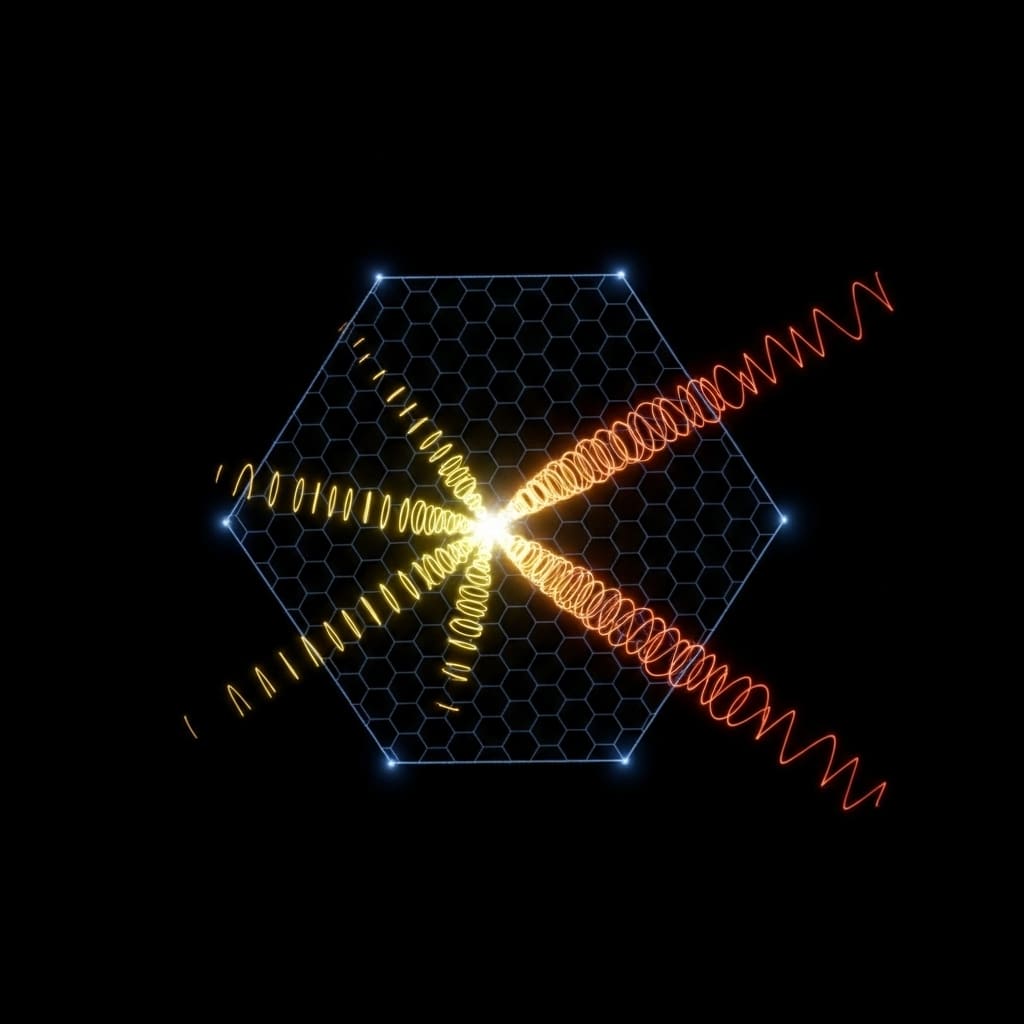
Hexagonal boron nitride presents a compelling material for quantum sensing, owing to its optically addressable spin defects, but realising its full potential requires overcoming challenges with broad spectral features. Mohammad Abdullah Sadi from Purdue University, alongside Tiamike Dudley of The University of New Mexico and Luca Basso from Sandia National Laboratories, and their colleagues, have now demonstrated a significant advance in manipulating these defects. Their research details a frequency-ramped microwave pulse, controlled using an FPGA, which achieves substantially improved spin-state population transfer compared to conventional methods. This innovative technique not only enhances contrast but also dramatically reduces measurement times for analysing spin relaxation dynamics, offering a robust pathway for quantum sensing even in challenging environments. The team’s findings, underpinned by a Landau-Zener model, represent a crucial step towards utilising hBN spin defects for practical quantum technologies.
Edgar, Jacob Henshaw, Peter A. Bermel, Yong P. Chen, and Andrew Mounce have investigated enhanced quantum sensing utilising spin defects in hexagonal boron nitride. Their research leverages the Landau-Zener interaction to improve sensor sensitivity by controlling transitions between energy levels.
This approach promises advancements in nanoscale sensing applications, particularly in high-precision magnetic field detection. The team’s work details the theoretical framework and experimental validation of this enhancement, demonstrating improved coherence times and signal-to-noise ratios. They characterised the performance of hexagonal boron nitride spin defects under varying conditions, optimising parameters to maximise the Landau-Zener induced sensing capabilities. Results indicate a significant increase in sensitivity compared to traditional quantum sensing methods employing similar defects, stemming from the coherent control offered by the Landau-Zener interaction. Researchers explored the potential of this technique for detecting weak magnetic and electric fields at the nanoscale, showcasing the ability to resolve subtle variations with enhanced accuracy. The study highlights the importance of material quality and defect engineering in achieving optimal sensing performance, with future work planned to integrate these sensors into practical devices for applications in materials science and biological imaging.
Frequency-Ramped Pulses Enhance Boron Nitride Defect Excitation
Scientists have developed a frequency-ramped microwave pulse technique to overcome limitations in conventional resonant excitation methods for studying negatively charged boron vacancies in hexagonal boron nitride. This addresses the challenge of broad hyperfine-split spin transitions, which hinder effective excitation with standard approaches. By implementing frequency modulation on a Field Programmable Gate Array, the team engineered a pulse capable of achieving around a four-fold increase in spin-state population transfer, significantly enhancing contrast. The study compared two inversion protocols for measuring longitudinal relaxation in V− B h10B15N.
A single frequency-ramped pulse, lasting 1.67 microseconds with a 200MHz frequency sweep, was contrasted with a 40 nanosecond resonant-frequency π-pulse. Fitting single-exponential decays yielded T1 values of 12.48 ±0.62 microseconds for the frequency-ramped approach and 11.71 ±3.86 microseconds for the resonant π-pulse method, demonstrating consistency within uncertainties, but with a six-fold reduction in uncertainty for the frequency-ramped method. Multiple, consecutive frequency-ramps were implemented to induce spin inversion, reducing photon collection time to 20 nanoseconds and achieving a peak contrast of 17.5 percent, a four-fold enhancement over resonant π-pulse inversion. QuTiP Lindblad simulations, using parameters of Ω/2π = 4.52MHz, T1 = 12.6 microseconds, and T2 = 0.139 microseconds, corroborated observed trends and confirmed the interplay between adiabatic passage dynamics and decoherence. This approach not only improves measurement precision but also reduces acquisition time, achieving approximately sixteen-fold faster measurements for spin relaxation dynamics. The work pioneers a robust technique for relaxometry with spin defects in hBN, particularly valuable in noisy environments, and establishes a foundation for advanced investigations into these promising quantum systems.
Rapid Spin Control in Boron Nitride Defects
Scientists have achieved a four-fold increase in spin-state population transfer using a frequency-ramped microwave pulse technique applied to negatively charged boron vacancies in hexagonal boron nitride. This breakthrough, implemented with an FPGA-based system and delivered via a gold-on-sapphire device, translates to a greater than sixteen-fold reduction in measurement time for spin relaxation dynamics. Experiments successfully manipulated spin defects within isotopically enriched h10B15N, demonstrating enhanced control over quantum sensing applications. The research focused on precisely measuring the spin dynamics of V−B centers, described by a ground-state Hamiltonian incorporating Zero Field Splitting and hyperfine coupling terms.
Measurements confirm a longitudinal ZFS of approximately 3.48GHz and a transverse ZFS of roughly 50MHz. The use of h10B15N, where boron is enriched with the 10B isotope, reduced spectral linewidths compared to naturally occurring hBN, despite 10B possessing a higher nuclear spin, resulting in four resolved hyperfine transitions. The team generated frequency-ramped microwave pulses using a QICK-DAWG, achieving a baseband signal with a quadratic phase. By upconverting this signal, they created a sweep and applied it to the hBN flake, observing characteristic hyperfine structure in ODMR spectroscopy of the approximately 60nm thick h10B15N flake.
Rabi oscillation measurements at a resonant frequency of 3191MHz demonstrated a π-pulse duration of approximately 40ns and a maximum contrast of 1.2%. However, the frequency-ramped microwave pulses consistently delivered contrast enhancements exceeding 1.2%, proving robust to variations in ramp center frequency, with optimal performance observed at a chirp bandwidth of around 200MHz. This approach effectively addresses multiple hyperfine transitions simultaneously, broadening spectral coverage and enabling more robust spin manipulation.
Chirped Pulses Boost Boron Nitride Spin Control
Researchers have demonstrated a frequency-ramped microwave pulse technique to significantly enhance spin manipulation of negatively charged boron vacancies in isotopically enriched hexagonal boron nitride. By implementing Landau-Zener transitions with chirped waveforms generated on a field-programmable gate array, they achieved nearly a fourfold increase in population transfer and a sixteen-fold reduction in measurement time for spin relaxation dynamics. This improvement is notable given the challenges posed by the broad hyperfine-split spin transitions typically observed in these materials. The study establishes that the observed sweep dynamics are effectively modelled by a simplified two-level Landau-Zener model, despite the complex hyperfine structure of the boron vacancy defects.
While higher microwave power improves population transfer, lower operating temperatures are expected to further enhance performance through extended T1 relaxation times and improved adiabaticity. This work offers a robust approach to relaxometry, proving valuable in noisy environments and for characterising photosensitive samples. Performance is currently limited by material characteristics and environmental factors. Future research will focus on integrating this technique into existing quantum sensing protocols and exploring more complex pulse sequences using the flexible FPGA-based implementation. This frequency-ramped spin manipulation strategy presents a versatile method for improving quantum sensing in various solid-state quantum systems exhibiting inhomogeneously broadened transitions.
👉 More information
🗞 Landau Zener Interaction Enhanced Quantum Sensing in Spin Defects of Hexagonal Boron Nitride
🧠 ArXiv: https://arxiv.org/abs/2601.05013


