Image blur significantly degrades visual quality, and researchers continually seek improved methods for restoring sharp images. Uditangshu Aurangabadkar, Darren Ramsook, and Anil Kokaram, all from Trinity College Dublin, investigate a loss function designed to tackle out-of-focus blur more effectively than traditional approaches. Their work centres on refining state-of-the-art deblurring models by explicitly addressing the issue of ringing artefacts, which often accompany blur removal. The team also introduces Omega, a new image quality metric that combines established measures with sensitivity to these artefacts, providing a fairer assessment of restoration performance, and ultimately achieves a substantial improvement of up to 15 percent in image sharpness and 10 percent in overall quality as measured by their new metric.
Employing this approach allows for the fine-tuning of state-of-the-art deblurring models, achieving improved results. Standard image quality metrics often struggle to distinguish between genuine sharpness and unwanted ringing artifacts, hindering accurate evaluation. Therefore, researchers propose a novel full-reference image quality metric, Omega (Ω), which combines established measures with a focus on sharpness. This metric demonstrates sensitivity to ringing artifacts while remaining largely unaffected by slight increases in sharpness, providing a fairer comparison of restoration performance.
Sharpness Loss Improves Deblurring Model Performance
Recent research focuses on improving image deblurring by addressing the limitations of standard image quality metrics, which often fail to distinguish between genuine sharpness and undesirable ringing artifacts. This study pioneers a novel approach to deblurring by explicitly incorporating a sharpness-focused loss function into state-of-the-art models and introducing a new image quality metric for fairer evaluation. The team engineered a method to fine-tune existing deblurring models, achieving a 15 percent increase in performance, measured by a specific sharpness metric, and up to a 10 percent improvement using the newly proposed Omega metric. The research employs three distinct state-of-the-art deblurring architectures, each with varying complexity, to comprehensively assess the impact of the new loss function.
To accurately assess restoration quality, the study introduces Omega, a full-reference image quality metric that combines the widely used PSNR with a sharpness-focused metric, Q. This innovative metric addresses the shortcomings of Q, which can increase even when ringing artifacts are present. The team meticulously designed Omega to be sensitive to ringing, providing a more reliable measure of restoration performance. The method involves dividing an image into smaller patches to calculate the Q metric, enabling a detailed assessment of sharpness and artifact levels.
Omega Metric Improves Deblurring Image Quality
Recent research demonstrates significant advancements in image deblurring through the development of a novel image quality metric and its application to state-of-the-art models. The work addresses a critical limitation of standard metrics like PSNR and SSIM, which fail to adequately distinguish between genuine sharpness and undesirable ringing artifacts commonly introduced during deblurring. To overcome this, scientists proposed Omega (Ω), a full-reference image quality metric that combines PSNR with a sharpness-focused metric, Q, effectively penalizing restorations exhibiting ringing. Experiments reveal that incorporating this new loss function into existing deblurring models yields substantial improvements in image quality.
The team achieved an average increase of 15 percent in sharpness and up to a 10 percent increase in Omega compared to models trained with standard loss functions. This enhancement is particularly noticeable in challenging cases where traditional methods struggle to balance sharpness and artifact reduction. The researchers evaluated their approach using three leading deblurring architectures, each with varying numbers of trainable parameters. They successfully integrated their sharpness-based loss, Q, into the existing loss functions of each model, creating a composite loss that prioritizes both sharpness and the suppression of ringing artifacts.
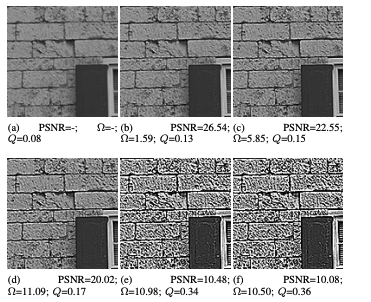
Detailed analysis demonstrates the sensitivity of Omega to images with varying degrees of sharpness and ringing. For example, tests on a sample image series show Omega values corresponding to variations in PSNR and sharpness metrics, confirming that Omega effectively differentiates between sharp, clean images and those exhibiting unwanted artifacts, providing a more accurate assessment of restoration quality. This breakthrough delivers a powerful new tool for evaluating and optimizing image deblurring algorithms, paving the way for more visually pleasing and accurate image restoration.
Sharpness Loss Improves Restoration and Metric
This research demonstrates the impact of a specific loss function on the performance of state-of-the-art image deblurring models. The team successfully fine-tuned existing models by incorporating this loss function, which explicitly addresses image sharpness, resulting in demonstrably sharper restored images. Results show an approximate 15 percent increase in sharpness and up to a 10 percent improvement in a novel image quality metric, Omega, compared to models trained with standard loss functions. The researchers also introduced Omega, a new full-reference image quality metric designed to be sensitive to ringing artifacts, a common problem in image restoration.
This metric combines traditional measures of image quality with a component that specifically assesses sharpness, providing a more nuanced evaluation of restoration performance. The authors acknowledge a limitation in the interpretability of Omega, but plan to address this in future work. They intend to investigate the correlation between Omega, other quality measures, and subjective human evaluation through large-scale studies, potentially leading to even more effective image restoration techniques.
🗞 Impact of a Sharpness Based Loss Function for Removing Out-of-Focus Blur
🧠 ArXiv: https://arxiv.org/abs/2509.11735