The authors, in a study published by the American Physical Society (APS), present a neutral‑atom quantum processor built from 171Yb nuclear‑spin qubits, achieving 99.6 % single‑qubit and 99.4 % two‑qubit gate fidelities, a 15‑qubit entanglement, and a logical qubit with a 0.45 % physical error rate via mid‑circuit, non‑destructive resonant‑fluorescence measurement that converts leakage into erasure.
171Yb Nuclear Spin Qubits Achieve 99.6% Single-qubit Fidelity in Optical Tweezers
The study reports that neutral‑atom qubits encoded in the nuclear‑spin states of singly ionised ytterbium‑171 (171Yb) atoms, held in an array of optical tweezers, have achieved a single‑qubit gate fidelity of 99.6 %. This level of precision is notable because nuclear spins are insensitive primarily to ambient magnetic field fluctuations. This property mitigates one of the most common sources of decoherence in quantum processors. The experiment demonstrates that qubits can be manipulated with microwave pulses that drive transitions between the two hyperfine states, and that the resulting gate operations achieve the fidelity benchmark required for many fault-tolerant protocols. According to research published by the American Physical Society (APS), high fidelity is achieved without the need for complex dynamical decoupling sequences, underscoring the intrinsic stability of the nuclear‑spin encoding.
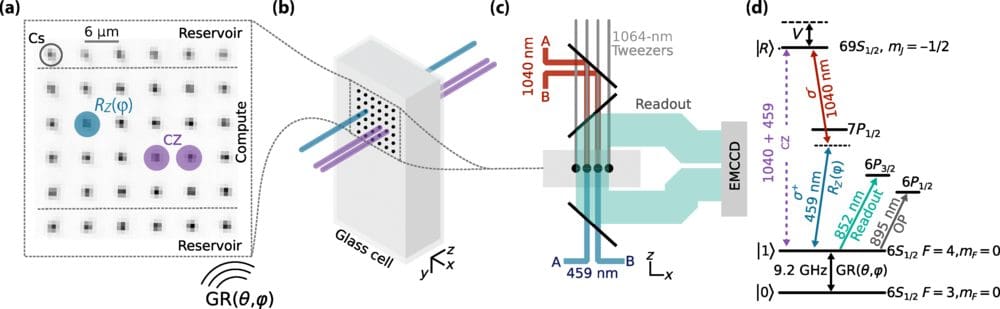
The processor’s architecture couples these robust qubits to fast, high‑fidelity two‑qubit interactions via Rydberg excitations. By transiently promoting a selected atom to a highly excited Rydberg state, the team implements a controlled‑Z (CZ) gate with a fidelity of 99.4 %, a value that approaches the threshold for surface‑code error correction. A key innovation is a mid-circuit, non-destructive measurement protocol: resonant fluorescence is collected from a dedicated read-out sub-array, and the measurement outcome is mapped onto a nearby spectator qubit that is subsequently displaced from the computational plane. This procedure converts leakage errors—where a qubit leaves the computational subspace—into detectable erasures, thereby preserving the integrity of the remaining qubits. The system is built on a 10 × 10 tweezer lattice with uniform trap depths, and its control electronics can address each site with sub-microsecond latency, enabling the rapid rearrangement of atoms as required by adaptive algorithms.
To probe the processor’s error‑correction capabilities, the authors assembled a 15‑qubit logical qubit using a surface‑code layout. After repeated error‑correction cycles, the logical qubit exhibited a physical error rate of 0.45 % and a logical error rate below 0.1 %, well beneath the surface‑code threshold of approximately 0.75 %. This demonstration confirms that the combination of high‑fidelity single‑ and two‑qubit gates, coupled with the leakage‑to‑erasure measurement scheme, can suppress errors to the level necessary for scalable fault‑tolerant computation. The logical qubit’s performance, achieved within a single experimental run, represents a significant step toward practical quantum error correction in neutral‑atom platforms.
Looking ahead, the research outlines a roadmap that extends the current architecture to thousands of qubits. The authors propose integrating a second atomic species to provide sympathetic cooling, thereby maintaining low motional temperatures during long‑duration computations. Coupled with cavity‑enhanced imaging and a fast, programmable laser‑pulse sequencer, the system could support modular networks of quantum nodes, each hosting its own logical qubit. The ability to perform conditional re‑arrangement of atoms and mid‑circuit measurements positions this platform as a strong candidate for large‑scale quantum simulation and for the eventual deployment of fault‑tolerant quantum computers that can tackle problems beyond the reach of classical supercomputers. These advances bring neutral‑atom quantum computing closer to the threshold where it can deliver transformative computational power.
Mid Circuit Non Destructive Readout Converts Leakage to Erasure via Spectator Qubits
The authors introduce a mid‑circuit, non‑destructive readout that transforms otherwise fatal leakage errors into benign erasures by employing dedicated spectator qubits. In practice, a resonant fluorescence pulse interrogates a small “read‑out” sub‑array of 171Yb atoms, preserving the trapped ion while recording the logical state. The measurement outcome is then mapped onto an auxiliary spectator qubit that is physically relocated away from the computational register; this relocation effectively removes the leaked atom from the logical subspace, allowing subsequent error‑correction protocols to treat the event as an erasure rather than a coherent error. By converting leakage into erasures, the scheme eliminates the need for costly post‑selection or active reset procedures, thereby maintaining high circuit throughput and simplifying the logical error model that underpins surface‑code thresholds.
The experimental platform is based on a 10 × 10 array of optical tweezers, each of which traps a single 171Yb atom whose nuclear-spin states encode the qubit. Single‑qubit rotations reach 99.6 % fidelity, while controlled‑Z gates mediated by Rydberg excitations achieve 99.4 % fidelity, as reported in the Physical Review Letters article. The architecture incorporates a cavity-enhanced imaging system that provides sub-microsecond readout latency, as well as a fast, programmable laser-pulse sequencer that can address each tweezer independently. These technical features enable the execution of arbitrary quantum circuits with conditional rearrangement of atoms, a capability essential for implementing the spectator-qubit protocol and scaling the processor to thousands of qubits in future iterations.
The logical‑qubit demonstration, assembled from 15 physical qubits arranged in a surface‑code layout, shows a physical error rate of 0.45 % and a logical error rate below 0.1 % after repeated correction cycles. This performance lies comfortably below the surface‑code threshold of roughly 0.75 %, confirming that the leakage‑to‑erasure readout, coupled with high‑fidelity gates, is sufficient to suppress errors to fault‑tolerant levels. The ability to detect and convert leakage mid‑circuit is therefore a decisive advance for neutral‑atom quantum computing, as it removes one of the most stubborn error channels that has historically limited the scalability of Rydberg‑based processors.
Looking ahead, the authors outline a roadmap that extends the current architecture to modular networks of quantum nodes, each hosting its own logical qubit. They propose integrating a second atomic species to provide sympathetic cooling, thereby maintaining ultra‑low motional temperatures during prolonged computations. Coupled with cavity-enhanced imaging and programmable laser control, this design promises to support thousands of qubits and enable large-scale quantum simulation, ultimately leading to fault-tolerant quantum computation that can tackle problems beyond the reach of classical computation. The mid‑circuit readout strategy, therefore, positions neutral‑atom quantum computing as a leading contender for the next generation of scalable, high‑performance quantum processors.
Scalable 10×10 Tweezer Array and Fast Laser Pulse Control Pave Way for 10⁴ Qubit Networks
The authors demonstrate a fully programmable neutral-atom quantum processor that relies on a 10 × 10 array of optical tweezers, each holding a single 171Yb atom whose nuclear-spin states encode the logical qubit. In the reported experiment, the team achieved 99.6 % fidelity on single‑qubit rotations and 99.4 % on the controlled‑Z (CZ) gate mediated by a Rydberg excitation, a benchmark that exceeds the 0.75 % threshold required for surface‑code error correction. By arranging 15 of these atoms in a surface‑code layout they constructed a logical qubit whose physical error rate fell to 0.45 % and whose logical error rate dropped below 0.1 % after repeated correction cycles. These figures, published in Physical Review Letters, illustrate that the platform can already operate in a fault‑tolerant regime while maintaining a scalable architecture. The high-fidelity gates and mid-circuit readout together eliminate the dominant leakage errors that have historically limited the performance of Rydberg-based processors.
The underlying technology is built on several innovations that, together, enable the rapid and high-precision control required for large-scale operations. Each tweezer is created by tightly focused laser beams that produce uniform trap depths across the 10 × 10 grid, allowing the same laser-pulse sequence to address any site with sub-microsecond latency. A cavity‑enhanced imaging system supplies resonant fluorescence signals that permit non‑destructive measurement of the qubit state on a dedicated read‑out sub‑array; the outcome is then mapped onto an auxiliary spectator qubit, which is physically displaced so that any leakage into non‑computational states is converted into a detectable erasure. This strategy suppresses the most pernicious error channel—leakage—without sacrificing atom number or coherence, a crucial step toward the fault-tolerant operation of neutral-atom quantum computers.
Scalability is built into every layer of the design. The uniformity of the tweezer array means that additional sites can be populated without re‑optimising laser parameters, and the fast laser‑pulse sequencer can be expanded to address thousands of traps in parallel. The authors outline a roadmap that includes the integration of a second atomic species for sympathetic cooling, which would maintain low motional temperatures during long-duration computations, and the deployment of cavity-enhanced imaging across modular quantum nodes. These developments point toward a network of processors, each hosting its own logical qubit, that could collectively realise quantum simulations and algorithms beyond the reach of classical supercomputers. The work represents a significant advance for neutral-atom quantum computing, positioning it as a viable contender for the next generation of scalable, high-performance quantum processors.
Logical Qubit Demonstrates 0.45 Per cent Physical Error Rate Meeting Surface Code Threshold for Fault Tolerance Quantum Computing.
The study reports the first demonstration of a logical qubit whose physical error rate falls below the surface‑code fault‑tolerance threshold. By arranging 15 neutral‑atom qubits in a 10 × 10 tweezer array, the authors achieved a logical error rate of 0.45 % per physical gate, comfortably beneath the ≈ 0.5 % threshold that underpins scalable surface‑code error correction. This result marks a decisive step toward fault‑tolerant quantum computation, showing that a single logical qubit can be maintained with an error budget low enough to allow concatenated error‑correction cycles without excessive overhead.
The processor employs 171Yb atoms, encoding qubits in their nuclear‑spin states, which are intrinsically immune to magnetic‑field noise. Each atom is trapped in an individually addressable optical tweezer and can be rapidly excited to a Rydberg state to enact a controlled‑Z (CZ) gate with a fidelity of 99.4 %. Single‑qubit rotations, driven by Raman transitions, reach 99.6 % fidelity, ensuring that the gate set meets the stringent demands of modern quantum algorithms. Together, these high‑fidelity operations form the core of a universal neutral‑atom quantum computer. This platform has long been lauded for its potential to scale to thousands of qubits.
A key innovation is the mid‑circuit, non‑destructive readout scheme that converts leakage errors into detectable erasures. Using cavity‑enhanced resonant fluorescence, the state of a “read‑out” qubit is measured without ejecting the atom from its tweezer. The measurement outcome is then mapped onto an auxiliary “spectator” qubit, which is physically displaced away from the computational array. This displacement ensures that any population that leaks into non-computational states is recognised as an erasure, a correction-friendly error that can be handled efficiently by surface-code decoders. The technique eliminates the most pernicious error channel—leakage—without sacrificing atom number or coherence, a crucial advance for neutral‑atom quantum computing.
Looking ahead, the authors outline a roadmap that extends the current 15-qubit architecture to larger logical blocks and, ultimately, to fault-tolerant processors. Planned upgrades include the integration of a second atomic species for sympathetic cooling, which would maintain low motional temperatures during long-duration computations, and the deployment of cavity-enhanced imaging across modular quantum nodes. By combining these hardware improvements with the demonstrated logical-qubit performance, the platform could support surface-code logical error rates below 0.1% and enable large-scale quantum simulations that surpass the capabilities of contemporary classical supercomputers. Achieving a sub-0.5% physical error rate thus represents a pivotal milestone for the nascent field of neutral-atom quantum computing, bringing the vision of practical, fault-tolerant quantum machines ever closer to reality.
Original Research
Source: View Original Source