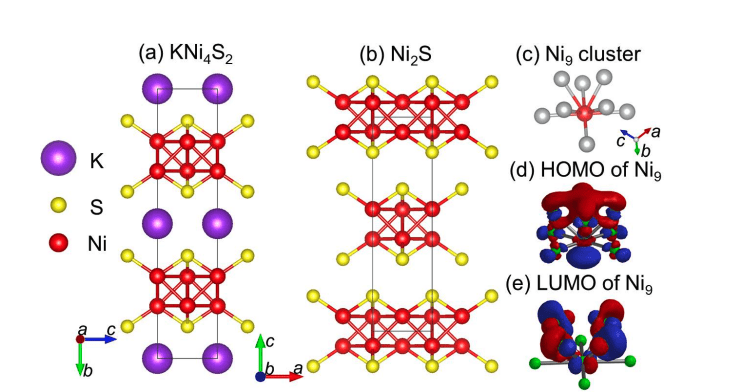
The search for materials that seamlessly transition between distinct electronic states represents a significant challenge in condensed matter physics, yet offers the potential for revolutionary technologies. Hengdi Zhao from Argonne National Laboratory, Xiuquan Zhou from Georgetown University, and Hyowon Park, also of Argonne, alongside Tianqi Deng, Brandon Wilfong, and Alann P. Au II, report the discovery of a layered material, KxNi4S2, that uniquely hosts both Dirac cones and flat bands within the same system. This material exhibits a remarkable ability to switch between a non-magnetic, topologically nontrivial metallic state and an antiferromagnetic state as potassium content changes, a behaviour previously uncommon in materials science. The team’s findings demonstrate a versatile platform for exploring fundamental physics and offer a promising route towards controlling and harnessing the interplay between Dirac cones and flat bands for future applications, with the material exhibiting exceptionally high electron mobility.
Topological Materials and Correlated Electron Systems
This document presents a comprehensive resource for researchers investigating materials science, condensed matter physics, and computational methods. It focuses on topological materials, strongly correlated electron systems, materials discovery, synthesis, and computational techniques, combining theoretical calculations with experimental investigation. The collection serves as a reference guide for understanding and designing novel materials with interesting electronic and magnetic properties. The document categorizes research into several key areas, detailing the theoretical basis and experimental observation of topological insulators and materials exhibiting strong electron correlations, such as Mott insulators and high-temperature superconductors.
A significant portion focuses on high-pressure synthesis, utilizing techniques like diamond anvil cells to stabilize materials and explore novel properties. Computational methods, including Density Functional Theory and the VASP code, are extensively detailed, alongside software packages used for materials calculations and analysis. This document provides a valuable resource for researchers in materials science, condensed matter physics, and related fields, offering a comprehensive overview of current research and techniques.
KxNi4S2 Transitions Between Dirac and Mott States
Scientists have discovered a novel material, KxNi4S2, that uniquely combines Dirac cones and flat bands within the same system, a characteristic rarely observed in materials. This layered material allows for continuous tuning of its electronic properties through topochemical K-deintercalation, effectively controlling the balance between these two distinct electronic states. Experiments reveal that KNi4S2 (x=1) behaves as a topologically nontrivial Dirac metal, confirmed by band inversion near the Fermi level. In contrast, fully deintercalated Ni2S (x=0) exhibits a trivial electronic structure. The team measured a high carrier mobility of up to 1471 cm2V-1s-1 in the potassium-rich material, indicative of the Dirac cones facilitating efficient charge transport.
As potassium content decreases, the material undergoes a transformation, with the emergence of flat bands and an antiferromagnetic transition at temperatures up to 10. 1 K. Electrical transport measurements demonstrate a linearly temperature-dependent resistivity across all compositions, suggesting strong correlations within the material. The team observed a significant reduction in carrier mobility, decreasing from 1471 cm2V-1s-1 at x=0. 7 to 9.
4 cm2V-1s-1 at x=0, directly correlating with the shift away from Dirac cones induced by potassium-deintercalation. Hall effect measurements confirm that electrons are the dominant charge carriers throughout the series, with the fully deintercalated material exhibiting a two-fold enhancement in carrier density. Further analysis of the material’s heat capacity reveals a more than two-fold enhancement of the Sommerfeld coefficient, increasing from 32. 9 mJ/mole/K2 to 75. 99 mJ/mole/K2 as potassium is removed, suggesting enhanced electronic correlations associated with the emerging flat bands. The research confirms theoretical predictions of a tunable ground state, offering a versatile platform for exploring the interplay between Dirac cones, flat bands, and their impact on material properties.
Potassium Tuned Dirac and Flat Bands
Scientists have successfully created a novel material, KxNi4S2, that simultaneously exhibits both Dirac cones and flat bands, electronic properties typically found separately in different materials. This achievement is particularly noteworthy as it occurs within a single system and does not rely on commonly observed Kagome or honeycomb lattice structures. By carefully controlling the amount of potassium within the material through a process of intercalation and deintercalation, the researchers demonstrate the ability to tune the material’s electronic state across a wide energy range. Notably, the material transitions from a non-magnetic, topologically significant Dirac metal at higher potassium concentrations to an antiferromagnetic metal dominated by flat bands as potassium content decreases. This tunability represents a significant advance in materials science, offering a platform to investigate the interplay between these distinct electronic states and potentially leading to new functionalities. While the team did not observe superconductivity under high pressure, they highlight the potential for in-situ control of the material’s properties using techniques like electrochemical tuning, opening avenues for reconfigurable electronics, multi-state memory, and adaptive sensors.
👉 More information
🗞 Evolution from Topological Dirac Metal to Flat-band-Induced Antiferromagnet in Layered KxNi4S2 (0<=x<=1)
🧠 ArXiv: https://arxiv.org/abs/2509.09903