
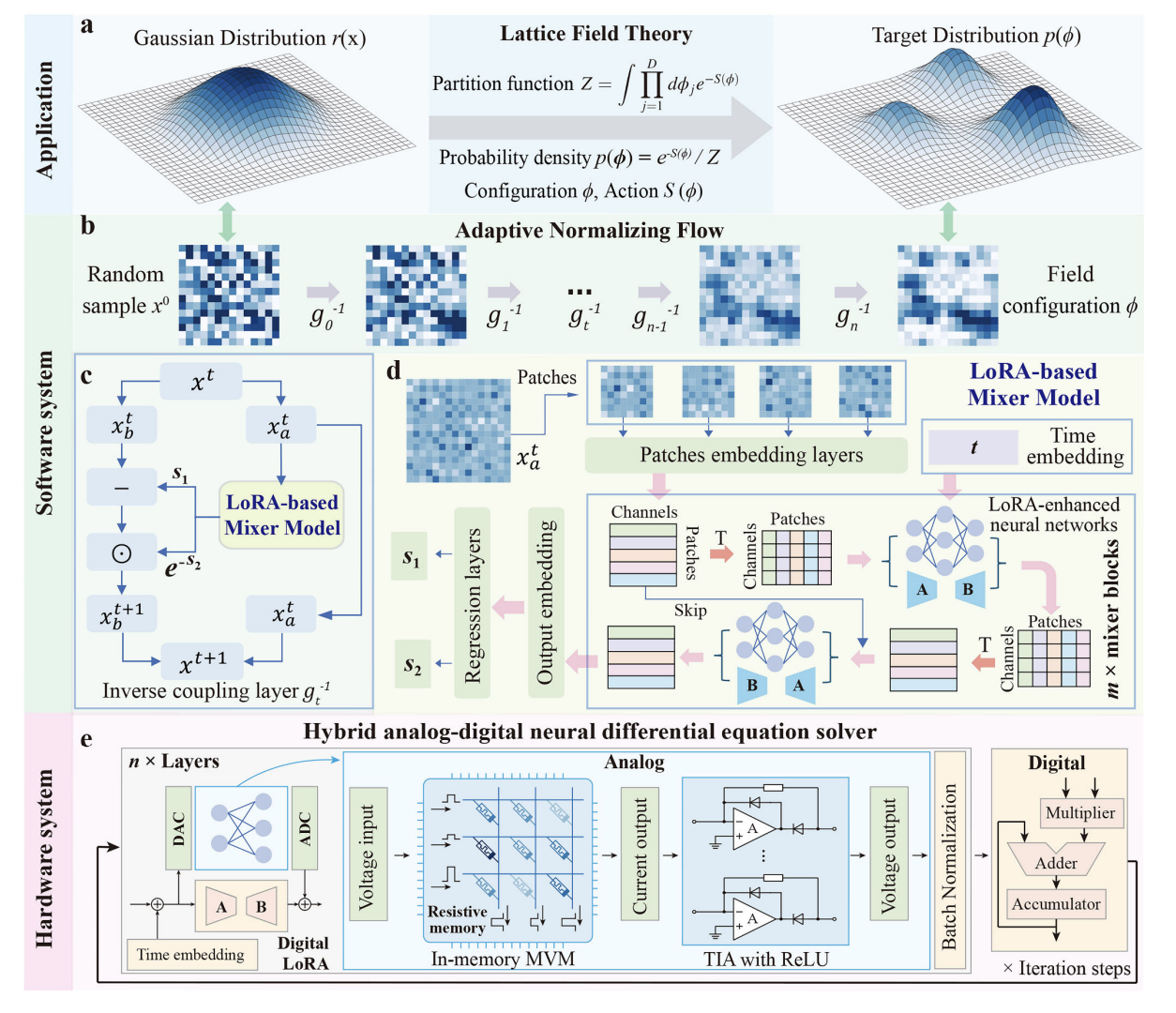
Lattice field theory simulations form the bedrock of modern research in particle, nuclear, and condensed matter physics, yet their application to complex systems faces significant computational hurdles. Meng Xu, Jichang Yang, Ning Lin, and colleagues address these challenges with a novel approach integrating adaptive normalizing flow with a resistive memory-based neural differential equation solver. This innovative software-hardware co-design dramatically accelerates simulations by efficiently generating statistically independent configurations and leveraging the inherent parallelism and energy efficiency of resistive memory computing. Validating their method on established theoretical models, the team demonstrates substantial improvements over conventional techniques, achieving significant reductions in computation time and energy consumption, and paving the way for more complex and accurate simulations in the future.
Graphene, Quantum Electrodynamics and Effective Field Theory
Theoretical physics, machine learning, and hardware innovation are converging to unlock new possibilities in scientific discovery. Researchers are developing computational tools to tackle complex physical systems and design novel materials. Effective field theory, a method for simplifying complex problems by focusing on the most relevant interactions, is particularly valuable in condensed matter physics, such as the study of graphene. Normalizing flows, a powerful class of machine learning models used for probabilistic modeling, are being applied to generate ensembles of configurations in lattice field theory, potentially speeding up simulations.
Specialized types of normalizing flows, called equivariant flows, are designed to respect the symmetries of the physical system, ensuring accuracy and efficiency. Researchers are exploring deep learning models, including normalizing flows and diffusion models, to improve the efficiency and accuracy of lattice field theory calculations. This work also investigates neuromorphic computing, inspired by the brain, and the use of memristors, resistive switching devices that can act as artificial synapses, to build energy-efficient and massively parallel computing systems. In-memory computing, where computations are performed directly within the memory, further enhances performance.
This convergence of physics and machine learning is driven by the need to overcome computational bottlenecks and unlock the secrets of complex physical systems. Hardware-software co-design, where algorithms and hardware are designed together, is becoming increasingly important. Preserving symmetries in machine learning models is crucial for ensuring the accuracy and reliability of simulations. This holistic approach promises to push the boundaries of scientific discovery.
Adaptive Normalizing Flow with Resistive Memory Solver
Researchers have developed a novel software-hardware co-design to overcome limitations in lattice field theory (LFT) simulations, a crucial technique used in particle, nuclear, and condensed matter physics. This approach integrates an adaptive normalizing flow (ANF) model with a resistive memory-based neural differential equation solver, enabling efficient generation of LFT configurations. The ANF model efficiently generates statistically independent configurations in parallel, substantially reducing computational costs. Low-rank adaptation (LoRA) allows cost-effective fine-tuning of the model across diverse simulation parameters, requiring fine-tuning of less than 8% of the model’s weights.
Complementing this software innovation, the researchers engineered a hardware solution based on in-memory computing with resistive memory, dramatically enhancing parallelism and energy efficiency by performing computations directly within the memory. The co-design was validated on both the scalar φ4 theory and the effective field theory of graphene wires, employing a hybrid analog-digital neural differential equation solver equipped with a 180nm resistive memory in-memory computing macro. Experiments demonstrate significant performance gains, achieving approximately 8. 2-fold and 13. 9-fold reductions in integrated autocorrelation time compared to traditional hybrid Monte Carlo methods.
Furthermore, the system delivers up to approximately 16. 1- and 17. 0-fold speedups compared to state-of-the-art GPUs, alongside improvements of 73. 7- and 138. 0-fold in energy efficiency. This integrated approach paves the way for more efficient and affordable large-scale LFT simulations in high-dimensional physical systems.
Adaptive Normalizing Flows Accelerate Lattice Simulations
This work presents a breakthrough in lattice field theory (LFT) simulations, achieving substantial gains in computational efficiency and energy savings through a novel software-hardware co-design. Researchers successfully integrated an adaptive normalizing flow (ANF) model with a resistive memory-based neural differential equation solver, enabling efficient generation of LFT configurations. The ANF model facilitates parallel generation of statistically independent configurations, reducing computational demands while maintaining accuracy comparable to traditional hybrid Monte Carlo methods. Experiments utilizing a 180nm resistive memory in-memory computing macro demonstrate significant performance improvements.
The co-design achieves approximately 8. 2-fold and 13. 9-fold reductions in integrated autocorrelation time compared to conventional hybrid Monte Carlo (HMC) methods. Fine-tuning requires less than 8% of the model’s weights using LoRA, minimizing computational overhead. Compared to state-of-the-art GPUs, the co-design delivers up to 16.
1- and 17. 0-fold speedups for two distinct tasks. The system exhibits exceptional energy efficiency, achieving 73. 7- and 138. 0-fold improvements over GPU-based solutions.
The resistive memory array, composed of 1-transistor-1-resistor (1T1R) cells, functions as an analog matrix multiplier within the hybrid system. Characterization of the resistive memory demonstrates highly uniform bipolar resistive switching, and data retention tests confirm the stability of stored conductance states. Matrix multiplication is successfully implemented, and validation on a scalar φ4 lattice field theory confirms the effectiveness of the co-design, generating two-dimensional configurations and enabling the computation of physical observables.
Adaptive Simulation with Neural Differential Equations
This work presents a significant advancement in lattice field theory simulations, overcoming limitations imposed by.
👉 More information
🗞 Efficient lattice field theory simulation using adaptive normalizing flow on a resistive memory-based neural differential equation solver
🧠 ArXiv: https://arxiv.org/abs/2509.12812