Creating complex, multi-entangled states, essential for advanced quantum technologies, remains a significant challenge for researchers. Gözde Üstün from UNSW Sydney and Simon J. Devitt from the University of Technology Sydney, along with their colleagues, now compare two distinct approaches to generating these crucial states, known as qudit graph states, using silicon-based spin qudits. Their work investigates a method that builds complex structures from a single emitter through a process called fusion, and contrasts it with a scheme employing direct coupling of two emitters. By evaluating the strengths and limitations of each technique, the team advances the development of scalable quantum architectures and offers new insights into efficient methods for creating the complex entanglement necessary for future quantum devices.
High-Spin Qudits and Fusion Computing
This research explores a cutting-edge program focused on building a scalable and fault-tolerant quantum computer based on high-spin qudits in silicon. The work combines advanced materials science, nanofabrication, microwave engineering, and quantum control techniques to overcome limitations in traditional quantum computing approaches. Scientists are investigating both photonic and silicon-based architectures, aiming to leverage the strengths of each platform for improved performance and scalability. A key focus is the development of fusion-based quantum computing, a method for high-dimensional computation that promises to improve success probabilities in complex calculations.
Researchers are employing the ZX calculus, a graphical language for quantum circuits, to design and analyze fault-tolerant architectures and modular systems. This approach allows for the unification of different fault tolerance strategies and the creation of scalable quantum processors. Central to this research is the use of high-spin qudits, which encode more information per qubit than traditional spin-1/2 qubits. Scientists are utilizing the spin of donor atoms, such as phosphorus, implanted in silicon to create these qudits. They are developing methods for coherent electrical control and readout of these high-spin nuclei, a significant challenge due to the increased complexity of controlling higher-dimensional spin states.
To enhance qubit coherence, researchers are enriching silicon with specific isotopes, like 28Si, and fabricating nanoscale transmission lines and microwave resonators to precisely control and read out the spin qubits. Further advancements include the development of kinetic inductance parametric amplifiers (KIPAs) to amplify the weak signals from the spin qubits, improving readout fidelity, and techniques to improve qubit coherence and readout accuracy. Researchers are also analyzing error channels in quantum non-demolition measurements and creating Schrödinger cat states of nuclear spin qudits in silicon, demonstrating coherent electrical control of single high-spin nuclei.
Qudit Graph States from Antimony Donors in Silicon
Scientists are pioneering new approaches to quantum computing by harnessing the unique properties of qudits, quantum systems capable of representing more information than traditional qubits. This work presents a comparative study of two distinct hardware schemes for generating qudit graph states using antimony donors in silicon, aiming to establish the essential physical building blocks for scalable fusion-based quantum computation. The research focuses on creating multi-entangled states, known as resource states, crucial for performing complex quantum operations. One scheme proposes generating linear qudit graph states from a single antimony donor, a high-spin impurity in silicon.
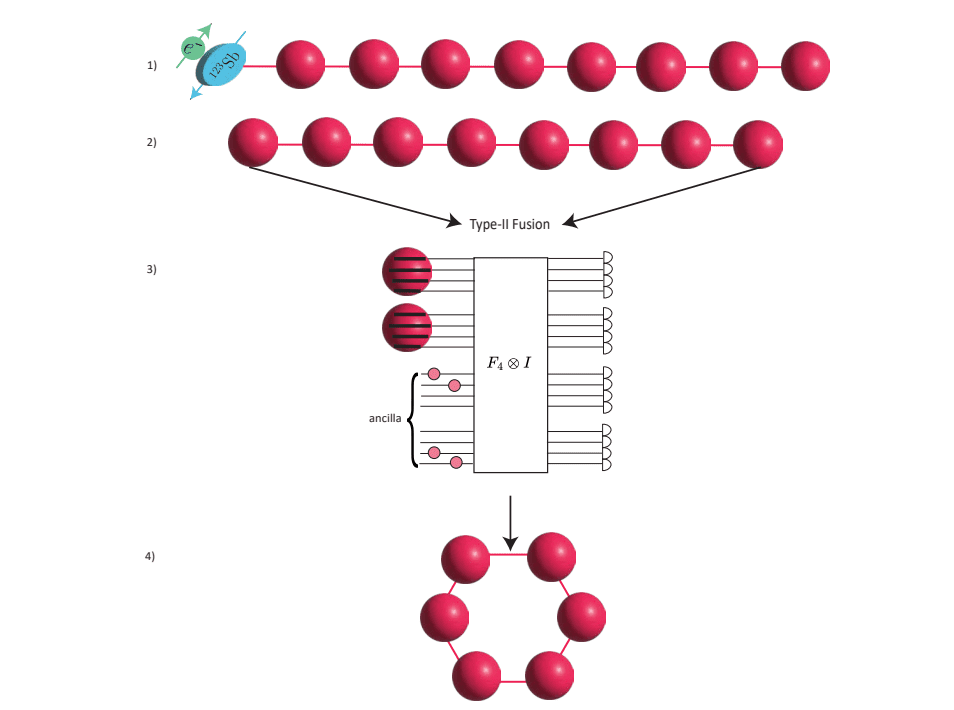
Scientists excite this donor, causing it to emit a series of photons, each representing a qudit. These photons are then combined using fusion, a destructive measurement technique, to construct more complex resource states like rings or ladders. This method leverages the deterministic creation of linear graphs from a single emitter. The team meticulously analyzes the success probabilities associated with these fusion operations, essential for evaluating the reliability of the approach. Alternatively, the researchers developed a system employing two antimony donors hyperfine-coupled to a shared electron.
This configuration allows for the direct creation of resource states via controlled-Z (CZ) gates, entangling the qudits without the need for fusion. By directly coupling the emitters, scientists bypass the probabilistic nature of fusion, potentially offering a more deterministic pathway to complex graph states. The study meticulously compares these two hardware approaches, evaluating their respective experimental advantages and limitations. Scientists demonstrate that qudits naturally support high-dimensional states and enable deterministic implementation of single-qudit unitaries. Furthermore, the research highlights that using qudits allows for increased information storage with the same level of error resilience, without increasing the number of physical systems, and that the threshold for qudit surface codes increases with dimension. These advancements, combined with recent progress in fusion operations, pave the way for scalable quantum computing in higher dimensions.
Silicon Qudits Generate Complex Graph States
Scientists are pioneering new methods for generating complex quantum states, essential for advanced quantum computing, using silicon-based spin qudits. Their work compares two distinct approaches to creating these multi-entangled states, known as graph states, which serve as the building blocks for quantum algorithms. One method utilizes a single silicon spin qudit and relies on fusion to combine linear graph states into more intricate structures. Experiments demonstrate the creation of an eight-qudit linear graph state with each qudit possessing a local dimension of four. Following preparation, the team successfully decoupled the nuclear spin from the photons, resulting in a purely photonic graph state.
Subsequent fusion of the first and eighth photons, employing two single-photon ancilla states, yielded a six-ring qudit graph state, maintaining the four-mode encoding within each node. However, the success of fusion operations remains a challenge, with probabilities notably lower than those achievable with qubit-based systems. An alternative approach bypasses fusion altogether by employing two spin qudits directly coupled via a controlled-Z (CZ) gate. This allows for the direct generation of equivalent resource states. Researchers investigated a system utilizing two antimony donors sharing a single electron, creating an asymmetric coupling to their respective nuclear spins.
The resulting spin system is described by a 128-dimensional Hamiltonian, incorporating Zeeman interaction, hyperfine coupling, and quadrupole interactions. Measurements confirm hyperfine coupling strengths and quadrupole interactions, providing crucial parameters for controlling the spin system. This system’s Hilbert space spans 128 states, allowing for numerous ESR and NMR transitions. By coupling these antimony donors to microwave cavities, scientists anticipate achieving comparable coupling strengths, enabling coherent emission of photons and furthering the development of scalable quantum architectures.
Silicon Qudits Demonstrate Graph State Creation
This research presents a comparative study of two methods for creating complex, multi-entangled states, known as qudit cluster states, using silicon-based spin qudits. One method utilizes a single antimony donor and relies on fusion to combine linear graph states into more intricate structures. The second method employs two antimony donors sharing a single electron, directly generating the desired graph states via a controlled-Z (CZ) gate, thereby avoiding the need for fusion. The team demonstrates the feasibility of creating specific resource states, such as six-ring and two-dimensional ladder graphs, using both schemes. While the two-donor system eliminates the probabilistic nature of fusion, it requires precise control of the coupled spin system to achieve reliable entanglement.
👉 More information
🗞 Comparing Schemes for Creating Qudit Graph States from 16- & 128-dimensional Hilbert Space using Donors in Silicon
🧠 ArXiv: https://arxiv.org/abs/2511.06636