

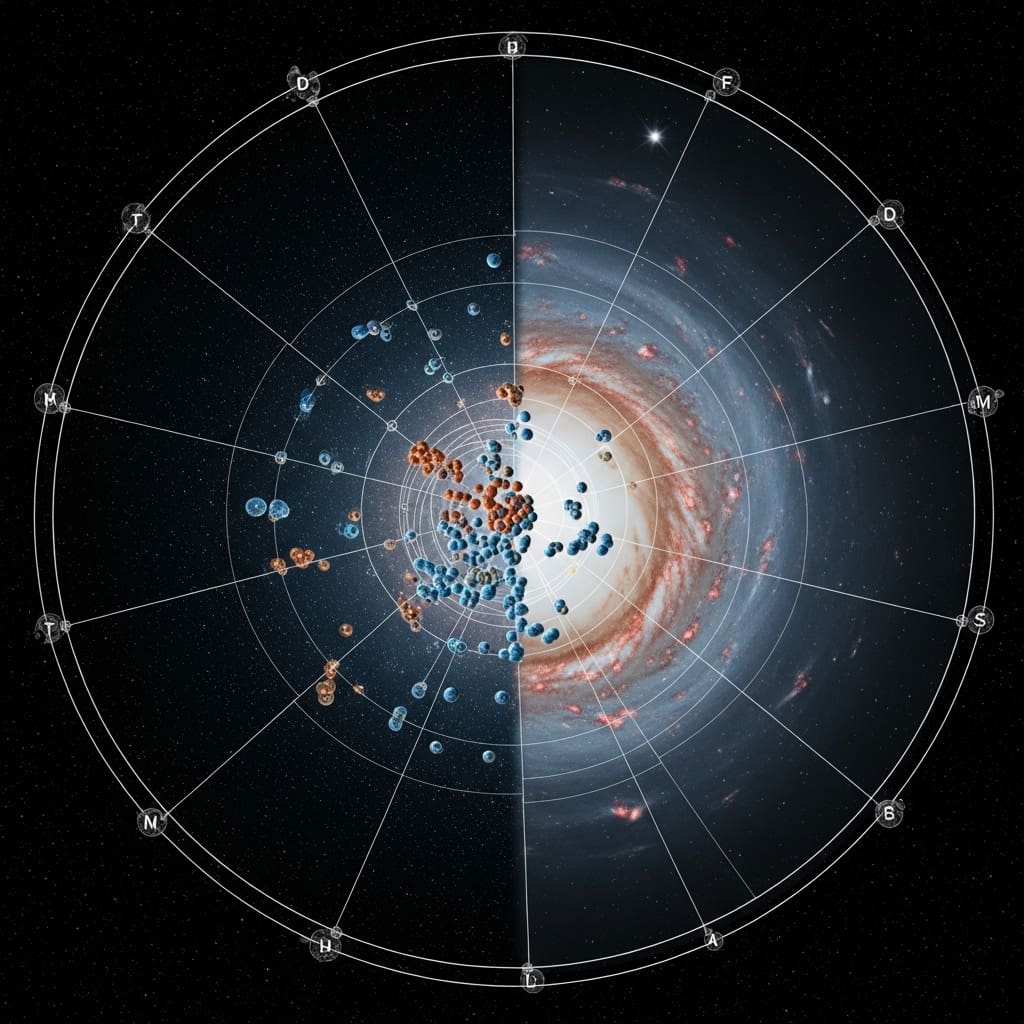
Researchers are probing the outer reaches of galaxy clusters to understand how these vast structures assemble and evolve. Eleanore B Todd, Jon P Willis, and Rebecca E A Canning, from the University of Victoria and the Institute of Cosmology & Gravitation, alongside Ophélie K Leste, Rahma Alfarsy and Steven W Allen, present initial findings from a detailed investigation of XLSSC 122, a galaxy cluster at a redshift of 1.98. Their work, extending 3 Mpc from the cluster core, expands the known catalogue of member galaxies to 74 and reveals a surprisingly rapid increase in the proportion of red galaxies as you move inwards , suggesting a swift quenching process like ram pressure stripping is at play. This detailed analysis of XLSSC 122’s outskirts offers crucial insights into galaxy evolution within clusters and challenges existing models by indicating a similar evolutionary rate to lower-redshift clusters.
The study unveils a clear picture of environmental quenching in action, demonstrating how the cluster environment actively suppresses star formation in infalling galaxies. By meticulously mapping the distribution of red and blue galaxies, the team has quantified the efficiency of this quenching process, providing valuable constraints on the physical mechanisms at play. Furthermore, the luminosity function analysis reveals subtle differences in the galaxy population compared to lower-redshift clusters, hinting at the evolving nature of galaxy formation and assembly over cosmic time.
This research opens new avenues for investigating the role of ram pressure stripping and other environmental effects in shaping the properties of galaxies within dense cluster environments. The expanded catalogue of spectroscopically confirmed member galaxies serves as a valuable resource for future studies, enabling detailed investigations of individual galaxy properties and their relationship to the cluster environment. Crucially, the team also harnessed the G141 grism for slitless spectrography across the same area as the F140W photometry, providing crucial spectroscopic data for member galaxy identification. Observations of the cluster core were initially conducted in 2017-2018 during HST cycle 25, and were supplemented by eight additional fields in the cluster outskirts observed in 2023-2024 during cycle 30, resulting in coverage of nine fields in total. This innovative approach, combining deep imaging and spectrography across a large area, delivers a robust dataset for tracing galaxy properties across varying environmental densities. The inclusion of fields extending to 10 virial radii allows for direct comparison between cluster outskirts and the broader z = 1.98 field environment, enabling a precise assessment of the cluster’s influence on member galaxy evolution. The resulting updated catalogue of cluster members, detailed in Table 0.3, forms the foundation for understanding the interplay between environment and galaxy quenching in the early universe.
XLSSC 122 reveals bimodal colour and structure
Tests prove the single, well-characterised cluster, combined with extensive radio, x-ray, and optical observations, allows for detailed investigation of the cluster environment’s influence on member galaxies, from the core outwards. The updated catalogue of cluster members for XLSSC 122 is detailed in Table 0. These observations encompass 9 fields, with the F814W band exposures taken in parallel imaging mode to overlap with the F140W and F105W IR exposures, providing spectroscopic and photometric data in at least one band for all fields as seen in Table 0.1. Measurements confirm the F105W, F140W, and F814W images underwent processing using the calwf3 reduction pipeline through the Grizli software, including bias subtraction, dark current subtraction, flat field correction, cosmic ray rejection, and non-linearity correction. They suggest the observed red fraction increase is consistent with a weak ram pressure stripping scenario, particularly affecting lower-mass galaxies, and that galaxies, once quenched, remain so for at least 0.5 Gyr. The publicly available catalogues and reduced spectra will facilitate further investigation by the wider astronomical community.
👉 More information
🗞 Initial Investigations of the Outskirts of XLSSC 122
🧠 ArXiv: https://arxiv.org/abs/2601.13492