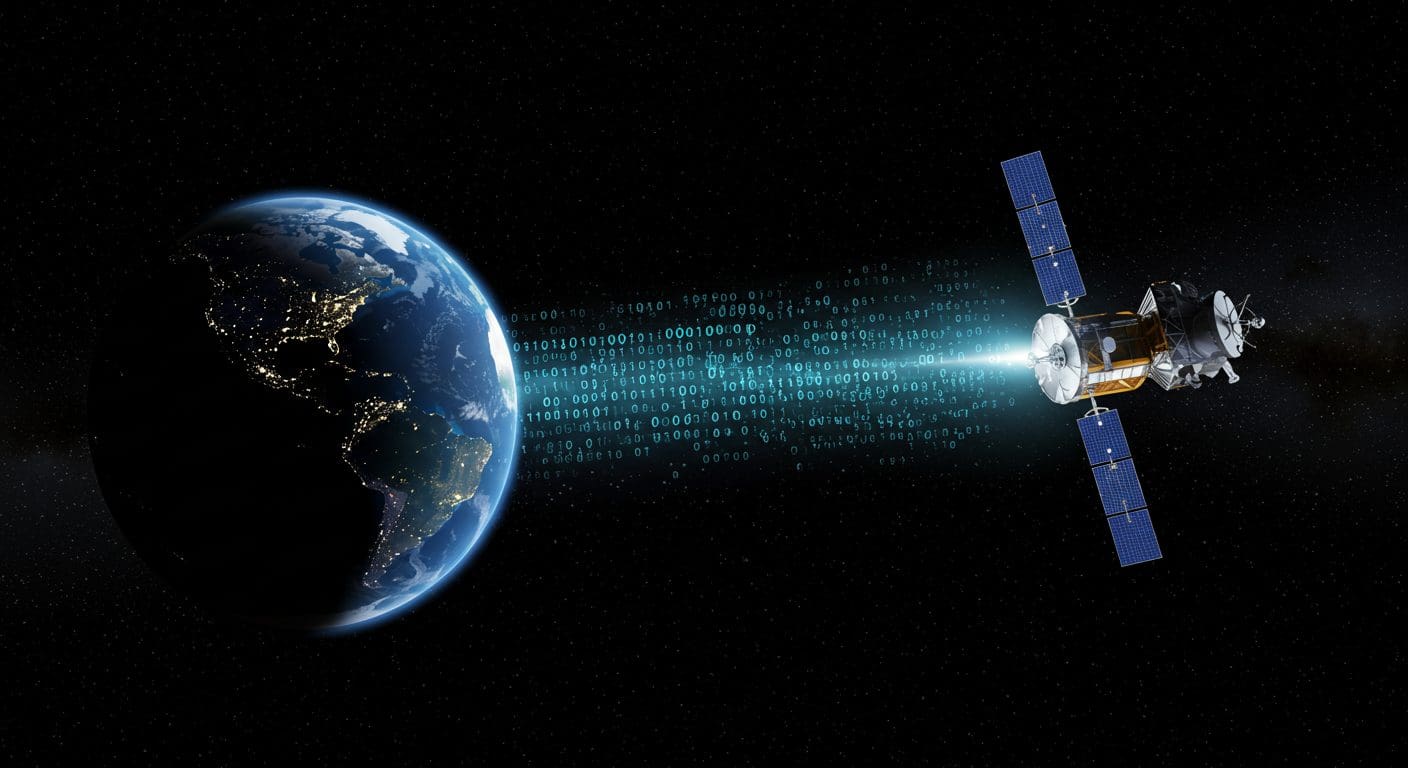
The increasing demand for secure communication fuels research into quantum key distribution (QKD), a method promising unbreakable encryption, and satellite-based QKD systems represent a crucial step towards global secure networks. Argiris Ntanos, Aristeidis Stathis, and Panagiotis Kourelias, from the National Technical University of Athens, along with colleagues including Nikolaos K. Lyras of the European Space Agency, now demonstrate a compact ground terminal designed to receive these quantum signals. Their system achieves exceptional performance, suppressing daylight interference by over 120 decibels and isolating noise to an impressive 135 decibels, a significant advancement for practical QKD implementation. Successful outdoor tests over a 100-meter free-space optical link validate the feasibility of integrating satellite-based quantum communication with existing urban fibre networks, paving the way for truly secure, global connectivity.
Compact Ground Terminals for Satellite Quantum Key Distribution
Satellite-based Quantum Key Distribution (SatQKD) is now a viable technology for enabling global-scale secure communication, following successful demonstrations by the Micius and Jinan satellites. Practical implementation demands solutions to significant engineering challenges, particularly concerning background noise and signal isolation. Existing optical ground terminals often struggle with daylight interference and crosstalk, limiting range and reliability, and hindering seamless integration with terrestrial fibre networks. Therefore, developing compact, high-isolation ground terminals is crucial for realising a practical and scalable SatQKD infrastructure.
This system prioritises robust performance in realistic outdoor conditions, substantially suppressing daylight background noise and effectively isolating against crosstalk interference. Successful demonstration validates its feasibility for integrating satellite QKD with urban fibre segments, paving the way for a hybrid quantum communication network combining the global reach of satellites with the high capacity and security of fibre optics. The research focuses on optimising system parameters to maximise key rates and minimise error rates, contributing to the development of a secure and practical global quantum communication infrastructure.
Compact Terminal for Satellite Quantum Key Distribution
Scientists engineered a compact optical ground terminal to facilitate satellite quantum key distribution (QKD), achieving high isolation between classical communication channels and delicate quantum signals. The study pioneered a filtering scheme leveraging spectral, spatial, and temporal techniques to simultaneously suppress background noise and isolate quantum signals, operating within the C-band frequency. A custom-built fiber-coupling assembly, integrated with an 8-inch telescope, forms the core of the ground terminal, delivering free-space-to-single-mode fiber coupling efficiencies exceeding 10% under stable conditions. The team mitigated crosstalk by applying a triple-stage 0.
8nm band-stop filter to the classical signal, suppressing noise at the quantum passband before transmission, and utilizing wavelength division multiplexing (WDM) modules for signal combination and separation. Further refinement involved a two-stage 0. 2nm passband filter on the receiver side, effectively suppressing both background sky radiance and residual crosstalk, alongside temporal filtering achieved through Single Photon Avalanche Detector (SPAD) gating. The combined filtering system demonstrably reduced classical channel leakage by 121 dB, with 101 dB achieved through spectral filtering and an additional 20 dB from temporal filtering. Nighttime background noise was effectively suppressed through spatial filtering enabled by the single-mode fiber coupling, while daylight operation yielded noise levels of only 50 counts per second when pointed at a solar elongation angle of 45°, and 150 cps at 20°. These results confirm the system’s ability to handle qubits with negligible Quantum Bit Error Rate (QBER) penalty, demonstrating the potential for deployable, scalable 1550nm SatQKD ground stations.
Daylight SatQKD with Compact Ground Stations
C-band satellite quantum key distribution (SatQKD) requires miniaturized systems and portable ground stations to enable scalable networks. Transitioning from feasibility demonstrations demands solutions to challenges in system size, autonomy, and real-time key exchange. Integrating space-based quantum links with existing terrestrial fibre networks is crucial, and operating at the 1550nm telecom wavelength leverages established optical components. Efficient coupling of free-space optical beams into single-mode fiber not only ensures compatibility with current networks but also suppresses background noise, allowing SatQKD operation even during daylight.
This coupling facilitates transferring keys from telescope locations to secure environments for wider distribution. The Eagle-1 mission aims to launch a C-band QKD terminal as part of the EuroQCI initiative, and initial technical requirements for optical ground stations have been published to guide system design. Researchers experimentally investigated spectral, spatial, and temporal filtering to simultaneously suppress background photons and isolate quantum signals from classical C-band communication, using an 8-inch telescope with a custom fiber-coupled receiver. The developed optical ground terminal achieved greater than 10% coupling efficiency and demonstrated stable key generation over a 100m free-space optical link.
The system achieved greater than 120 dB of crosstalk suppression and greater than 135 dB of daylight noise reduction. Measurements showed a noise click rate of 50 counts per second during daylight operation with the telescope at a 45-degree solar elongation angle. The system maintained stable key rates of 4. 2 kbps, 98% visibility, and a quantum bit error rate below 1% over a 1200-second period. These results validate the feasibility of small-sized optical ground terminals for future satellite QKD networks and urban quantum communication infrastructure.
Compact Ground Terminal Enables Satellite QKD
This research demonstrates a compact optical ground terminal capable of receiving quantum signals in the C-band, a crucial step towards satellite-based quantum key distribution (QKD). The team achieved high isolation, suppressing daylight background noise by over 120 dB and crosstalk by 135 dB, and successfully transmitted a quantum signal over a 100-meter outdoor free-space optical link. These results validate the feasibility of integrating small-sized optical ground terminals into existing urban fibre networks, paving the way for future satellite QKD systems and wider quantum communication infrastructure. The developed system demonstrates over 10% coupling efficiency and stable key generation, representing a significant advance in practical QKD technology. However, the authors acknowledge that the experimental conditions were relatively stable, lacking the atmospheric turbulence and other impairments present in real satellite links. Future work will need to address these challenges to maintain performance in operational satellite QKD scenarios.
👉 More information
🗞 SMF Coupled Compact Ground Terminal with Advanced Filtering Towards Daylight C Band Satellite QKD
🧠 ArXiv: https://arxiv.org/abs/2509.07667