The behaviour of light within three-dimensional photonic crystals profoundly influences the rate at which light emits, a phenomenon central to many optical technologies. Timon J. Vreman, Ad Lagendijk, and Willem L. Vos from the University of Twente have investigated this process through detailed calculations of the radiative local density of states, which governs spontaneous emission. Their work demonstrates a strong correlation between two distinct computational methods, plane-wave expansion and finite-difference time-domain, for determining this crucial property, showing differences of less than 12 percent. By employing the plane-wave expansion method to model realistic distributions of light-emitting sources within these crystals, the researchers establish a direct link between theoretical predictions and experimental observations of light decay, paving the way for the design and optimisation of advanced photonic materials and devices.
Photonic Crystals Control Quantum Dot Emission
This research investigates how three-dimensional photonic crystals modify the spontaneous emission of light from quantum dots, tiny semiconductor crystals that emit light. The motivation stems from the potential to improve the efficiency of light-emitting devices, create advanced quantum technologies, and develop highly sensitive detectors. Photonic crystals achieve this control by altering the density of optical states, effectively changing how quickly emitters release light. By carefully designing these crystals, scientists aim to either increase or decrease emission rates, or even redirect the emitted light.
The study combines theoretical modeling with experimental techniques. Researchers use computer simulations, including finite-difference time-domain and plane-wave expansion methods, to predict how light propagates and interacts within the photonic crystal structure. These simulations calculate the photonic band structure, a crucial property determining how light behaves. Experimentally, the team fabricates these crystals using techniques like colloidal crystals and inverse woodpile structures. They then measure the decay rate of light emitted from quantum dots embedded within the crystals using time-resolved fluorescence spectroscopy and synchrotron X-ray fluorescence tomography to determine the dots’ positions.
The research confirms that three-dimensional photonic crystals significantly alter the spontaneous emission rate of quantum dots, with the extent of the modification dependent on the crystal’s design and the dot’s location. A crucial finding is that the emission decay is often non-exponential, meaning a simple decay model is insufficient to describe the process. This complexity arises because the photonic crystal creates a distribution of decay rates, rather than a single, uniform rate. The research highlights the importance of considering this distribution of decay rates, influenced by the photonic crystal’s band structure, and demonstrates that the position of the quantum dot within the crystal is critical, with emission rates varying depending on the local optical density of states.
The inverse woodpile structure emerges as a promising design for achieving strong modification of spontaneous emission. The study relies on key theoretical concepts, including the density of optical states, which describes the available optical modes at a given energy, and Fermi’s Golden Rule, which calculates the transition rate between energy levels. Maxwell’s equations, the fundamental laws governing electromagnetic fields, also underpin the calculations. The transfer matrix method is used to analyze how light interacts with layered structures. The ability to control spontaneous emission promises more efficient light-emitting devices and the creation of single-photon sources for quantum communication and computation.
The sensitivity of the emission to the surrounding environment could also lead to advanced sensors. Future research will focus on optimizing photonic crystal designs, exploring new materials, developing more sophisticated models, and investigating the effects of imperfections on emission properties. This work provides a comprehensive investigation into the interplay between quantum emitters and three-dimensional photonic crystals, paving the way for advanced optoelectronic and quantum technologies.
Radiative Density of States in Photonic Crystals
Scientists investigated the spontaneous emission of light within three-dimensional photonic crystals, focusing on how these structures modify the radiative local density of states, or RLDOS, which governs the emission process. Researchers demonstrated that both plane-wave expansion and finite-difference time-domain methods yield similar frequency-dependent trends in the RLDOS, with discrepancies attributable to differing treatment of boundary conditions. To connect theoretical calculations with experimental observations, the team employed the plane-wave expansion method to compute distributions of emission rates across numerous points within the photonic crystal, mirroring realistic experimental conditions. By calculating the RLDOS at many specific emitter positions, scientists generated data that directly correlates with time-resolved decay curves measured in experiments.
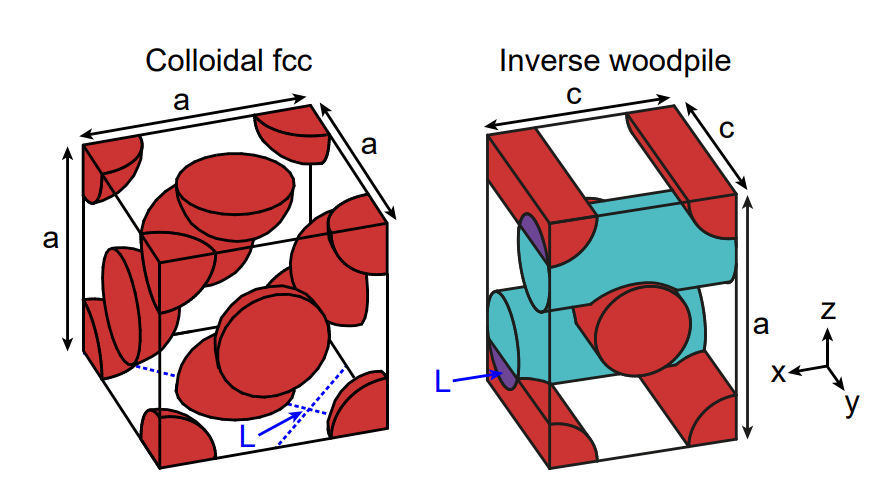
The study focused on two distinct photonic crystal structures, a face-centered cubic colloidal crystal and an inverse woodpile structure, to ensure the robustness of the findings and demonstrate the broad applicability of the computational methods. The team meticulously calculated the RLDOS at multiple emitter positions using the plane-wave expansion method, achieving this in comparable computational time to single-position calculations. This enabled the creation of an ensemble of RLDOS values, which were then used to model the decay curve of the entire emitter ensemble, directly mirroring the data obtained from experimental measurements. This innovative approach bridges the gap between theoretical calculations and experimental observations, providing a powerful tool for interpreting spontaneous emission experiments in three-dimensional photonic crystals and paving the way for advanced optical design and product development.
Photonic Crystal Emission Validated by Multiple Methods
This work presents a detailed investigation of spontaneous emission within three-dimensional photonic crystals, employing both plane-wave expansion and finite-difference time-domain methods to calculate the radiative local density of states. Researchers demonstrate that these two computational approaches yield similar frequency-dependent trends in the RLDOS, with any discrepancies remaining below 12% and attributable to differing boundary conditions inherent in each method. This validation is crucial for accurately interpreting experimental results and confidently applying these calculations to complex photonic structures. The study extends beyond single-point calculations, addressing the challenge of interpreting experiments that probe emission from ensembles of quantum emitters distributed throughout a crystal.
By utilizing the plane-wave expansion method, scientists computed the RLDOS at numerous specific emitter positions, enabling the calculation of time-resolved decay curves that directly correspond to experimental observations. This advancement allows for a more accurate comparison between theoretical predictions and experimental data, bridging a significant gap in the field. Specifically, calculations were performed on two distinct photonic crystal structures: a face-centered cubic colloidal crystal and an inverse woodpile structure. The face-centered cubic crystal, lacking a band gap, served as a benchmark for validating the computational methods, while the inverse woodpile structure, possessing a complete 3D band gap, demonstrated the ability to model more complex photonic environments. The team successfully calculated decay curves from these structures, providing a direct link between the calculated RLDOS and the observed time-resolved decay of emitted photons. This breakthrough promises to accelerate the design and optimization of photonic devices for a wide range of applications.
🗞 Radiative local density of states in three-dimensional photonic band-gap crystals to interpret time-resolved emission
🧠 ArXiv: https://arxiv.org/abs/2510.25407