
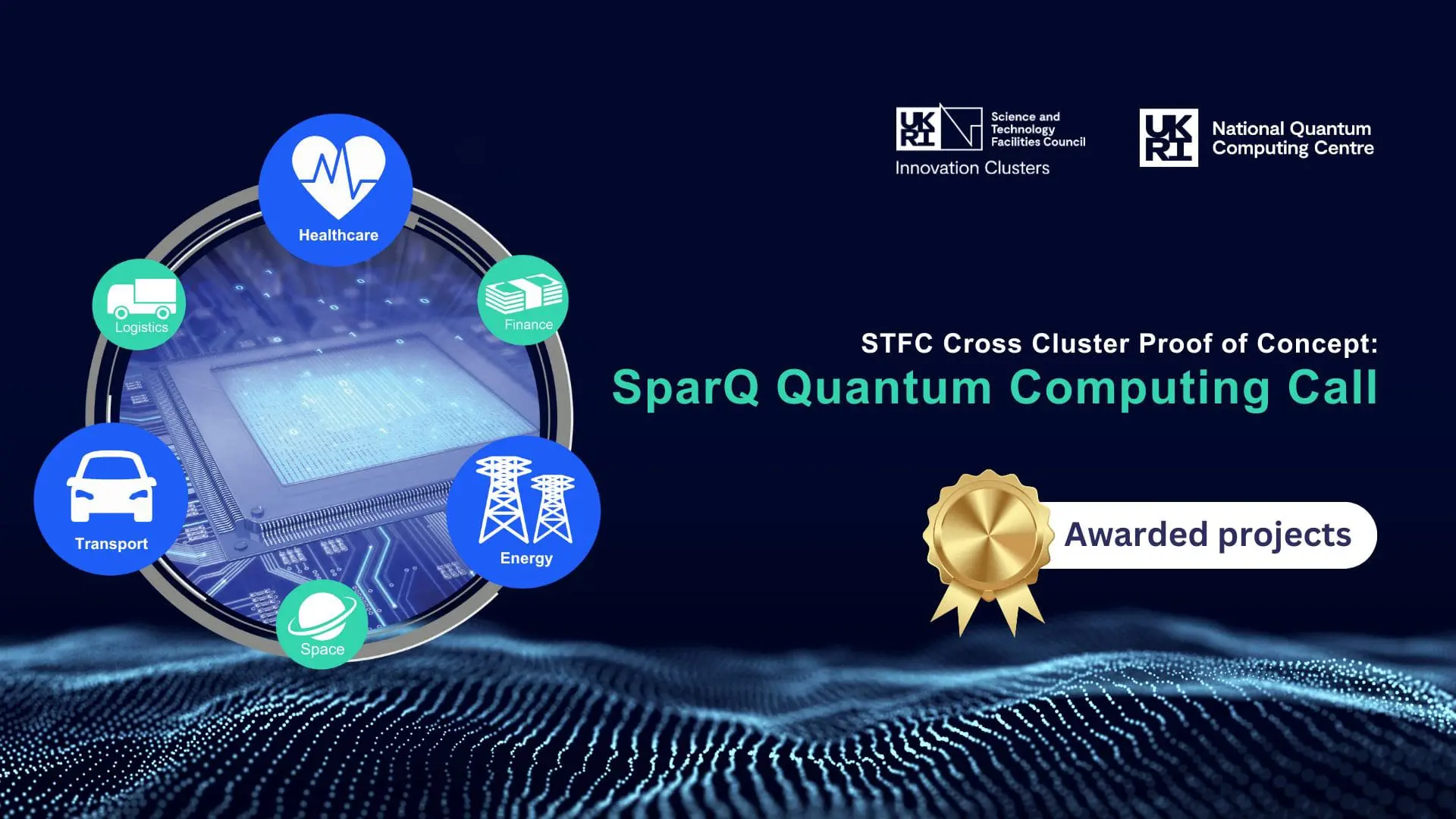
In a significant step forward for quantum computing, the National Quantum Computing Centre (NQCC) has announced funding for 12 innovative projects that will explore the technology’s potential in various fields.
These projects, set to run until March 2025, are part of the NQCC’s SparQ programme and involve collaborations with leading organizations such as Airbus, Royal Brompton and Harefield hospitals, and Capgemini. The use cases span diverse areas, including renewable energy generation, cancer diagnosis, and disaster response operations.
For instance, Oxford Ionics will investigate mid-circuit measurement in quantum algorithms for aerodynamics simulations. At the same time, Applied Quantum Computing Limited will explore the application of Quantum Machine Learning to improve early cancer detection.
Other notable projects include Frazer-Nash Consultancy’s work on quantum optimization solutions for the renewable sector and Unisys Ltd’s development of Quantum Machine Learning for fraud detection in credit card transactions. These initiatives have the potential to revolutionize various industries and demonstrate the power of quantum computing in real-world applications.
Quantum Computing Proof of Concept Call: 12 Projects Awarded Funding
The National Quantum Computing Centre (NQCC) has announced the successful projects awarded funding as part of this year’s Proof of Concept Call in Quantum Computing. This initiative, funded through the NQCC’s SparQ programme, will support the exploration of 12 use cases in quantum computing relevant to the public, private, and charitable sectors.
The selected projects span diverse fields and applications, ranging from renewable energy generation to methods to improve cancer diagnosis. These projects, undertaken in collaboration with the NQCC, will run until the end of March 2025. The funding will enable researchers to explore the potential of quantum computing in various domains, driving innovation and advancing the field.
One of the key aspects of this initiative is its focus on practical applications of quantum computing. By exploring use cases in diverse fields, the projects aim to demonstrate the potential of quantum computing to solve real-world problems. For instance, the project led by Oxford Ionics, Quanscient Ltd, NQCC, and Airbus will investigate the role of mid-circuit measurement in quantum algorithms for Computational Fluid Dynamics (CFD) simulations, with the goal of demonstrating quantum advantage in aerodynamics.
Another project, led by Applied Quantum Computing Limited, Royal Brompton and Harefield hospitals, Brunel University of London, STFC Harwell, Digital Catapult, and NQCC, will explore the application of Quantum Machine Learning (QML) to improve the early detection of cancer via the use of AI classification methods for liquid biopsies. This project has the potential to revolutionize cancer diagnosis by leveraging the power of quantum computing.
Diverse Applications of Quantum Computing
The 12 projects awarded funding demonstrate the diverse applications of quantum computing across various sectors. For instance, the project led by Frazer-Nash Consultancy, ORCA Computing, The Crown Estate, and NQCC will explore quantum optimisation solutions for the renewable sector, including batteries and windfarms.
Another project, led by Capgemini, Airbus, NQCC, and King’s College London, will focus on QuantiCo: Quantum Computing for Corrosion. This project aims to develop a quantum computing-based solution to predict corrosion rates in various materials, which could have significant implications for industries such as aerospace and energy.
The projects also cover applications in finance, with Unisys Ltd, NQCC, and Paysafe exploring the use of Quantum Machine Learning for Fraud Detection in Credit Card Transactions. This project can potentially improve fraud detection rates and reduce financial losses for businesses and individuals.
Here is a list of the 12 Projects
- Oxford Ionics, Quanscient Ltd (TBC), NQCC, Airbus– Understanding the role of mid-circuit measurement in quantum algorithms for Computational Fluid Dynamics (CFD) simulations, towards demonstrating quantum advantage in aerodynamics
- Mind Foundry, NQCC – Proof of Concept Application of Quantum Optimisation in Planning of In-Field Sensor Networks for supporting Disaster Response Operations
- Applied Quantum Computing Limited, Royal Brompton and Harefield hospitals, Brunel University of London, STFC Harwell, Digital Catapult, NQCC – Investigating the application of Quantum Machine Learning (“QML”) to improve the early detection of cancer via the use of AI classification methods for liquid biopsies
- Frazer-Nash Consultancy, ORCA Computing, The Crown Estate, NQCC -From batteries to windfarms: Quantum optimisation solutions for the renewable sector
- Capgemini, Airbus, NQCC, King’s College London – QuantiCo: Quantum Computing for Corrosion
- Unisys Ltd, NQCC, Paysafe – Quantum Machine Learning for Fraud Detection in Credit Card Transactions
- PsiQuantum, QinetiQ, STFC Hartree Centre, NQCC – Quantum Resource Estimation as a Pipeline for Polymer Simulation (QREPPS)
- Quantarverse Limited, Radiation Analysis Services Ltd, Quantum Software Lab(QSL), The University of Edinburgh, NQCC – Space-Hardened Quantum Error Correction for Orbital Computing
- Aioi R&D, Mind Foundry, NQCC – Closure Optimisation for Road Network Maintenance
- LTIMindtree, D-Wave, NQCC – Quantum Approach for Scalable Dynamic Flexible Job Shop Scheduling Platform
- Quantinuum, STFC Hartree Centre, NQCC – Quantum simulations for enhanced NMR in next-generation batteries
- ColdQuanta UK Ltd (Infleqtion) , Avatrial, NQCC – Omics Insights with Quantum (OmIQ)
A key aspect of this initiative is the collaboration between academia, industry, and government agencies. The projects bring together experts from various fields, including quantum computing, materials science, and finance, to explore the potential of quantum computing in diverse applications.
The collaboration will enable knowledge sharing and expertise exchange, driving innovation and advancing the field of quantum computing. For instance, the project led by PsiQuantum, QinetiQ, STFC Hartree Centre, and NQCC will develop a pipeline for polymer simulation using Quantum Resource Estimation (QREPPS). This project has the potential to improve our understanding of polymer properties and behavior.
Future Directions and Implications
The 12 projects awarded funding have significant implications for the future of quantum computing. These projects will help drive innovation and advance the field by exploring practical applications of quantum computing.
As the projects progress, they are expected to demonstrate the potential of quantum computing to solve real-world problems, driving adoption and investment in the technology. The initiative also has the potential to establish the UK as a leader in quantum computing research and development, with implications for economic growth and job creation.
The projects will run until the end of March 2025, providing a timeline for the delivery of results and outcomes. As the projects progress, they are expected to provide valuable insights into the potential of quantum computing, driving innovation and advancing the field.
External Link: Click Here For More