

The quest for increasingly dense and reconfigurable data storage drives exploration of novel materials exhibiting complex topological textures, and recent work focuses on harnessing these properties in ferroelectrics. Florian Mayer from Materials Center Leoben Forschung GmbH, along with colleagues, investigates how introducing zirconium into barium titanate alters these textures, revealing a pathway to chemically programmed, fractionalized ferroelectric topology. The team demonstrates that substituting zirconium creates unique arrangements of topological features, including stable antiskyrmions and skyrmions, and importantly, maintains these structures at temperatures up to room temperature, a significant advance over existing materials. This research establishes zirconium-substituted barium titanate as a promising platform for developing multistate memory devices and exploring fundamental aspects of topological phenomena in solids, offering potential for substantial improvements in data storage density and device functionality.
Zirconium Effects on Skyrmion Stability and Structure
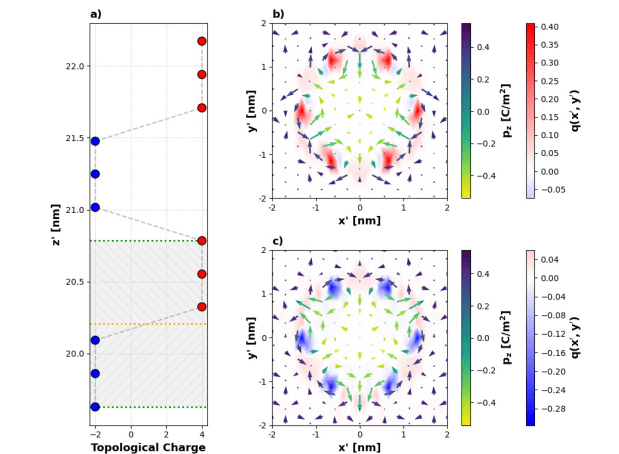
This supplemental material details a comprehensive investigation into the behavior of topological defects, specifically antiskyrmions, within barium zirconate titanate (BZT) as zirconium concentration varies. Researchers employed a combination of Density Functional Theory (DFT) calculations and a field-theoretic EH model to understand how zirconium influences the stability, structure, and evolution of these defects. The EH model, validated against DFT results, accurately simulates the system and allows for exploration of topological phenomena within BZT. The study reveals that introducing zirconium creates a unique effect, a Z2 color holonomy, which causes a shift in topological charge as it crosses the chemical interface between materials.
Each vortex gains one unit of charge upon crossing this interface, confirming the role of the Z2 holonomy in charge transfer. Furthermore, the research demonstrates that random zirconium substitution introduces fluctuations in the topological charge along the core of the antiskyrmion, with the amplitude and frequency of these fluctuations increasing with zirconium concentration. At higher concentrations, the system transitions to a skyrmion-glass-like state, characterized by a heterogeneous distribution of topological charge, demonstrating composition-dependent behavior.
Zirconium Doping Creates Ferroelectric Superlattices
Scientists have pioneered a new approach to engineering ferroelectric topology by introducing zirconium into barium titanate (BT), creating a chemically ordered superlattice. By doubling the unit cell of the perovskite structure of BT and substituting one titanium atom with zirconium within this expanded structure, achieving a precise 12. 5% zirconium concentration, researchers broke translational symmetry while preserving point symmetry. This deliberate substitution initiates a higher-level chemical ordering that persists even in the rhombohedral phase. The resulting superlattice exhibits a distinct arrangement where zirconium atoms occupy every second B-site along Cartesian directions, creating a repeating titanium-zirconium-titanium sequence.
Analysis of the crystallographic direction reveals that the unit cell is effectively doubled, defining a superlattice translation vector. This arrangement consists of three (111) planes, analogous to the ABC stacking found in face-centered cubic structures, with a chemical motif resulting in a titanium-zirconium stacking sequence. This precise chemical modulation creates two distinct halves within the unit cell, each exhibiting a unique stacking arrangement, yet sharing identical geometric B-site positions, a critical feature for investigating topological textures.
Stable Antiskyrmions in Barium Zirconate Titanate
Researchers demonstrate the creation and stabilization of complex topological textures within barium zirconate titanate (BZT), a material with tailored chemical composition, opening avenues for advanced memory devices and exploration of fundamental topological phenomena. The work establishes BZT as a platform for manipulating fractionalized ferroelectric topology across a broad temperature range, from cryogenic temperatures to room temperature. Molecular dynamics simulations reveal that a precisely ordered 12. 5% zirconium substitution within the barium titanate lattice induces a unique splitting of topological charge.
This ordered arrangement sustains stable nanodomains, where one half of the unit cell hosts a well-defined -2 antiskyrmion, comprised of six -1/3 topological quarks, while the opposing half supports a +4 skyrmion with six +2/3 quarks. This charge separation originates from the chemical sublattice and accompanying changes in local anisotropy, effectively doubling the topological landscape. Investigations into randomly substituted BZT demonstrate the robustness of these textures, although increasing zirconium concentration introduces distortions. Thermal stability maps show that pure barium titanate retains -2 textures up to approximately 100 Kelvin, while BZT exhibits a non-monotonic critical temperature, reflecting a competition between ferroelectric softening and disorder pinning.
Importantly, the 12. 5% ordered BZT arrangement remains rhombohedral above 300 Kelvin, enabling the stabilization of field-induced nanodomains at 293 Kelvin. These results demonstrate the potential for chemically programmed, fractionalized ferroelectric topology, paving the way for multistate, reconfigurable devices and a deeper understanding of topological quasiparticles in condensed matter physics.
BZT Creates, Manipulates Complex Ferroelectric Textures
This research establishes barium zirconate titanate (BZT) as a versatile material for controlling ferroelectric topology, demonstrating the creation and manipulation of complex textures at both cryogenic and room temperatures. Scientists discovered that ordered BZT, with a specific zirconium concentration, exhibits alternating topological structures: one half hosting an antiskyrmion with fractional charge, and the other a skyrmion with a different fractional charge. These structures share a common vortex skeleton but differ in their integrated charge, a characteristic confirmed through detailed analysis of local charge density. In disordered BZT, researchers observed the formation of a “skyrmion-glass” state, where disorder pins and distorts the topological textures, leading to spatially varying fractionalization of charge.
Thermal investigations revealed a complex relationship between zirconium concentration and critical temperature, reflecting a competition between ferroelectric softening and disorder-induced pinning. Importantly, the ordered BZT maintains its rhombohedral structure above 300K, allowing for the creation of field-stabilized nanodomains at room temperature, while disordered compositions fragment under the same conditions. This work demonstrates the potential of BZT for creating reconfigurable devices based on engineered ferroelectric topology, ranging from fractionalized topological charges at low temperatures to stabilized textures near room temperature, and opens avenues for multistate memory applications.
👉 More information
🗞 Topological Textures in Zr-Substituted Barium Titanate
🧠 ArXiv: https://arxiv.org/abs/2509.26023