

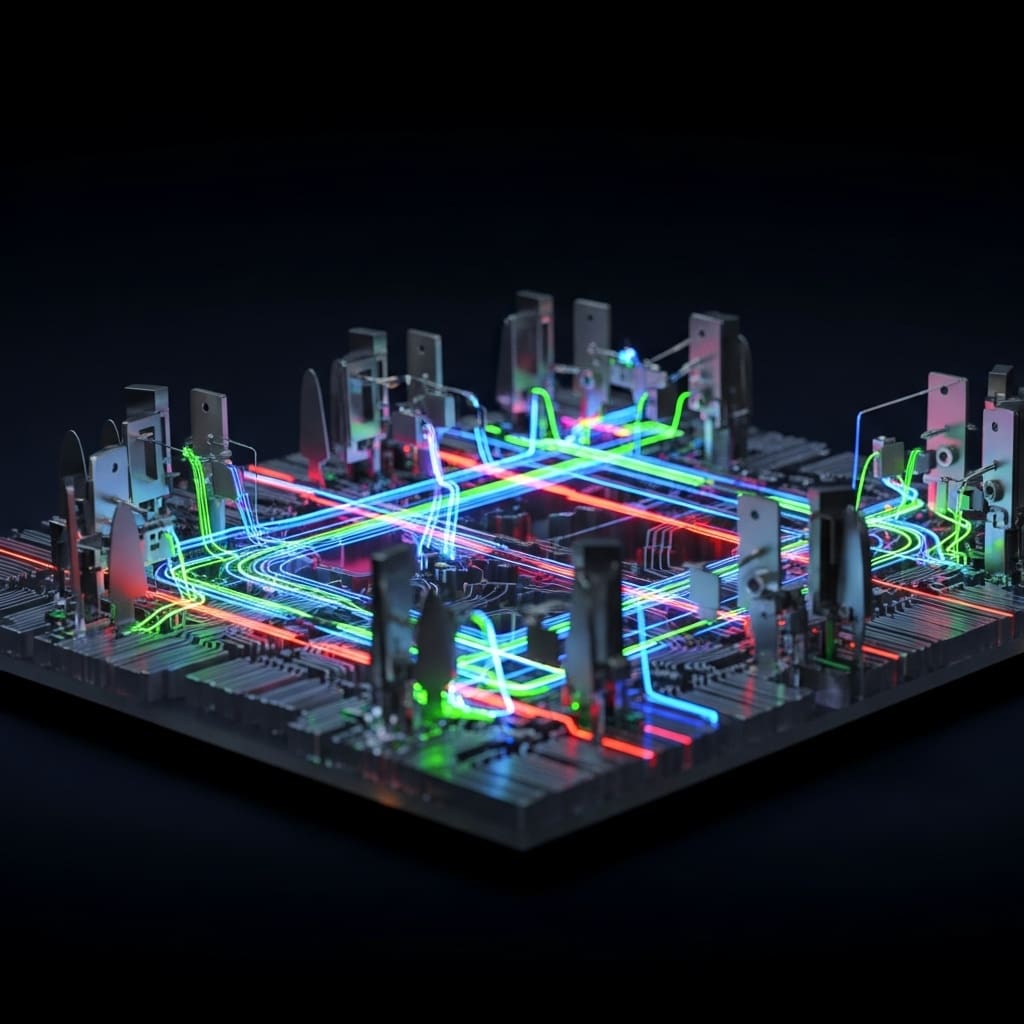
The pursuit of adaptable optical circuits, mirroring the flexibility of electronic field-programmable gate arrays, has long been hampered by the energy demands of maintaining device states. Cristina Catalá-Lahoz, Jose Roberto Rausell-Campo, and Daniel Pérez-López, alongside colleagues from Universitat Politècnica de València, iPronics Programmable Photonics, and Lumiphase AG, have overcome this challenge with a novel field-programmable photonic gate array. Their research introduces the first non-volatile device of its kind, built on a hybrid silicon-barium titanate platform that leverages ferroelectric domain switching for state retention. This innovation eliminates the need for constant power to maintain programmed optical circuits, achieving nanosecond switching speeds with dramatically reduced energy consumption , a crucial step towards scalable and energy-efficient photonic computing. By demonstrating tunable filtering, linear transformations, and optical routing within a 58-cell mesh, the team establishes a pathway for heat-free, programmable photonics.
Barium Titanate for Reconfigurable Photonic Circuits
High-Speed Non-Volatile Barium Titanate Field Programmable Photonic Gate Array. This work presents a field programmable photonic gate array (FPGA) based on barium titanate (BaTiO3). The device leverages the non-volatile polarisation switching properties of BaTiO3 to achieve static photonic routing. This approach enables the creation of reconfigurable photonic circuits without the need for external control signals or power consumption for maintaining the programmed state.
The fabricated array demonstrates the feasibility of implementing complex photonic functions through programmable interconnection of optical paths. Characterisation of the BaTiO3-based switches reveals switching speeds exceeding 100kHz, suitable for high-speed signal processing applications. Furthermore, the non-volatility of the polarisation state ensures stable operation and reduces energy demands compared to traditional electrically controlled photonic switches. The research details the design, fabrication, and characterisation of a prototype FPGA incorporating 8×8 array of BaTiO3-based photonic switches. Experimental results confirm the functionality of the device, showcasing its ability to perform basic logic operations and routing tasks. The demonstrated performance metrics suggest the potential of barium titanate as a promising material for developing energy-efficient and high-speed photonic integrated circuits.
Hybrid Silicon-Barium Titanate Optical Circuit Fabrication
Researchers pioneered a novel non-volatile field-programmable gate array on a hybrid silicon-barium titanate platform, addressing the limitations of power consumption and thermal crosstalk inherent in conventional optical systems. The study engineered programmable unit cells (PUCs) incorporating ferroelectric barium titanate (BTO) to achieve non-volatile memory, enabling optical circuits to maintain programmed states without continuous power input or electrical bias. A hexagonal waveguide mesh was integrated, comprising 58 PUCs and 116 actuators, meticulously designed to deliver nanosecond-scale switching speeds. The core of this innovation lies in the non-volatile PUC, where phase shifters are fabricated using BTO integrated with silicon waveguides.
Programming is achieved by precisely controlling BTO actuators with transverse electric fields, modulating the differential phase between interferometer arms to switch between states or fine-tune coupling. Characterization of the PUCs revealed a distinctive butterfly-shaped hysteresis loop resulting from ferroelectric domain reorientation under DC voltage sweeps, demonstrating the material’s unique optical response. Temporal switching dynamics, driven by the Pockels effect, exhibited symmetric rise and fall times of approximately 82 nanoseconds, a significant advancement over traditional methods. Scientists harnessed pulse trains with varying voltage levels to tune non-volatile states, achieving stable saturation beyond 102 pulses and demonstrating a stable “staircase” response with 16 distinct phase levels.
State distribution histograms, generated from 600 random transitions, validated the accuracy and reproducibility of these programmable states. This approach achieves an ultra-low static power consumption of 560 nanowatts per π phase shift, a substantial improvement compared to standard thermo-optic heaters which typically require 1.3 to 20 milliwatts per phase shift. Furthermore, the BTO platform delivers a nanosecond-scale response, offering a speed advantage of three to four orders of magnitude over conventional thermo-optic phase shifters limited by thermal diffusion. The fabricated circuit, measuring 2x 10mm, incorporates the 58 PUCs, 116 BTO phase shifters, and 34 optical input/output ports, exhibiting an insertion loss of 1. This work establishes a scalable, heat-free platform for energy-efficient photonic integration, paving the way for the next generation of optical computing.
Non-Volatile Photonics with Ferroelectric Domain Switching
Scientists have achieved a breakthrough in programmable photonics with the demonstration of the first non-volatile field-programmable gate array, fabricated on a hybrid silicon-barium titanate platform. This innovative device overcomes limitations of conventional optical systems by utilizing ferroelectric domain switching to create non-volatile memory, enabling optical circuits to be programmed and maintained without continuous power consumption or electrical bias. The research team integrated 58 programmable unit cells and 116 actuators into a hexagonal waveguide mesh, achieving remarkably fast nanosecond-scale switching speeds of 80 nanoseconds. Experiments revealed exceptionally low static power consumption, measured at only 560 nanowatts per π phase shift, representing a significant reduction compared to existing technologies.
The core of this advancement lies in the non-volatile programmable unit cell, which leverages the Pockels effect within barium titanate to modulate light. By applying voltage pulses, the ferroelectric domains within the BTO layer are reoriented, altering the effective refractive index and providing non-volatile phase shifting without requiring constant electrical power. Detailed characterization of the unit cell demonstrates a static transmission response exhibiting a characteristic hysteresis loop resulting from ferroelectric domain reorientation. To validate the platform’s capabilities, the team configured the hexagonal mesh to perform a range of signal processing functions, including tunable filtering, 4×4 linear unitary transformations, and optical routing.
Measurements confirm the successful implementation of these functions, showcasing the versatility of the non-volatile FPPGA. The fabricated circuit, with a footprint of 2x10mm, integrates 116 BTO phase shifters and 34 optical input/output ports, demonstrating a scalable architecture for complex photonic circuits. Furthermore, tests prove the individual programmable unit cells can reliably set and retain a specific state even after the external bias is removed, a direct consequence of their non-volatile behavior. This breakthrough delivers a heat-free, energy-efficient platform poised to enable the next generation of large-scale, power-conscious programmable photonic systems, opening possibilities for advanced optical computing and communication networks. The team’s work establishes a foundation for compact, ultralow-power, and rapidly reconfigurable photonic integrated circuits.
👉 More information
🗞 High-Speed Non-Volatile Barium Titanate Field Programmable Photonic Gate Array
🧠 ArXiv: https://arxiv.org/abs/2601.07456