The quest for faster and more energy-efficient magnetic data storage drives research into light-based methods of controlling magnetisation, offering a potential pathway to entirely new memory technologies. However, achieving reliable and deterministic switching with single pulses of light has proven challenging, previously limited to specific materials requiring precise conditions. Now, Chen Xiao, Boyu Zhang, Xiangyu Zheng, and colleagues from Beihang University and Nanjing University demonstrate coherent magnetisation switching in common ferromagnetic materials using only single femtosecond laser pulses. This breakthrough overcomes a fundamental obstacle in the field, exhibiting robust and reproducible switching across a broad range of pulse durations and achieving remarkable energy efficiency, even at the nanoscale. These results represent a significant advance toward integrating opto-spintronics into next-generation memory and storage devices, paving the way for faster, more efficient data handling.
Optical and Thermal Control of Magnetization
Researchers investigated controlling magnetization in thin films using both light and temperature, aiming for efficient, all-optical switching for data storage and spintronics. They fabricated films using magnetron sputtering, employing materials like cobalt-iron-boron and magnesium oxide with buffer layers of tantalum, titanium, and tungsten to optimize magnetic properties. Different structures, including Hall effect devices and magnetic tunnel junctions, were created to assess magnetic behavior. Films were patterned into precise structures using UV lithography and ion beam etching, with electrical contacts deposited via sputtering and lift-off.
Nanodot devices were created with electron beam lithography, and the magnetic properties characterized using Hall effect and tunnel magnetoresistance measurements. Magneto-optic Kerr microscopy, integrated into a custom probe station, visualized magnetic domains and monitored changes during laser excitation, with time-resolved measurements studying magnetization dynamics. To model material behavior, scientists developed simulations based on the Landau-Lifshitz-Gilbert equation, incorporating temperature-dependent magnetic anisotropy and using a one-dimensional thermal model to simulate temperature profiles during laser excitation, performed using Python software. Key parameters, including laser fluence and applied magnetic fields, were carefully controlled, with changes in resistance monitored to detect switching events and magnetic domains visualized using Kerr microscopy. This combined advanced materials fabrication, precise techniques, and detailed simulations to understand and control magnetization.
Laser Control of Magnetization via Thermal Torque
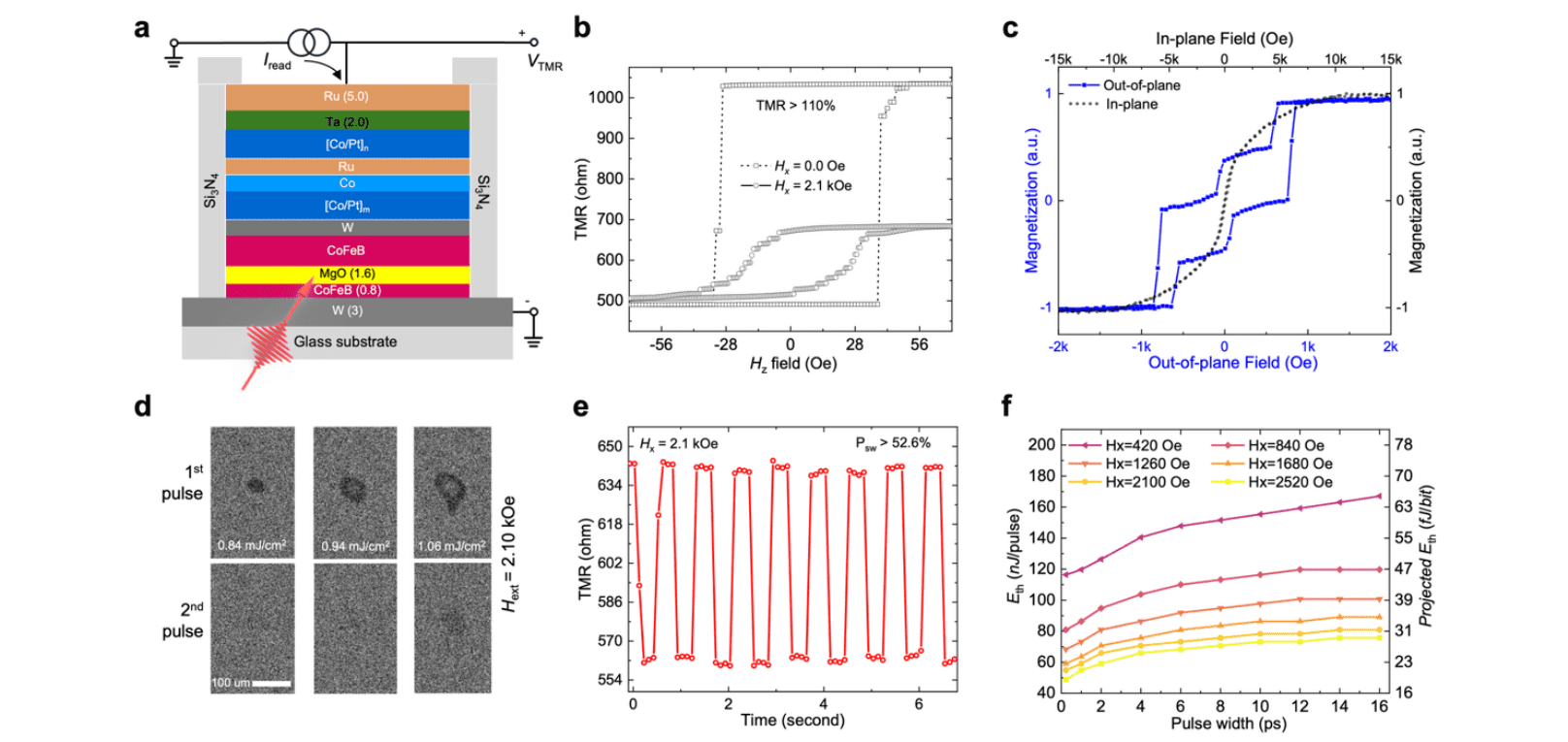
Scientists developed a new method for manipulating magnetization in ferromagnetic materials using ultrashort laser pulses, achieving coherent switching driven by thermal anisotropy torque. They created thin films of cobalt-iron-boron on substrates, employing magnetron sputtering and annealing to enhance magnetic properties, then patterned them into cross-shaped Hall bar structures for optical access and electrical readout. Initial characterization involved standard resistance-magnetic field measurements, followed by femtosecond laser pulses synchronized with the magnetic field sweep. Researchers observed stochastic magnetization transitions between up and down states, even against the applied field, demonstrating the laser’s ability to modify magnetization, independent of read current polarity and light helicity.
To achieve deterministic toggle switching, they systematically adjusted laser power and balanced in-plane and perpendicular magnetic fields, with a stack of tungsten, cobalt-iron-boron, magnesium oxide, and tantalum exhibiting the best energy efficiency. Experiments using this stack yielded 100% toggle switching events, confirmed by electrically detected state diagrams. Switching probabilities were calculated based on resistance variations, revealing a dependence on laser fluence and in-plane field, corroborated by Kerr microscopy revealing ring structures indicative of precessional switching. These results represent a significant advance toward integrating opto-spintronics into next-generation memory and storage technologies.
Laser Pulses Control Magnetization with High Precision
Scientists demonstrated coherent magnetization switching in ferromagnets using single laser pulses, achieving a breakthrough in opto-spintronics and paving the way for next-generation memory and storage technologies. This research overcomes a limitation in ferromagnetic materials, lacking the internal structure necessary for efficient optical control of magnetization, with experiments revealing switching driven by thermal anisotropy torque, enabling bistable toggle switching with remarkable precision and efficiency. The team achieved robust toggle switching by carefully balancing an in-plane magnetic field with single laser pulses, observing reliable magnetization flipping with each pulse. Measurements demonstrate this effect is independent of the external magnetic field, a significant departure from previous methods, and confirmed across a broad range of pulse durations, from femtoseconds to picoseconds, a critical requirement for practical applications. This breakthrough delivers exceptional energy efficiency, requiring only 17 femtojoules per 100-nanometer-sized bit to achieve switching. The team also observed high magnetoresistance exceeding 110% in cobalt-iron-boron/magnesium oxide-based magnetic tunnel junctions, indicating strong signal clarity and reliability, confirming the scalability of the method to nanoscale dimensions for high-density storage solutions.
Ultrafast Laser Switching Achieves Low Energy Magnetization
This research demonstrates coherent magnetization switching in standard ferromagnets using single laser pulses, a significant advance over previous work limited to specific compositions and temperature requirements. The team achieved deterministic toggle switching, reversing the magnetization, across a broad range of pulse durations, from femtoseconds to picoseconds, and successfully implemented this phenomenon in magnetic tunnel junctions exhibiting high magnetoresistance and nanoscale scalability. Notably, the process requires remarkably low energy consumption, placing it among the most competitive writing technologies when compared to existing hard drives and magnetic random-access memory. These findings bridge the gap between spintronics and ultrafast magnetism, offering a pathway to a new generation of highly stable photonic memory and storage technologies. Researchers acknowledge that further improvements in energy efficiency are possible through the use of plasmonic focusing techniques, with future work potentially focusing on realizing fully all-optical switching in a single ferromagnetic layer by substituting external magnetic fields with internal anisotropy. This approach allows for efficient access to the magnetic layer through transparent substrates, potentially enabling novel architectures with integrated optical waveguides for exceptionally fast and energy-efficient data processing and high read-out sensitivity.
👉 More information
🗞 Single femtosecond laser pulse-driven ferromagnetic switching
🧠 ArXiv: https://arxiv.org/abs/2510.27288