Noise represents a fundamental limitation in modern computation, hindering the reliable extraction of results from complex calculations, and researchers continually seek ways to overcome this challenge. Debarthi Pal from the Indian Institute of Science, Bangalore, and Ritajit Majumdar from IBM Quantum, IBM India Research Lab, alongside their colleagues, present a new method that significantly reduces the computational burden of noise mitigation techniques. Their work addresses a key drawback of existing approaches like circuit cutting and operator backpropagation, which often demand exponentially increasing computational resources. By intelligently combining operator backpropagation with circuit cutting and employing a simulated annealing process to optimise performance, the team achieves substantial reductions in resource requirements, demonstrating a threefold improvement for Variational Eigensolver circuits and a tenfold improvement for Hamiltonian simulations, without sacrificing accuracy, and extending these savings to a broader range of computational problems.
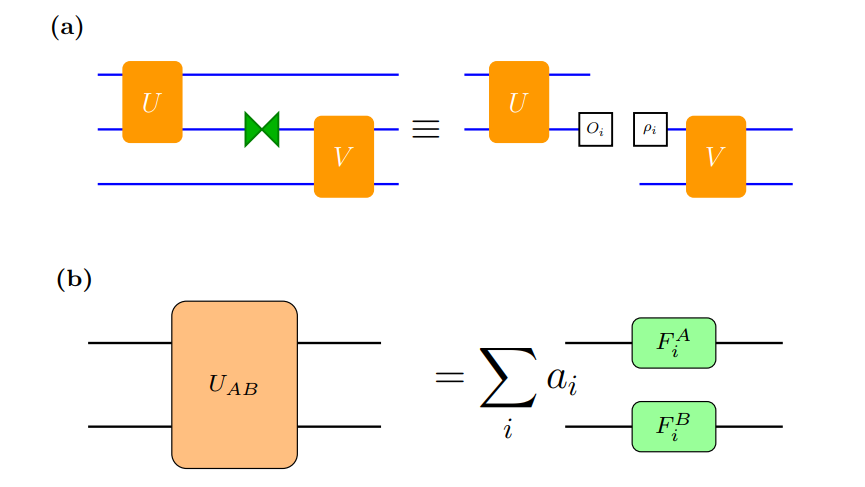
While effective in principle, circuit cutting often requires an exponentially growing number of circuit executions. The team demonstrates that combining circuit cutting with operator backpropagation (OBP) significantly reduces this overhead, achieving a threefold and tenfold reduction in circuit executions for Variational Quantum Eigensolver (VQE) and Hamiltonian simulation circuits respectively. The researchers discovered that selecting the optimal parameter for OBP is crucial for its effectiveness; naive selection can increase the number of circuit executions. To address this, they developed a method using simulated annealing to efficiently find the best parameter value, consistently achieving lower resource requirements. This approach proves broadly applicable across diverse circuits from the Benchpress dataset and for observables with varying weights, opening the door to applying circuit cutting to deeper and wider quantum circuits.
Circuit Cutting and Backpropagation Optimisation
Researchers have developed a novel approach to minimize noise in quantum circuits by strategically combining circuit cutting with operator backpropagation (OBP). Current quantum computers are susceptible to noise, hindering accurate computation. This work demonstrates that a carefully orchestrated combination of these two techniques can mitigate drawbacks and significantly reduce computational overhead. The team pioneered a method to identify the optimal backpropagation parameter for specific circuits and observables using simulated annealing, efficiently exploring the parameter space and maximizing resource reduction.
Implementing this approach on a 6-qubit VQE circuit and a 19-qubit Hamiltonian simulation circuit achieved a threefold and tenfold decrease in resource requirements. Importantly, the study reveals that the combined method not only reduces computational cost but can also enhance the accuracy of results by further decreasing the depth of subcircuits. The researchers validated the general applicability of their method using circuits from the Benchpress database, observing consistent savings across various observable weights.
Circuit Cutting and Backpropagation Reduce Quantum Noise
Scientists have achieved a significant breakthrough in mitigating noise in quantum circuits by combining circuit cutting with operator backpropagation (OBP). This work addresses a fundamental challenge in quantum computing, where inherent system noise limits the reliability of calculations. The team developed a method that strategically utilizes OBP to reduce the computational overhead associated with circuit cutting, enabling the execution of larger and deeper circuits. The research demonstrates a substantial reduction in resource requirements for key quantum algorithms, with VQE circuits experiencing a threefold decrease and Hamiltonian simulation circuits achieving a remarkable tenfold reduction.
These improvements do not come at the expense of accuracy; results indicate that the combined approach can even enhance the quality of calculations. The team validated these findings using circuits from the Benchpress database, confirming the broad applicability of the method and its effectiveness across diverse quantum computations. To optimize performance, scientists employed a simulated annealing technique to intelligently identify the optimal backpropagation parameter for each circuit and observable, maximizing resource reduction.
Circuit Cutting and Backpropagation Reduce Overhead
This research presents a significant advancement in mitigating noise within quantum circuits, a persistent challenge in quantum computing. The team successfully combined circuit cutting, a technique for dividing complex circuits into smaller parts, with operator backpropagation, a method for reducing circuit depth. Critically, they demonstrate that this combined approach can substantially lower the computational overhead typically associated with circuit cutting. Results indicate a threefold and tenfold reduction in required resources for VQE and Hamiltonian simulation circuits respectively, while maintaining or even improving accuracy.
This improvement extends to circuits from the Benchpress database and across various observable weights, suggesting broad applicability. The key to this success lies in the development of a method using simulated annealing to identify the optimal parameters for operator backpropagation, avoiding performance degradation that can occur with naive parameter selection. This work paves the way for applying circuit cutting to larger and more complex quantum circuits than previously feasible.
🗞 Low overhead circuit cutting with operator backpropagation
🧠 ArXiv: https://arxiv.org/abs/2510.19467