Detecting intrusions in the rapidly expanding world of Internet of Things (IoT) presents a significant challenge, particularly as devices operate with limited resources and require immediate responses to threats. Tung-Anh Nguyen, Van-Phuc Bui, and Shashi Raj Pandey, along with colleagues, address this problem by introducing a new approach to anomaly detection called FedSVD. This innovative framework utilises Singular Value Decomposition and a unique optimisation technique on Grassmann manifolds to identify both familiar and previously unseen intrusions without the need for labelled data or central data collection. The team demonstrates that FedSVD substantially reduces communication demands and computational burden, achieving performance comparable to complex deep learning methods, yet with over ten times faster inference speeds, making it ideally suited for real-time security applications on low-power devices.
Federated Anomaly Detection for IoT Networks
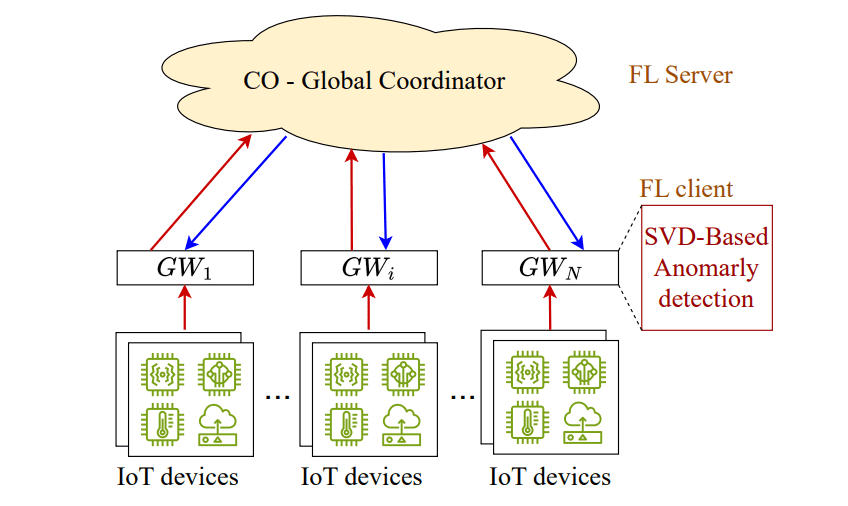
Scientists developed FedSVD, a new unsupervised federated learning framework for real-time anomaly detection in Internet of Things networks, addressing limitations of traditional centralized methods and supervised learning approaches. The study pioneers a decentralized system where local training occurs on individual devices, sharing only model parameters to preserve data privacy and reduce bandwidth requirements. The core of FedSVD involves performing SVD locally on each IoT device to extract essential features from network data without requiring labeled examples, enabling detection of both known and previously unseen intrusions.
This approach captures the intrinsic geometric structure of high-dimensional network traffic, facilitating rapid convergence and accurate anomaly detection without centralized data collection. Experiments using the NSL-KDD dataset demonstrate that FedSVD achieves performance comparable to advanced methods while maintaining high detection accuracy. The research team engineered a system where each IoT device performs local computations using SVD, exchanging only compact subspace representations with a central server, minimizing communication costs and preserving data privacy. Extensive experiments demonstrate that FedSVD achieves performance comparable to deep learning baselines, while reducing inference latency by over 10x, making it suitable for latency-sensitive IoT applications. This innovative approach addresses the limitations of legacy IoT devices lacking specialized hardware, offering a lightweight and efficient solution for real-time anomaly detection in large-scale networks.
Federated Learning Detects IoT Network Anomalies
Scientists have developed FedSVD, a new unsupervised federated learning framework designed for real-time anomaly detection in Internet of Things (IoT) networks. The research addresses critical limitations of traditional anomaly detection systems in IoT environments, particularly concerning data privacy, bandwidth constraints, and computational demands. The core of FedSVD lies in its ability to capture the intrinsic geometric structure of high-dimensional network traffic data, enabling rapid convergence and accurate anomaly detection.
By exchanging compact subspace representations instead of full data samples, the framework minimizes communication and storage requirements. Experiments demonstrate that FedSVD achieves performance comparable to advanced methods while maintaining high detection accuracy. The team successfully implemented and validated FedSVD on the NVIDIA Jetson AGX Orin platform, confirming its practical feasibility for deployment in real-world scenarios. Measurements confirm that this approach effectively models normal network behavior and identifies deviations indicative of threats, all without relying on labeled data or centralized data collection. The research team’s work represents a significant advancement in lightweight, privacy-preserving anomaly detection for the rapidly expanding world of interconnected devices.
Decentralized Anomaly Detection with Federated Learning
The research team presents FedSVD, a new unsupervised federated learning framework designed for real-time anomaly detection within Internet of Things networks. This approach enables decentralized learning, making it particularly suitable for resource-constrained devices commonly found in IoT deployments. Experimental results demonstrate that FedSVD achieves detection performance comparable to more complex deep learning methods, while significantly reducing both inference latency and memory usage. This efficiency allows for practical deployment on platforms like the NVIDIA Jetson AGX Orin, opening possibilities for real-time intrusion detection in diverse IoT applications. Nevertheless, this work represents a significant advancement in decentralized anomaly detection, offering a lightweight and efficient solution for securing increasingly interconnected IoT networks.
👉 More information
🗞 Microsecond Federated SVD on Grassmann Manifold for Real-time IoT Intrusion Detection
🧠 ArXiv: https://arxiv.org/abs/2510.18501