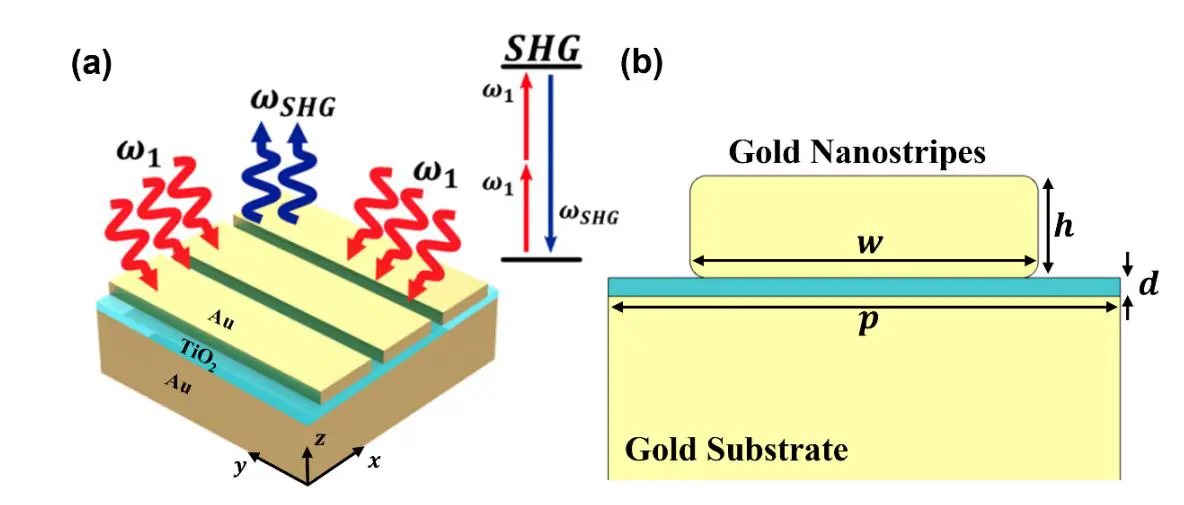
The pursuit of efficient nonlinear optical processes drives innovation in photonics, and researchers are increasingly turning to metasurfaces for compact and versatile solutions. Sky Semone, Matthew J. Brandsema, and colleagues from Pennsylvania State University, along with Thang Hoang from the University of Memphis, now demonstrate a significant advance in second harmonic generation (SHG), a process that doubles the frequency of light. The team achieves a remarkable 105-fold boost in SHG efficiency by carefully engineering a metasurface composed of gold nanocavities and an ultrathin layer of titanium dioxide. This breakthrough stems from exploiting the nonlinear properties of the gold surface itself, combined with intense electric field enhancement within the nanogaps, overcoming the limitations of conventional materials and paving the way for more efficient nonlinear and integrated photonic devices.
Plasmonic metasurfaces have emerged as a promising platform for enhancing a range of nonlinear optical processes, offering compact geometry and flexibility in light manipulation. Second order nonlinear processes, like second harmonic generation (SHG), typically require non-centrosymmetric crystals to be realised. This work experimentally demonstrates enhanced SHG response by using a gold nanocavity array forming a plasmonic metasurface absorber. Titanium dioxide (TiO2), a centrosymmetric dielectric material with subwavelength thickness, is deposited in the realised nanogaps.
Plasmonic Metasurface Fabrication and Characterisation
The team mapped the spatial distribution of electric fields at both the fundamental and second harmonic frequencies, revealing how the plasmonic resonance concentrates the electric field within the nanocavities. This concentration is crucial for efficient SHG. Nonlinear simulations and analysis of surface currents demonstrate that the nanocavity structure dramatically increases the surface current density at the second harmonic frequency, leading to a stronger electric field and, consequently, a higher SHG efficiency. The comparison with a structure lacking the nanocavity clearly highlights the benefits of this design.
Nanocavity Resonance Boosts Second Harmonic Generation
Scientists have demonstrated a 105-fold enhancement in second harmonic generation (SHG), a process that doubles the frequency of light, using a novel plasmonic metasurface. The research centers on a meticulously designed array of gold nanocavities, where an ultrathin layer of titanium dioxide is deposited within the resulting nanogaps. Despite titanium dioxide being a material with extremely low inherent second order nonlinear susceptibility, the team achieved substantial SHG boosting due to the unique properties of the metasurface. Experiments reveal that the significant electric field enhancement occurring within the nanogaps, created by the nanocavity resonance, is key to this breakthrough.
The observed increase in SHG is primarily attributed to the surface nonlinear susceptibility of the gold metal, effectively amplifying the light-matter interaction. Rigorous nonlinear simulations, considering both bulk and surface material properties, corroborate the experimental findings and provide a detailed understanding of the underlying mechanisms. This work demonstrates that robust harmonic generation can be achieved using an ultrathin plasmonic metasurface, opening new avenues for nonlinear and integrated photonic applications. Measurements confirm that the design effectively overcomes the limitations of traditional nonlinear materials, offering a pathway to compact and efficient light manipulation at the nanoscale.
Metasurface Boosts Second Harmonic Generation 105-Fold
This research demonstrates a significant advance in nonlinear optics through the experimental realization of substantially enhanced second harmonic generation (SHG) using an ultrathin plasmonic metasurface. The team successfully achieved a 105-fold boost in SHG signal, despite employing only centrosymmetric materials, which typically exhibit very low nonlinear susceptibility. This enhancement stems from the unique design of a nanocavity array that forms a plasmonic metasurface absorber, concentrating electric fields within nanogaps and leveraging surface nonlinearities of the metal component. Rigorous theoretical simulations, incorporating both bulk and surface material properties, corroborate the experimental findings and reveal that induced nonlinear surface currents at the metal-dielectric interfaces are primarily responsible for the observed effect. This work not only provides tangible experimental results demonstrating strong SHG from surface nonlinearities, but also elucidates the underlying physical mechanisms through advanced computational modeling. This achievement paves the way for new nonlinear sensing and imaging applications, potentially leading to more compact and efficient photonic devices.
🗞 Leveraging Plasmonic Nanocavity Arrays Forming Metasurfaces to Boost Second Harmonic Generation due to Surface Effects
🧠 ArXiv: https://arxiv.org/abs/2512.14459