

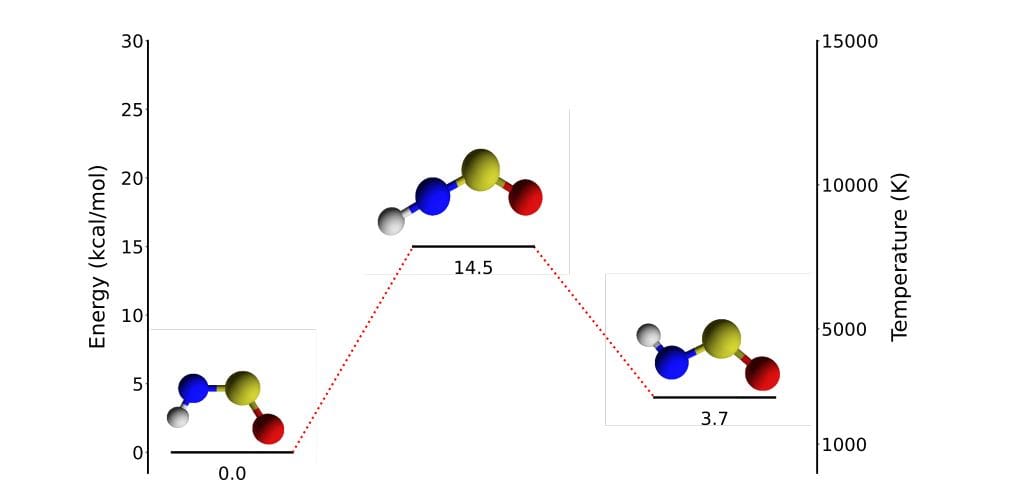
The unexpectedly low abundance of sulfur-bearing molecules in interstellar space presents a significant puzzle for astrochemists, and understanding the behaviour of nitrogen, sulfur and oxygen-containing compounds is crucial to resolving it. Valerio Lattanzi, Miguel Sanz-Novo and Víctor M. Rivilla, working with colleagues at the Center for Astrochemical Studies and the Centro de Astrobiología, have now characterised a key molecule in this context, -HNSO, through laboratory experiments. This research represents a breakthrough because, until now, high-resolution data for this higher-energy form of HNSO had remained elusive, hindering efforts to identify it in astronomical observations. By meticulously recording and analysing its rotational spectrum, the team has not only confirmed its existence but also predicted its spectral signatures with unprecedented accuracy, making it a prime target for future searches in interstellar clouds and opening new avenues to investigate the role of quantum tunnelling in the distribution of HNSO isomers.
Interstellar HNSO Isomers and Prebiotic Chemistry
Scientists have extensively investigated molecules containing nitrogen, sulfur, and oxygen found in interstellar space, with a primary focus on thionylimide (HNSO). This research details the detection of both cis- and trans- isomers of HNSO and explores the implications for understanding prebiotic chemistry and the distribution of elements throughout the interstellar medium. Accurate determination of their relative energies and rotational constants is essential for correctly identifying these molecules through their spectral fingerprints, highlighting the abundance of complex organic molecules in interstellar space. Considering high-energy isomers and alternative molecular arrangements is vital for a complete understanding of interstellar chemistry.
The research confirms that cis-HNSO represents the ground state isomer, while trans-HNSO exists at a higher energy level, providing the first detection of HNSO in space and evidence for all three isomers. This work addresses the “missing sulfur problem” in the interstellar medium, suggesting that sulfur may be incorporated into complex molecules or polycyclic aromatic hydrocarbons. The detection of molecules containing nitrogen, sulfur, and oxygen is relevant to understanding the origins of prebiotic chemistry and the building blocks of life, with hydrogen sulfide and nitric oxide potentially serving as precursors to these molecules. Alongside HNSO, scientists have detected glycine, glycolamide, cyanomethanimine, formic acid, methylformamide, and carbonic acid in interstellar space, providing valuable insights into the chemical processes occurring in star-forming regions. This research combines high-level quantum chemical calculations, astronomical observations, and spectral analysis to achieve these results, building upon related research on interstellar molecules, prebiotic chemistry, and the distribution of elements in the universe, with potential applications in understanding the origins of life and the search for extraterrestrial life.
Thionylimide Spectroscopy and Isomer Identification
Maintaining the cell temperature near freezing minimized Doppler broadening of the spectral lines and prevented system overheating. The team leveraged the strong signals from the well-characterized cis-HNSO isomer to calibrate the instrument and verify its performance before focusing on the more elusive trans- conformer. Through careful optimization of the operating conditions, the team successfully detected individual transitions of the trans- conformer with good signal-to-noise. These measurements were complemented by high-level quantum-chemical calculations to provide theoretical predictions for comparison and validation, providing a robust foundation for identifying trans-HNSO in astronomical observations and understanding its role in interstellar chemistry.
Thionylimide’s High-Energy Conformer Spectroscopically Characterized
Scientists have achieved the first laboratory detection and detailed spectroscopic characterization of the high-energy conformer of thionylimide, recording over one hundred assigned transitions and yielding a highly accurate rotational spectrum. Data analysis reproduced the observed spectrum with high precision, confirming the accuracy of the measurements and validating theoretical predictions from CCSD(T) calculations. This high-energy conformer exhibits significantly larger dipole components than its lower-energy isomer, resulting in spectral lines that are more than five times brighter, assuming equal abundances, making it a particularly promising candidate for future detection in astronomical surveys. Accurate frequency predictions derived from these measurements will be added to public databases, facilitating targeted searches for this molecule in interstellar environments. Researchers combined these findings with recent evidence demonstrating isomerization between the two conformers at cryogenic temperatures, opening new avenues for investigating whether quantum tunneling governs the distribution of HNSO isomers in interstellar space, potentially resolving the long-standing “missing sulfur problem”. These findings also highlight the astrobiological relevance of HNSO, linking it to the biochemistries of nitric oxide and hydrogen sulfide, essential gasotransmitters in living organisms.
Thionylimide Spectroscopy Enables Radioastronomical Detection
This research presents the first detailed spectroscopic characterization of the higher energy conformer of thionylimide, achieving high-precision measurements of over one hundred rotational transitions and establishing a robust foundation for identifying this molecule in astronomical environments. The resulting data closely match theoretical predictions, providing accurate frequencies essential for radioastronomical searches and will be incorporated into public spectroscopic databases, building upon the recent detection of the cis- isomer in the Galactic Center cloud, suggesting this region may be a rich source of molecular stereochemistry. The authors acknowledge that certain measured parameters have larger uncertainties, but emphasize their small absolute magnitudes and positive impact on spectral reproduction. Future research may focus on testing whether quantum tunneling governs the distribution of HNSO isomers in interstellar space, building on evidence that isomerization can occur at cryogenic temperatures. These findings contribute to a growing understanding of sulfur-bearing molecules in space and their potential roles in prebiotic chemistry.
👉 More information
🗞 Laboratory Detection and Rotational Spectroscopy of -HNSO: Implications for Astronomical Observations
🧠 ArXiv: https://arxiv.org/abs/2511.22548

