

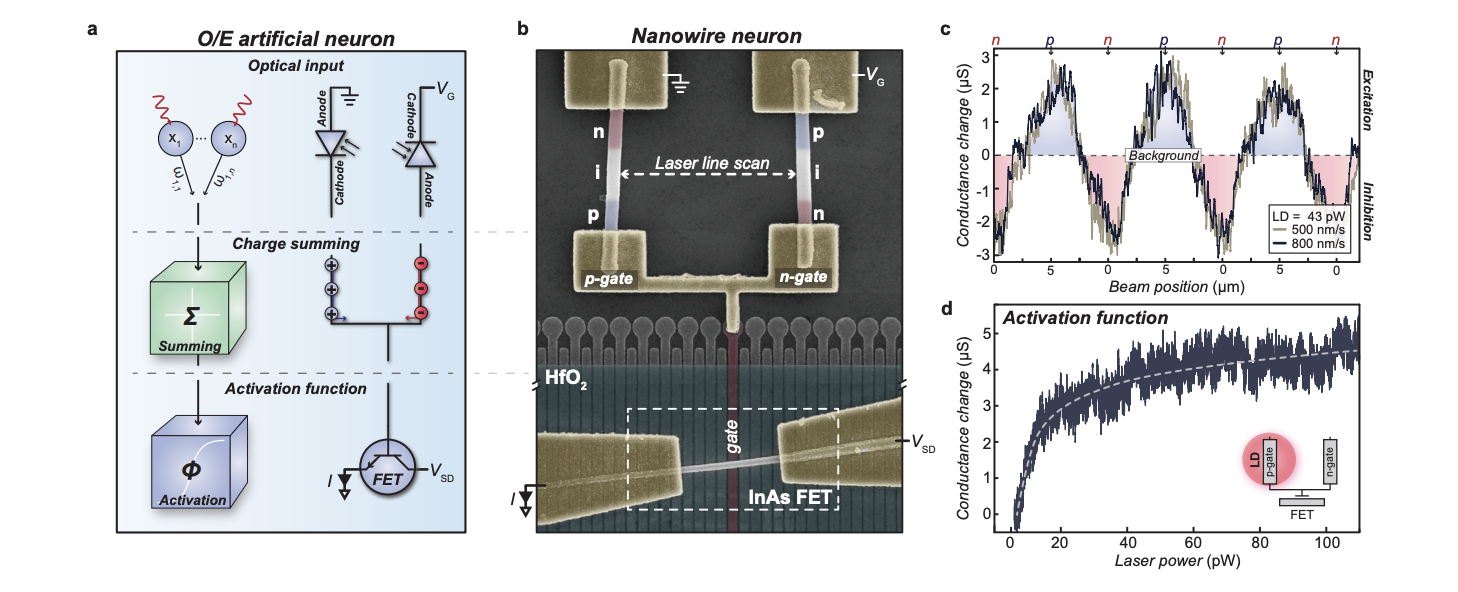
Artificial intelligence increasingly demands enormous computational power, driving a search for more efficient hardware solutions, and researchers are now turning to the brain for inspiration. Joachim E. Sestoft, Thomas K. Jensen, Vidar Flodgren, and colleagues, spanning the Niels Bohr Institute and Lund University, present a nanoscale photonic neuron that dramatically reduces energy consumption and circuit size compared to existing artificial neural networks. This innovative device, operating at a fraction of a watt, mimics key biological functions, including both excitatory and inhibitory signal processing, and accurately weights incoming information. The team’s work not only shrinks the footprint of artificial neurons by at least a hundredfold, but also establishes a pathway towards ultra-efficient computing and compact, adaptable sensing technologies, potentially revolutionising how we build and power future AI systems.
Current artificial neural networks largely rely on digital computation, demanding significant energy and limiting their ability to replicate the nuanced processing of the brain. This team investigates a new approach, leveraging light to perform computations with high speed and low energy consumption. Photonic neural networks offer a promising alternative, naturally implementing analog signal processing and parallel computation. This work demonstrates the fabrication and characterisation of a nanoscale photonic neuron, designed to emulate the core functionalities of a biological neuron within a compact integrated device. The device incorporates a resonant cavity to implement synaptic weighting, a slow-light structure to achieve signal integration, and a non-linear material to provide the activation function.
Compact Silicon Photonics for Neural Networks
Computational hardware inspired by biological neural networks promises to address the rapidly growing energy demands of artificial intelligence. Photonic approaches offer immense strengths in terms of power efficiency, speed, and synaptic connectivity. This research team investigates a novel approach to overcome limitations in circuit size, focusing on integrated silicon photonics to create compact and energy-efficient artificial neural networks. They fabricate nanoscale photonic circuits on a silicon chip, utilising waveguides to guide and manipulate light signals representing information. These circuits incorporate optical components, including modulators to control light intensity and detectors to convert light signals back into electrical signals. The methodology involves carefully engineering the geometry and arrangement of these components to emulate the behaviour of synapses and neurons, achieving a significant reduction in circuit footprint and energy consumption.
InAs Nanowires Emulate Biological Neuron Function
This research details the development of artificial neurons based on indium arsenide (InAs) nanowires, aiming to create energy-efficient and compact neuromorphic computing systems that mimic the human brain. The core innovation lies in an InAs nanowire acting as the synapse and integrating incoming signals. The neuron’s behaviour is controlled by electrostatic gates, allowing for tunable synaptic weights and signal integration. The neuron receives input via focused light, mimicking how biological neurons receive signals, which modulates the nanowire’s conductance. Key findings include significantly lower energy consumption compared to traditional CMOS-based artificial neurons, extremely dense integration of neurons, and the ability to control synaptic strength by adjusting electrostatic gates. This technology has potential applications in image recognition, pattern classification, and edge computing.
Compact Nano-Neuron Mimics Biological Processing
This research demonstrates a novel nano-optoelectronic neuron with a significantly reduced circuit footprint, at least 100 times smaller than existing technologies, and exceptionally low power consumption, operating in the picowatt regime. The device deterministically processes both excitatory and inhibitory signals, summing them and applying a non-linear function, mirroring key biological neural behaviours. Importantly, the neuron exhibits biological-like memory timescales and the ability to weight input channels, suggesting its potential for advanced information processing. The developed neuron is compatible with standard silicon technology and can operate across multiple wavelengths, broadening its applicability for both computation and sensing. The authors highlight two primary research pathways: the creation of photonic neuromorphic systems with minimized size and power demands, and the development of adaptive sensing technologies utilizing a compact, modular front-end architecture. Potential routes for tuning the neuron’s memory include nano-floating-gate structures and switchable molecular dyes, offering a promising step towards lightweight, edge-based neural networks capable of on-device, AI-enhanced sensing.
🗞 Nanoscale photonic neuron with biological signal processing
🧠 ArXiv: https://arxiv.org/abs/2509.06696


