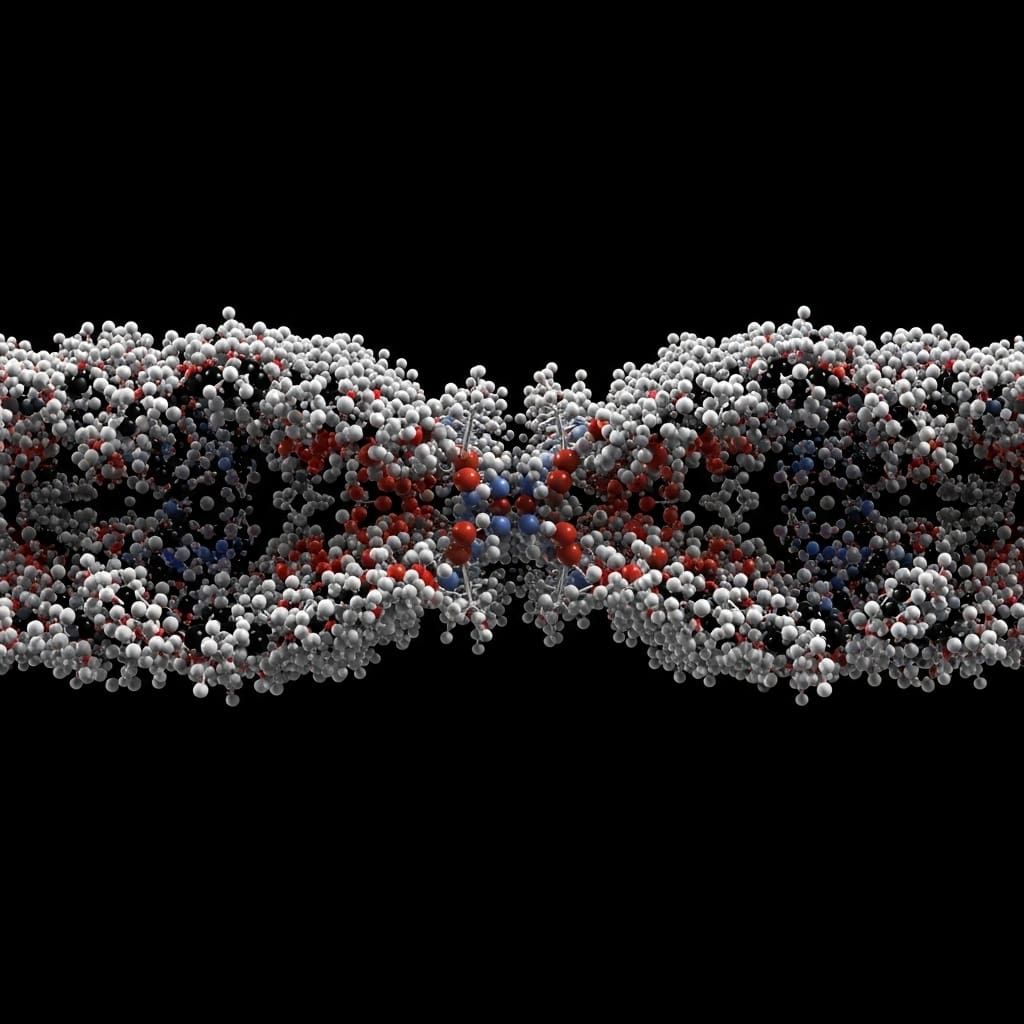
Alumina’s behaviour is central to a vast range of technologies, from catalysis to biomedical implants, yet accurately modelling its complex interactions at a molecular level has proved challenging. Researchers Cheng Zhu, Krishan Kanhaiya, and Sean P. Florez, all from the University of Colorado Boulder, alongside Samir Darouich, Karnajit Sen, and Patrick Keil from BASF SE and BASF Coatings GmbH et al, have now developed a groundbreaking solution: the INTERFACE Force Field (IFF). This new parameterisation, coupled with a comprehensive pH-resolved surface model database, offers the most accurate and transferable atomistic description of alumina phases to date, covering a-Al2O3, g-Al2O3, boehmite, diaspore, and gibbsite with a single, physically interpretable set of parameters. Significantly, the IFF achieves over 95 percent accuracy across structural, mechanical, and interfacial benchmarks, surpassing existing force fields and density-functional theory, and crucially, provides a transferable treatment of surface ionization and charge regulation , paving the way for realistic simulations of solid-electrolyte interfaces and accelerating the design of advanced alumina-containing materials.
This innovative approach provides the most accurate and transferable atomistic description of major alumina phases, α-Al2O3, γ-Al2O3, boehmite, diaspore, and gibbsite, using a single, physically interpretable parameter set compatible with widely used simulation packages like CHARMM, AMBER, and OPLS-AA. Experiments show that simulations utilising the IFF framework reproduce experimental data with over 95 percent accuracy across structural, mechanical, and interfacial benchmarks, significantly exceeding the performance of existing force fields and even density-functional theory approaches.
A key innovation lies in the first transferable treatment of surface ionization and charge regulation across alumina phases over a broad range of pH values, allowing for realistic simulations of solid-electrolyte interfaces without the need for phase-specific adjustments. Quantitative reliability is demonstrated by accurately reproducing trends in zeta potentials and the pH-dependent adsorption of a corrosion inhibitor at alumina-water interfaces, validating the model’s predictive power. The study unveils that predicted adsorption free energies and surface contact times correlate with experimental results across more than an order of magnitude, enabling efficient screening of materials and clarifying the limitations of classical adsorption models. Relative to computationally intensive ML-DFT workflows, the IFF approach is 100 to 1000times faster, facilitating simulations of larger systems and longer timescales previously inaccessible to quantum methods.
This advancement establishes a predictive computational platform for the design of alumina-containing functional materials, paving the way for innovations in catalysts, corrosion-resistant coatings, energy storage devices, and biomaterials under realistic process conditions. Researchers proved that the IFF framework accurately captures the complex interplay between phase structure, pH-dependent surface chemistry, electrolyte organisation, and adsorption, offering a powerful tool for materials scientists and engineers. The work opens new avenues for tailoring the properties of alumina-based materials at the atomic level, accelerating the discovery and development of advanced technologies reliant on these versatile compounds. The IFF parameterization covers a-Al2O3, g-Al2O3, boehmite, diaspore, and gibbsite, utilising a single, physically interpretable parameter set compatible with CHARMM, AMBER, OPLS-AA, CVFF, and PCFF force fields. Researchers rigorously tested the framework across structural, mechanical, and interfacial benchmarks, achieving over 95 percent accuracy in reproducing experimental reference data.
This performance surpasses existing force fields and even the reliability of current density-functional theory approaches, demonstrating a significant advancement in computational materials science. A key innovation lies in the first transferable treatment of surface ionization and charge regulation across alumina phases over a broad range of pH values, enabling realistic simulations of solid electrolyte interfaces without phase-specific reparameterization. The study pioneered quantitative reliability by successfully reproducing trends in zeta potentials and pH-dependent adsorption of a corrosion inhibitor at alumina-water interfaces. Predicted adsorption free energies and surface contact times correlated with experimental results across more than an order of magnitude, facilitating process-relevant screening and clarifying limitations of classical adsorption models.
Experiments employed a computational approach that is 100 to 1000times faster than ML-DFT workflows, reaching system sizes and timescales previously inaccessible to quantum methods. Scientists harnessed this accelerated computational power to establish a predictive platform for designing alumina-containing functional materials under realistic process conditions. The system delivers a robust and transferable model for alumina phases, enabling detailed investigations into corrosion protection, catalyst design, energy storage, and biomedical applications, all with unprecedented accuracy and efficiency. Across structural, mechanical, and interfacial benchmarks, simulations reproduce experimental reference data with over 95 percent accuracy, significantly exceeding the performance of existing force fields and density-functional approaches. This breakthrough establishes a new standard for predictive modelling of alumina-based materials.
Experiments revealed that the IFF accurately predicts structural and mechanical properties, demonstrating a remarkable level of agreement with experimental data. The team measured a consistent accuracy exceeding 95 percent across a comprehensive suite of benchmarks, confirming the reliability and transferability of the developed parameter set. A key advance is the first transferable treatment of surface ionization and charge regulation across alumina phases over a broad range of pH values, enabling realistic simulations of solid electrolyte interfaces without phase-specific reparameterization, a significant improvement over previous methodologies. Results demonstrate quantitative reliability by reproducing trends in zeta potentials and pH-dependent adsorption of a corrosion inhibitor at alumina-water interfaces.
Scientists recorded that predicted adsorption free energies and surface contact times correlate with experiments across more than an order of magnitude, enabling process-relevant screening and clarifying limitations of classical adsorption models. Tests prove that the approach is 100 to 1000times faster than ML-DFT workflows, reaching system sizes and timescales previously inaccessible to quantum methods. The breakthrough delivers a predictive computational platform for designing alumina-containing catalysts, corrosion-resistant coatings, energy storage devices, and biomaterials under realistic process conditions. Measurements confirm that the IFF accurately captures the complex interplay between phase structure, pH-dependent surface chemistry, electrolyte organization, and adsorption phenomena. A key achievement is the first transferable treatment of surface ionization and charge regulation across alumina phases over a wide pH range, allowing for realistic simulations of solid-electrolyte interfaces without requiring phase-specific adjustments.
Quantitative reliability has been demonstrated through accurate reproduction of zeta potential trends and pH-dependent adsorption of a corrosion inhibitor at alumina-water interfaces, with predicted adsorption free energies and contact times correlating well with experimental results. Compared to machine learning-enhanced density functional theory workflows, the IFF framework is 100 to 1000times faster, enabling simulations of larger systems and longer timescales previously inaccessible. The authors acknowledge a limitation in the current models relating to the complexity of fully representing doped aluminas or mixed-metal oxides, though they suggest the methodology is readily extensible to these systems. Future research directions include applying this framework to explore complex multiphase systems involving electrolytes, dopants, organic molecules, and polymers under realistic conditions. These new alumina models provide a reliable foundation for the predictive design of alumina-containing materials across diverse technologies, ranging from catalysis and corrosion protection to biomedical applications, and open a pathway toward multiscale integration of chemical accuracy and materials functionality.
👉 More information
🗞 INTERFACE Force Field for Alumina with Validated Bulk Phases and a pH-Resolved Surface Model Database for Electrolyte and Organic Interfaces
🧠 ArXiv: https://arxiv.org/abs/2601.12570