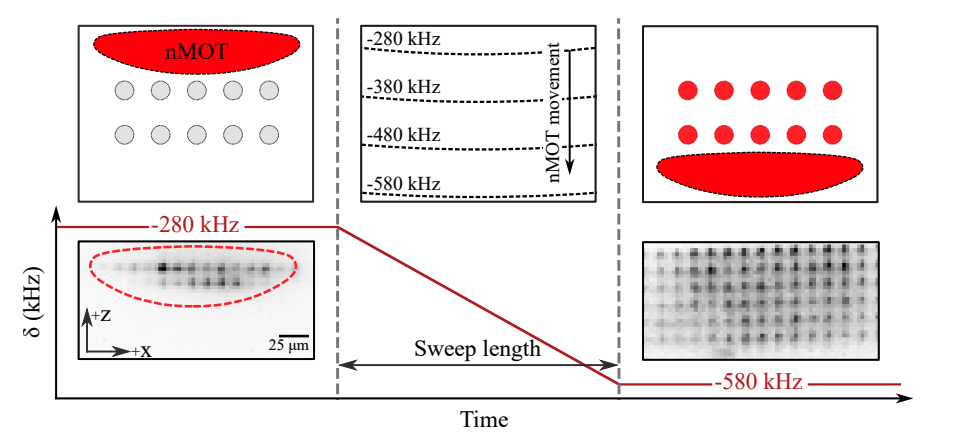
Arrays of neutral atoms held in optical tweezers represent a powerful platform for simulating complex physical systems and achieving precision measurements, but their potential is limited by the number of atoms they can reliably contain. Researchers Mitchell J. Walker, Ryuji Moriya, and Jack D. Segal, all from Durham University, alongside colleagues, now demonstrate a technique to expand the scale of these arrays significantly. Their method, termed ‘painted loading,’ involves sweeping the frequency of the cooling light to effectively ‘paint’ atoms across a larger area, creating arrays exceeding 100 μm in height —more than three times larger than those created using conventional methods. This advance promises to unlock new possibilities for exploring complex quantum phenomena and building more powerful quantum technologies by enabling the creation of substantially larger and more versatile atomic arrays.
Neutral Atom Arrays for Quantum Computing
Researchers are actively exploring neutral atom arrays as a promising platform for quantum computing and precision measurement. These systems utilize individual atoms, trapped and controlled by focused laser beams, to create scalable quantum registers. Recent advances focus on expanding the size and control of these arrays, paving the way for more complex quantum simulations and computations. Theoretical studies complement experimental work, providing insights into the fundamental physics governing these atomic arrays and guiding the development of new control strategies.
Painted Loading Expands 2D Atomic Arrays
Researchers engineered a novel method, called painted loading, for loading large two-dimensional arrays of strontium-88 atoms into optical tweezers. This approach significantly expands the spatial extent of loaded arrays, achieving heights exceeding 100 μm, more than three times the height attainable with static reservoir loading. The method begins with establishing a narrow-line cooled atomic reservoir positioned above the tweezer array. Scientists precisely control the detuning of the cooling light, effectively shifting the position of the atomic reservoir and moving atoms across the array to load individual tweezer sites.
By carefully adjusting the speed and shape of this frequency sweep, researchers demonstrate control over the distribution of atoms, creating arrays that are uniformly, non-uniformly, or selectively loaded. Experiments employ a high vacuum environment and utilize a liquid-crystal spatial light modulator to create and position the optical tweezers. The team validated their approach with a rate equation model, finding good qualitative agreement between the model predictions and experimental data. This model reveals that the interplay between the ramp speed of the frequency sweep and trap loss mechanisms governs the loading process, delivering a significant improvement in loading efficiency and array size for quantum simulation and precision metrology.
Expanded Tweezer Arrays Enable Larger Simulations
Researchers have developed a technique to significantly expand the scale of tweezer arrays used for manipulating neutral atoms, achieving a breakthrough in quantum simulation and metrology. By sweeping the frequency of cooling light, the team effectively moved a reservoir of strontium-88 atoms across the array during the loading process, enabling the creation of arrays exceeding 100 μm in height, more than three times larger than previously achievable with static loading methods. This innovative approach overcomes limitations imposed by the narrow spatial extent of conventional magneto-optical traps. Experiments reveal precise control over atom distribution within the array, allowing scientists to create uniformly loaded arrays, non-uniformly loaded arrays, and arrays with selectively populated regions, crucial for tailoring arrays to specific experimental requirements in quantum computing and simulation.
The team achieved an average temperature of 1. 49 μK across the expanded arrays, demonstrating the method’s ability to maintain low temperatures essential for preserving quantum coherence. A rate equation model developed by the researchers confirms that the underlying physics involves a delicate balance between the speed of the frequency sweep and trap loss mechanisms, providing valuable insight into the loading process and paving the way for advancements in precision measurement and quantum information processing.
Painted Loading Creates Scalable Atom Arrays
This work introduces painted loading, which provides full control over the distribution of atoms within large optical tweezer arrays. Researchers successfully demonstrated the creation of arrays with uniform atom numbers, linearly varying densities, and selectively loaded regions, exceeding the size of conventionally loaded arrays by a factor of three in height. The method involves sweeping the frequency of cooling light to move a reservoir of atoms across the array, enabling precise control over atom placement. The team characterised key parameters influencing loading efficiency, including atomic lifetimes and the rate of the frequency sweep, and incorporated these into a rate equation model that accurately reproduced experimental observations.
This model provides a foundation for future optimisation, potentially leveraging machine learning to further enhance array size, loading speed, and control over individual site occupancy. While demonstrated with strontium atoms, the technique is expected to be readily applicable to other species commonly used in neutral atom experiments. Future research will focus on extending this technique to three-dimensional arrays and single-atom arrangements, promising even greater gains in the number of available sites for quantum simulation and metrology.
🗞 Painted loading: a toolkit for loading spatially large optical tweezer arrays
🧠 ArXiv: https://arxiv.org/abs/2509.03473