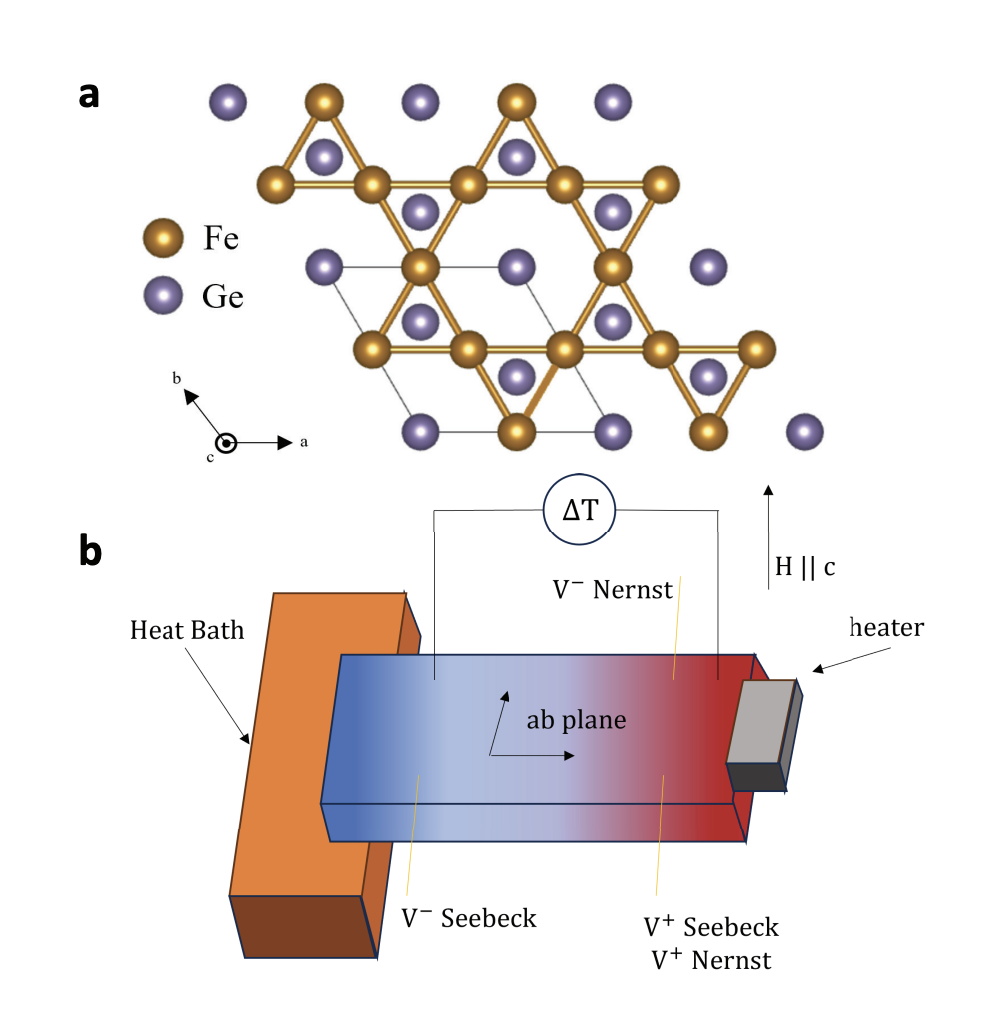
Kagome metals represent a fascinating frontier in materials science, offering a unique platform to investigate novel electronic behaviours, and researchers are increasingly focused on the charge density wave (CDW) phenomenon within these materials. Kaila Jenkins, Yuan Zhu, Dechen Zhang, and colleagues at the University of Michigan now present compelling thermoelectric evidence of how electronic structure changes accompany the CDW transition in the kagome metal FeGe. Their work addresses a significant gap in the field by directly linking thermoelectric signals to the emergence of the CDW, revealing modifications in electron behaviour and electrical transport properties. The team demonstrates that the CDW transition influences thermal properties and can be suppressed by introducing disorder into the material, offering valuable insights into controlling and manipulating these correlated electron systems.
Kagome Metals and Correlated Quantum Phenomena
Kagome metals represent a promising platform for investigating novel quantum phenomena, owing to their unique electronic structure characterized by linear dispersions, flat bands, and Van Hove singularities. A key feature observed in these materials is the charge density wave (CDW), a distortion of the lattice structure arising from the collective motion of correlated electrons. This distortion lowers the material’s overall energy, creating an energy gap that can give rise to behaviours resembling superconductivity, nonlinear transport, and other quantum correlated effects. Specifically, the kagome metal FeGe exhibits a CDW transition, prompting researchers to investigate its properties further.
Berry Curvature and Anomalous Nernst Effect Mechanisms
Research consistently explores the anomalous Nernst effect (ANE), a transverse thermoelectric effect arising from the interplay of spin-orbit coupling and broken time-reversal symmetry, often due to magnetism. This effect differs from the ordinary Nernst effect, which occurs in all materials due to temperature gradients. Several studies delve into the underlying mechanisms driving the ANE, highlighting the importance of the Berry curvature of the electronic band structure, particularly in topological materials. A recurring theme is distinguishing between intrinsic, band structure-related contributions, and extrinsic, scattering-related contributions to the ANE.
Researchers also investigate the role of disorder and scattering, with some suggesting that disorder can enhance the ANE by increasing asymmetry in scattering. Investigations cover a wide range of materials, including Kagome materials such as FeGe, and topological materials like MnBi4Te7. Heusler alloys, like Co2MnGa, are also studied. A major goal is to maximize the ANE for potential thermoelectric applications, achieved through material design, compositional tuning, strain engineering, and strategic disorder control. The relationship between disorder and the ANE is complex, with disorder sometimes suppressing the effect, but also potentially enhancing it through increased scattering asymmetry. The ANE is often linked to other phenomena, such as the anomalous Hall effect, charge density waves, and topological properties, ultimately aiming to develop new thermoelectric materials with improved efficiency.
Enhanced Nernst Effect Signals Charge Density Wave
Researchers have uncovered compelling evidence of modified electron behaviour in the kagome metal FeGe, linking changes in its electronic structure to the emergence of a charge density wave (CDW). This work addresses a gap in understanding FeGe, as previous studies lacked clear thermoelectric evidence connecting the CDW transition to alterations in its thermal properties. The team demonstrated that FeGe exhibits a strong Nernst effect and a distinct feature in thermopower measurements, confirming the presence of a CDW and its influence on the material’s behaviour. Notably, the researchers discovered multiple phase transitions, confirming the CDW’s influence on the thermal characteristics of FeGe and demonstrating that this order can be suppressed by introducing disorder into the material.
Samples annealed at different temperatures exhibited varying degrees of CDW order, confirmed by X-ray diffraction. These findings demonstrate a clear link between the CDW and the thermal properties of FeGe, and importantly, show that introducing disorder can effectively suppress the CDW. This discovery opens new avenues for exploring the interplay between charge order, magnetism, and thermal transport in kagome materials, potentially leading to the development of novel thermoelectric materials with enhanced performance and unique properties.
Disorder and Charge Density Wave Effects
This research demonstrates significant changes in the electronic structure of the Kagome metal FeGe, linked to the formation of a charge density wave (CDW). Through thermoelectric measurements, the team observed a dramatic enhancement of the Nernst effect and a change in the dominant charge carrier in samples exhibiting a CDW transition. These findings provide evidence that the CDW influences the thermal properties of FeGe and can be suppressed by introducing disorder into the material. The study also detected multiple phase transitions, aligning with previously reported magnetic behaviour and supported by observations of changes in the electronic structure. Importantly, the results suggest that disorder created during sample preparation can inhibit CDW formation, offering potential for tuning the material’s properties.
🗞 Thermoelectric evidence of the electronic structure changes from the charge-density-wave transition in FeGe
🧠 ArXiv: https://arxiv.org/abs/2508.19116