

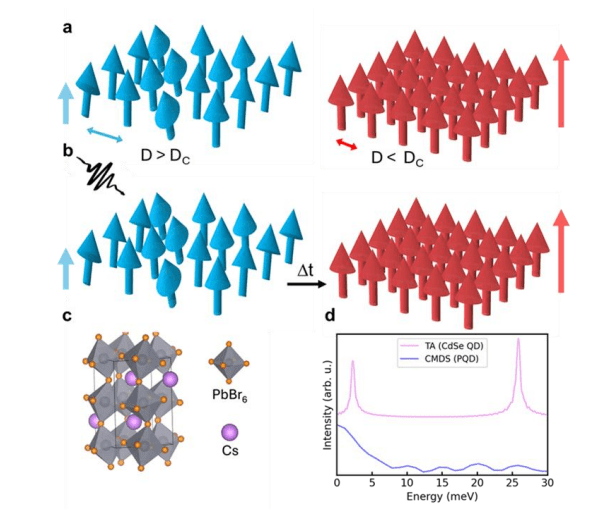
The spontaneous and coordinated release of light, known as superfluorescence, typically describes an outward burst of energy, but recent work demonstrates this process can be reversed within certain materials. Arnab Ghosh, Patrick Brosseau, and colleagues from McGill University, alongside Dmitry N. Dirin, Maksym V. Kovalenko, and others at ETH Zürich, now reveal evidence of a delayed, cooperative absorption of light, effectively a time-reversed version of superfluorescence. Their experiments with halide perovskite dots show that this unusual effect arises from transient fields created by lattice polarons, which precisely align the light-absorbing units within the material, achieving remarkable coherence even at room temperature. This discovery demonstrates the potential for self-organising, collective quantum states and paves the way for the development of novel devices capable of exceptionally efficient light absorption.
Cooperative burst of spontaneous emission arises when microscopic oscillators spontaneously synchronise their phases. This research demonstrates that this process can be reversed in time within quantum materials. Coherent multidimensional spectroscopy of halide perovskite quantum dots reveals a delayed cooperative absorption burst, driven by transient polaron fields that phase-lock unit-cell dipoles within 100 femtoseconds. The effect scales systematically with quantum-dot size and halide composition, reaching near-unity coherence fidelity even at 300 K. A microscopic exciton-polaron model reproduces the buildup and decay of the coherent state.
Exciton-Polarons in Perovskite Nanocrystals Observed
This research details the experimental and theoretical underpinnings of investigations into exciton-polarons in perovskite nanocrystals, focusing on coherent multi-dimensional spectroscopy and the observation of cooperative quantum phenomena. The central theme is the interaction between excitons, electron-hole pairs, and phonons, lattice vibrations, within perovskite nanocrystals, creating exciton-polarons, quasiparticles with modified properties. Coherent multi-dimensional spectroscopy, specifically 2D Electronic Spectroscopy, maps the coherent evolution of electronic states, revealing couplings between states and exciton-phonon interactions. Researchers used a modified Kuramoto model to describe the collective behavior of the exciton-polarons, adapting a model originally developed for coupled oscillators to explain their synchronization and resulting cooperative emission.
The key finding is that exciton-polarons can synchronize their oscillations, enhancing emission at the single-particle level. Researchers developed methods to mitigate interference and extract the true coherent signals. The team observed a delayed, cooperative emission component in the 2D spectra, attributing it to the synchronization of exciton-polarons, with strength dependent on nanocrystal size and composition. This work provides a detailed understanding of exciton-polaron interactions in perovskite nanocrystals. The observation of cooperative emission at room temperature is significant, opening possibilities for new quantum technologies. Perovskite nanocrystals are a tunable platform for exploring cooperative quantum phenomena, allowing researchers to tailor exciton-polaron properties and optimize cooperative emission. This research could lead to new light-emitting devices, quantum sensors, and other quantum technologies.
Delayed Absorption Mirrors Superfluid Emission
Scientists have demonstrated a time-reversed process mirroring superfluorescence, achieving delayed cooperative absorption within ensembles of perovskite quantum dots. Using coherent multidimensional spectroscopy, the team directly observed an ultrafast cooperative absorption burst, unfolding within 50 to 100 femtoseconds, that represents the absorption counterpart to superfluorescent emission. This breakthrough reveals that the process involves a collective uptake of energy gated by transient polaron fields which synchronize unit-cell dipoles. Experiments show systematic size and composition dependence across CsPbBr3 and CsPbI3 quantum dots, with the observed effect reaching coherence fidelities approaching 99% even at room temperature.
The research demonstrates that this delayed absorption arises from the alignment of microscopic dipoles into a coherently phased array, driven by transient polaronic lattice polarization. A microscopic exciton-polaron model quantitatively reproduces both the formation and dephasing of this coherent state, confirming lattice polarons as key mediators of dipole synchronization. Measurements confirm that the observed absorption is not a prompt single-particle response, but a collective phenomenon arising from many-body phase alignment. The work establishes a lattice-driven pathway to ultrafast many-body coherence, opening possibilities for superabsorbing quantum devices, ultrafast memories, and the engineering of novel coherent photonic states. This achievement represents the first real-time observation of the cooperative absorption conjugate to superfluorescence, confirming a long-anticipated theoretical prediction.
Delayed Absorption via Polaron Phase Locking
Researchers have demonstrated a surprising reversal of time within materials, observing a delayed cooperative absorption of light in halide perovskite dots. This effect, mirroring the well-known phenomenon of superfluorescence, reveals that these dots can absorb light in a coordinated manner after initial excitation. The team achieved this by employing a sophisticated spectroscopic technique to track the flow of energy within the dots, revealing a coherence that persists at room temperature and scales with the size and composition of the material. The research identifies lattice polarons, self-trapped vibrations within the material, as the key to this synchronization.
These polarons effectively phase-lock the individual dipoles within the dots, enabling the collective absorption process. The team’s microscopic model accurately predicts the observed buildup and decay of this coherent state, distinguishing perovskite materials from conventional semiconductors like cadmium selenide. Quantitative analysis, based on Raman spectroscopy and multidimensional spectroscopy, allowed the researchers to extract key material parameters. The authors acknowledge that the observed coherence is sensitive to temperature and material imperfections. Future work will focus on exploring strategies to enhance and stabilize this effect, potentially leading to the development of new devices capable of super-absorption or engineered collective states of light and matter. The team’s findings provide a fundamental understanding of how materials can organize and sustain coherence at room temperature, opening avenues for advanced optical technologies.
👉 More information
🗞 Time-Reversed Superfluorescence in a Polaronic Quantum Material
🧠 ArXiv: https://arxiv.org/abs/2511.02678