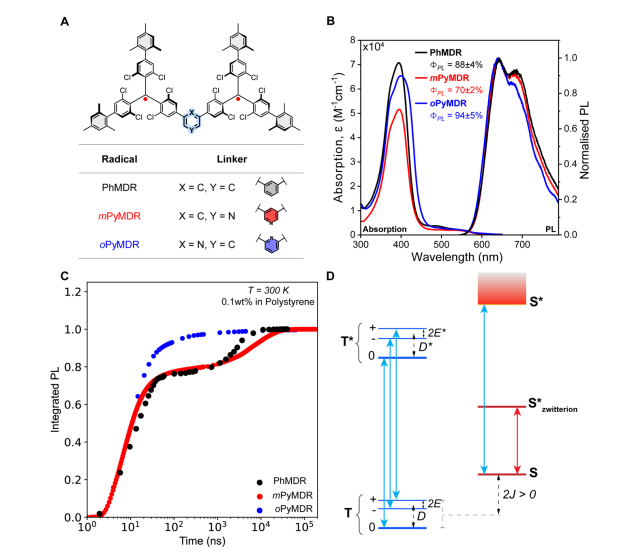
The pursuit of materials that combine light-based control with magnetic properties represents a significant challenge in modern physics and chemistry, and researchers are now reporting a breakthrough in this area. Rituparno Chowdhury from the University of Cambridge, Alistair Inglis from the University of Glasgow, and Lucy E. Walker, along with colleagues, demonstrate that a newly designed family of organic molecules exhibits both strong luminescence and the ability to control their spin states using light at room temperature. This achievement overcomes a major hurdle, as most materials requiring spin control operate at extremely low temperatures, and the team’s work establishes a new platform for chemically tunable, room-temperature spin-optical interfaces with potential applications in advanced sensing technologies. The molecules, based on interconnected trityl groups, uniquely support both bright light emission and a clear response to optical control of their magnetic properties, opening exciting possibilities for future device development.
Dinuclear Zinc Complexes, Luminescence and Slow Magnetism
Scientists have created a series of luminescent molecules that also exhibit slow magnetic relaxation, a key characteristic of single-molecule magnets. These dinuclear zinc complexes incorporate a tetraphenylethylene ligand, providing a rigid structure that enhances luminescence. The team systematically modified the ligand structure to fine-tune the electronic and steric environment surrounding the zinc ions, allowing precise control over the magnetic and optical properties. Detailed characterisation confirmed the compounds’ behaviour as single-molecule magnets. Measurements reveal antiferromagnetic interactions between the zinc ions, crucial for achieving slow magnetic relaxation at low temperatures. Luminescence spectroscopy demonstrates strong emission from the tetraphenylethylene ligand, and a correlation between luminescence duration and magnetic relaxation speed was observed. This work introduces a new class of luminescent single-molecule magnets, demonstrating a direct link between luminescence and magnetism, and establishes a clear pathway for designing single-molecule magnets with tailored properties by exploiting this interplay.
Triplet Diradicals and Diamond Quantum Sensing Platforms
This research explores organic triplet diradicals as potential building blocks for quantum sensors and qubits. Scientists are investigating materials that can hold quantum information for extended periods, crucial for practical quantum technologies, and are exploring hexagonal boron nitride, diamond with nitrogen-vacancy centres, silicon carbide, and proteins like cryptochrome as platforms to host these spin-based quantum systems. The team employs advanced techniques to characterise these materials and control their quantum states. Electron paramagnetic resonance and optically detected magnetic resonance are fundamental tools used to study the diradicals’ spin properties, with the latter allowing scientists to read out the quantum state using light. Time-resolved and photoluminescence spectroscopy are used to understand the dynamics and lifetimes of the triplet states, while scanning confocal microscopy and magnetic resonance force microscopy allow imaging and detection of magnetic fields at the nanoscale. Computational modelling complements the experimental work, simulating the electronic structure and properties of the materials.
Organic Diradicals Exhibit Strong Spin-Optical Control
Scientists have achieved room-temperature control of spin states in a new family of organic diradicals, demonstrating clear optically detected magnetic resonance and magneto-photoluminescence. These diradicals, composed of trityl groups linked by pyridyl or phenyl groups, possess a stable spin-triplet ground state and exhibit near-unity photoluminescence yields, enabling bright optical transitions. Experiments reveal a strong magneto-photoluminescence response, with a 10% modulation of luminescence intensity achieved with only a 2 millitesla applied magnetic field. By spectrally filtering the emitted light, scientists enhanced the optically detected magnetic resonance contrast by a factor of eight. Further investigation using magneto-photoluminescence revealed a 3 to 4-fold increase in contrast through spectral filtering, with the luminescence changing by 10% within 2 millitesla. Transient photoluminescence studies show that these diradicals exhibit a prompt component peaking at 640 nanometers with a lifetime of approximately 10 nanoseconds, evolving into a 700 nanometer-peaked spectrum that persists for over 100 microseconds.
Room-Temperature Spin-Optical Control with Diradicals
This research demonstrates a new family of organic molecules exhibiting bright luminescence and unique magnetic properties at room temperature. These diradicals, incorporating trityl groups linked via pyridyl or phenyl groups, support a stable spin-triplet ground state and achieve near-unity photoluminescence yields. Importantly, the team observed optically detected magnetic resonance and significant magneto-photoluminescence, indicating a strong interaction between light and the molecules’ spin state. These findings establish a new platform for room-temperature spin-optical interfaces with chemically tunable properties, offering potential applications in sensing technologies. The observed sensitivity to low magnetic fields, comparable to that found in avian navigation, suggests potential for biomimetic sensor development. This work represents a significant advance in the field of organic optoelectronics and lays the groundwork for novel spin-based devices.
🗞 Room temperature optical control of spin states in organic diradicals
🧠 ArXiv: https://arxiv.org/abs/2510.09440