The detection of single microwave photons presents a significant challenge in quantum technologies, and researchers are continually seeking more efficient and faster methods. Julien Basset, Ognjen Stanisavljević, and Julien Gabelli, alongside Marco Aprili and Jérôme Estève at Université Paris-Saclay and the CNRS, have now developed a detector capable of fast and continuous single-photon counting in the microwave domain. Their innovative approach relies on monitoring charge changes on a superconducting island caused by the arrival of individual photons, achieving ten percent detection efficiency with sub-50 nanosecond timing resolution and a remarkably short dead time of one microsecond. This advancement, enabled by enhanced light-matter coupling within a specially designed resonator, promises to unlock new possibilities in quantum sensing, microwave quantum optics, and the exploration of mesoscopic phenomena.
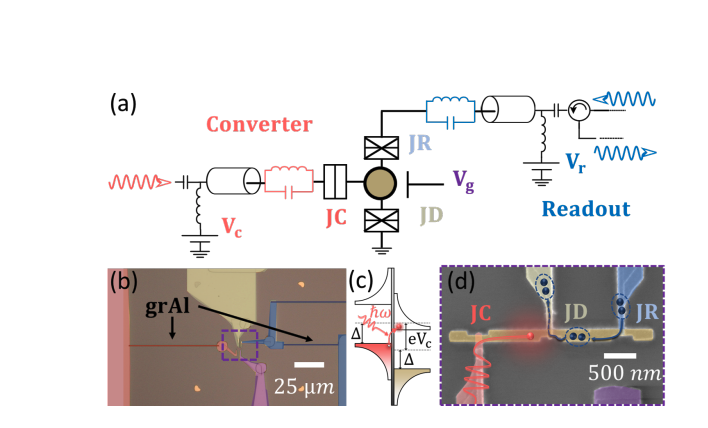
The detection process continuously monitors the island’s charge parity using microwave reflectometry, a technique that reveals changes in the island’s electrical state. This scheme achieves 10% detection efficiency with sub-50 nanosecond time resolution and a short dead time of approximately 1 microsecond, for microwave photons at 10GHz. The detector features three junctions connected to a superconducting island, which together convert incoming photons into measurable electrical signals and read out the resulting charge. Enhanced light-matter coupling, crucial to photon to quasiparticle conversion, is provided by a granular aluminum-based high-impedance structure, optimising the interaction between light and the detector material.
Microwave Photon Detection via Quasiparticle Tunneling
The research team engineered a novel single-photon detector operating in the microwave domain, based on photo-assisted quasiparticle tunneling events that alter the charge state of a superconducting island. This detector relies on continuous monitoring of the island’s charge parity using microwave reflectometry, a technique that precisely measures the quantum state of the system. The study pioneered a method for achieving 10% detection efficiency with sub-50 nanosecond time resolution and a short dead time of one microsecond, crucial for capturing fleeting microwave photons at 10GHz. The detector’s architecture features three junctions connected to a superconducting island, working in concert to convert photons into quasiparticles and read out the resulting charge.
Enhanced light-matter coupling, essential for efficient photon-to-quasiparticle conversion, is provided by a granular aluminum-based high-impedance microwave resonator, carefully designed to maximize interaction between light and the detector material. The team developed a sophisticated method for extracting charge parity by analyzing the phase rotation encoded onto a single quadrature of the microwave signal, constructing histograms that reveal distinct peaks corresponding to even and odd charge states. Experiments involved sending pulses containing a controlled number of photons onto the detector input, just before a readout pulse, and observing the resulting changes in charge parity. The detection probability, defined as the change in odd-state probability, exhibited distinct steps separated by energy quanta, confirming the occurrence of photo-assisted tunneling processes involving the absorption of one, two, or three photons.
At low photon numbers, the detector demonstrated a linear response, yielding a detection efficiency of 8. 6%, which translates to an estimated quantum efficiency of 13. 5% after accounting for various factors.
Microwave Photon Detection with Nanosecond Resolution
Scientists have developed a single-photon detector operating in the microwave domain, achieving 10% detection efficiency with sub-50 nanosecond time resolution and a short dead time of 1 microsecond for microwave photons at 10GHz. The detector utilizes photo-assisted quasiparticle tunneling events to detect photons, monitoring the charge parity of a central island using microwave reflectometry. This innovative device incorporates three junctions connected to the island, enabling both photoelectric conversion and charge readout, and employs a granular aluminum-based high-impedance microwave resonator to enhance light-matter coupling. Experiments reveal that the detector operates in the Cooper pair box regime, maximizing readout speed and self-resetting to an even-parity state within 1 microsecond.
By carefully tuning readout power and integration time, researchers balanced detection efficiency and minimized dark counts, observing Coulomb diamonds with a period corresponding to a 2e change in island charge. Analysis of these diamonds estimates the charging energy of the device to be approximately 20 microelectronvolts. The team demonstrated a transition from 2e to e-periodic gate modulation as the converter bias approached the superconducting gap, indicating the onset of quasiparticle poisoning. Further tests show that the detector responds to individual photons, with the probability of detecting a photon, measured as the change in charge parity, increasing sharply around 370 and 400 microvolts.
This step-like increase corresponds to the absorption of one, two, and three photons, confirming the photo-assisted tunneling process. Measurements demonstrate a readout error probability of approximately 0. 1, and the team successfully calibrated the number of photons per pulse, enabling precise detection probability measurements.
Microwave Single-Photon Detection With High Resolution
This research demonstrates a novel single-photon detector operating in the microwave domain, achieving 10% detection efficiency with sub-50 nanosecond time resolution and a short dead time of one microsecond for 10GHz microwave photons. The detector functions by monitoring charge parity on a superconducting island using microwave reflectometry, a technique enhanced by a high-impedance resonator that facilitates efficient photon-to-quasiparticle conversion. The team successfully implemented a Viterbi algorithm to accurately determine the charge parity of the island, crucial for identifying photon events, and demonstrated the detector’s performance across a range of temperatures.
Analysis revealed a detection efficiency of 56% and a residual population of quasiparticles, providing insights into the detector’s underlying mechanisms. While the current detection efficiency stands at 10%, the authors acknowledge this represents a significant step towards more sensitive microwave photon detection. Future work will likely focus on improving the efficiency and reducing noise, potentially through optimization of the resonator design and materials, to further enhance the capabilities of this innovative detector.
🗞 Fast and Continuous Detection of Single Microwave Photons via Photo-assisted Quasiparticle Tunneling to a Superconducting Island
🧠 ArXiv: https://arxiv.org/abs/2511.17470