

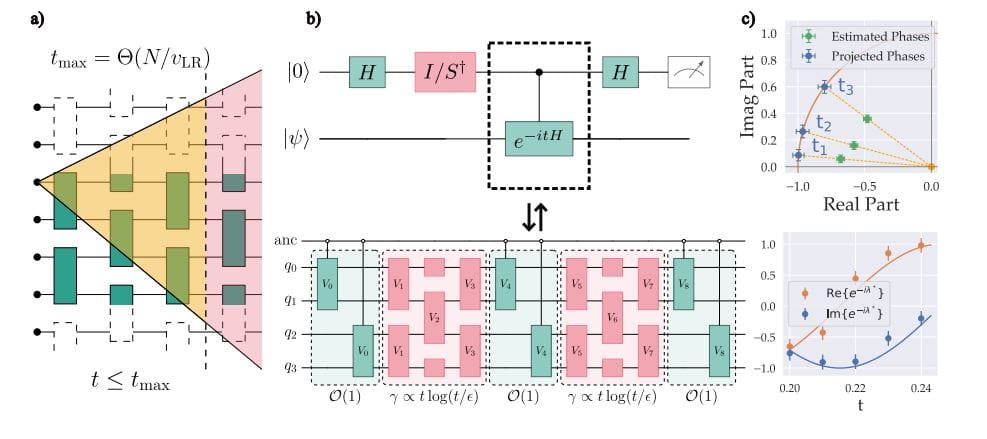
Simulating the behaviour of complex physical systems demands efficient methods for tracking how systems change over time, a process known as controlled time evolution, which often limits the speed of these simulations. Erenay Karacan from ETH Zurich and colleagues now present a new compression technique that dramatically reduces the computational resources needed for this crucial step. The team’s method encodes the evolution of systems with repeating patterns, such as those found in materials science, into quantum circuits with significantly less complexity, achieving a near-optimal reduction in circuit depth and control requirements. This breakthrough enables the accurate simulation of previously intractable systems, demonstrated by the successful implementation of Iterative Phase Estimation on a frustrated spin system with errors below one percent, and opens the door to exploring more complex quantum phenomena using near-term quantum computers.
Pauli Twirling And Error Characterisation
Quantinuum’s System Model H2 benefits from detailed analysis of noise and the development of techniques to mitigate its effects on quantum computations. Researchers investigate various error models to accurately characterize and predict potential errors within the system, employing Pauli twirling, a technique averaging over random Pauli operators, to understand and potentially reduce the impact of noise. Quantinuum provides powerful emulators for the H2 system, allowing scientists to simulate quantum circuits and rigorously test error mitigation strategies before implementation on actual hardware. Several error mitigation techniques are employed, including randomized compiling and group twirling, both methods for characterizing and mitigating noise, and noise tailoring, which optimizes quantum gates and circuits for resilience to specific noise profiles.
The team is actively pursuing real-time fault-tolerant quantum error correction, a significant step towards reliable quantum computation, and exploring techniques like block encoding and fast-forwarding to reduce noise and improve simulation accuracy. Optimization algorithms on matrix manifolds further enhance the performance of quantum algorithms. Achieving high gate fidelity and optimizing quantum circuits to minimize gate count and circuit depth are paramount for reducing error accumulation, and efficiently allocating quantum resources, such as qubits and gates, also contributes to improved algorithm performance. This comprehensive approach, encompassing detailed system modeling, sophisticated error mitigation techniques, emulator-based testing, and the pursuit of full fault-tolerance, positions Quantinuum’s H2 as a leading platform for advancing quantum computation.
Compressing Quantum Simulation Operators for Scalability
Researchers have developed a compression protocol that significantly improves the scalability of quantum simulations by efficiently encoding the controlled time evolution operator of translationally invariant, local Hamiltonians into a quantum circuit. This advancement addresses a key bottleneck in scaling simulations by reducing the control overhead from a multiplicative to an additive factor. The core of this breakthrough lies in leveraging the brickwall Ansatz, a specific arrangement of qubits that approximates the time evolution dynamics of local Hamiltonians, enabling the reuse of optimized gates across larger systems.
This is possible as long as the targeted evolution time remains within a limit determined by the system’s information propagation velocity. Scientists validated this approach using the noisy emulator of Quantinuum’s H2 trapped ion device, achieving ground state energy errors below 1% for a 4×4 triangular lattice and 1. 5% when accounting for hardware noise. A post-processing step renormalizes the estimated phase amplitude, amplifying statistical error bars and incorporating the effects of depolarizing noise, further enhancing accuracy. By fitting measured phases from multiple time points into a phase curve, the team achieved high-accuracy ground state energy estimation using a single ancilla qubit, a key feature of the iterative QPE protocol. This methodology not only reduces the computational cost of quantum simulations but also enhances their robustness against the inherent noise present in current quantum hardware.
Efficient Quantum Simulation of Frustrated Spin Systems
Scientists have developed a new compression protocol for encoding the controlled time evolution operator of translationally invariant, local Hamiltonians into a quantum circuit, achieving near-optimal scaling in circuit depth while significantly reducing control overhead. This work demonstrates a reduction of control overhead from a multiplicative factor to an additive one, representing a substantial improvement in efficiency. Measurements confirm that the protocol delivers ground state energy errors below 1% on a 4×4 triangular lattice, calculated with a hardware noise aware pipeline using Quantinuum’s H2 trapped ion device.
The team achieved sub-percent accuracy in energy estimates, quantifying error bars through detailed analysis, and numerical simulations validate a scaling of the maximal simulation time, demonstrating that circuit depth achieves near-optimal scaling. Researchers addressed the challenge of control overhead by leveraging a key equivalence involving a single ancilla qubit, allowing for controlling the evolution direction without sacrificing accuracy. This approach maintains the translational symmetry crucial for transferring optimized gates to larger systems, enabling simulations of larger systems with negligible increase in approximation error. The locality of the Hamiltonian and the finite propagation speed of operator spreading ensure this transferability, allowing for accurate simulations up to a maximal evolution time.
Translationally Invariant Control Enables Larger Simulations
This research introduces the Translationally Invariant Compressed Control (TICC) protocol, a new method for encoding the controlled time evolution of quantum systems exhibiting translational symmetry. The team demonstrates that TICC significantly reduces the overhead associated with controlled two-qubit gates, achieving scaling close to the theoretical optimum with respect to both evolution time and accuracy. Importantly, the researchers successfully implemented this protocol within a simulation of a trapped ion device, achieving sub-percent errors on a 4×4 lattice, demonstrating its potential for practical application and bringing the possibility of demonstrating quantum advantage closer to realisation. The authors acknowledge that formal proof of convergence for their optimisation protocol is still needed and plan to address this in future research, and intend to verify the protocol’s performance on a wider range of Hamiltonians, including fermionic systems and lattices with increased connectivity. Future work will focus on integrating the compression scheme with hardware possessing more versatile two-qubit gate operations, potentially reducing the number of required hardware operations and enabling simulations on even larger systems.
👉 More information
🗞 Phase Estimation with Compressed Controlled Time Evolution
🧠 ArXiv: https://arxiv.org/abs/2511.21225

