Protecting quantum information from environmental noise remains a central challenge in building practical quantum computers, and researchers continually seek methods to extend the time quantum states retain information, known as coherence time. Lida Sun, Yifang Xu, and Yilong Zhou, along with colleagues at their institutions, demonstrate a new approach to quantum error correction that bypasses the need for complex measurement-based feedback systems. The team implements an autonomous protocol, based on carefully designed drives and engineered dissipation, to stabilise quantum information encoded in a long-lived bosonic mode. This work achieves a significant breakthrough, extending the logical qubit coherence time to surpass that of the best physical qubit in the system, and represents the first experimental realisation of an autonomous quantum error correction scheme that successfully extends coherence beyond a critical performance threshold, paving the way for more scalable and robust quantum computing architectures.
Researchers investigated methods to surpass the limitations imposed by spontaneous emission, which typically degrades the coherence of quantum bits. The team employed a technique involving carefully engineered drives and dissipation to actively stabilise the quantum state, effectively counteracting the natural tendency towards decoherence. This approach allows for coherence times exceeding the timescale of the driving fields, a crucial requirement for implementing complex quantum algorithms and operations.
Autonomous Error Correction via Hamiltonian Engineering
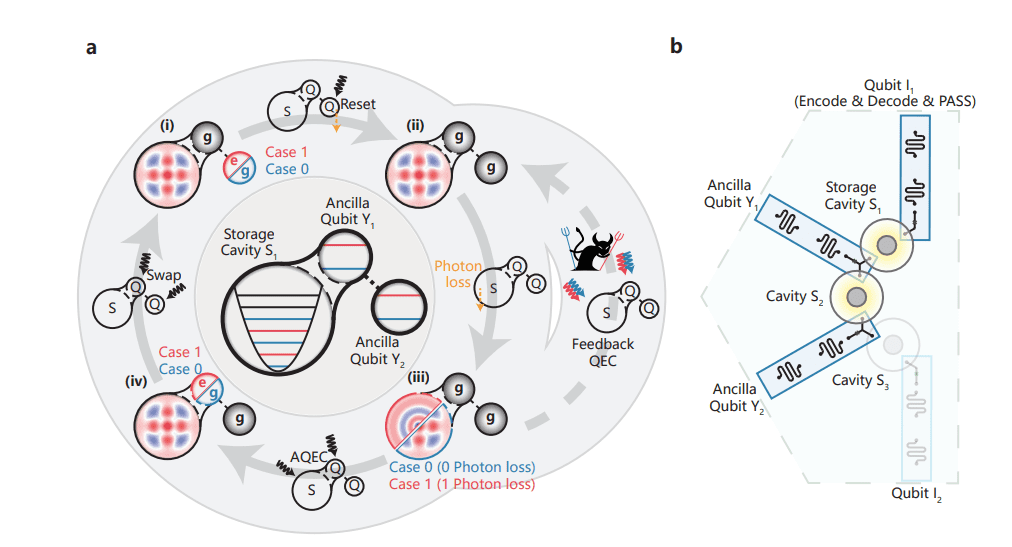
Quantum error correction (QEC) aims to mitigate the loss of quantum information to the environment, a critical requirement for practical quantum computing. Existing QEC implementations heavily rely on measurement-based feedback, however, constraints on readout fidelity, hardware latency, and system complexity often limit both performance and scalability. Autonomous QEC (AQEC) seeks to overcome these obstacles by stabilizing logical codewords using introduced drives that provide coherent control and engineered dissipation. Researchers propose an AQEC protocol, derived from quantum channel simulation, applicable to a variety of noise models and qubit architectures.
The protocol involves designing a Hamiltonian that effectively steers the system towards the error-corrected subspace, suppressing the growth of logical errors. Specifically, the Hamiltonian incorporates terms representing both coherent control and dissipation, carefully balanced to achieve optimal performance. This approach allows for continuous error suppression without the need for repeated measurements and feedback, potentially enabling more scalable and robust quantum computation. The method demonstrates resilience against various noise sources, including depolarizing and dephasing errors, and can be adapted to different qubit technologies, such as superconducting circuits and trapped ions.
Superconducting Qubit Error Correction Progress Demonstrated
This research details progress towards building more stable and reliable quantum computers using superconducting qubits. A central goal is to achieve quantum error correction, essential for creating practical, fault-tolerant quantum computers. Superconducting qubits, while promising, are susceptible to various sources of noise and errors. The research focuses on mitigating these errors through advanced control techniques, improved qubit design, and sophisticated error correction codes. The experiments utilize superconducting transmon qubits fabricated on a chip and controlled using microwave pulses.
Researchers rely on the surface code, a leading quantum error correction code particularly well-suited for implementation on two-dimensional arrays of qubits. The core idea is to encode quantum information into a logical qubit distributed across multiple physical qubits, providing redundancy that allows for the detection and correction of errors. Stabilizer measurements project the state of the logical qubit onto a specific subspace, and any deviation indicates an error. Achieving high-fidelity control over the qubits is crucial for implementing the surface code effectively, requiring precise calibration of microwave pulses and optimization of qubit parameters.
The research emphasizes the importance of precise microwave control and calibration for achieving high-fidelity qubit operations. The superconducting qubits operate at extremely low temperatures to suppress thermal noise. The primary goal is to demonstrate improved performance of logical qubits encoded using the surface code, measured by metrics such as logical error rate and coherence time. Increasing the code distance, a parameter determining the error correction capability of the surface code, improves performance. This research is a significant step towards building practical, fault-tolerant quantum computers, paving the way for more complex quantum computations. The techniques and insights developed will be valuable for other quantum computing platforms as well, as the ability to correct errors is essential for scaling up quantum computers to solve real-world problems.
Bosonic Qubit Exceeds Coherence Break-Even Point
This research demonstrates the first experimental realization of a bosonic logical qubit protected by autonomous quantum error correction, exceeding a critical performance threshold known as the break-even point. By employing a protocol inspired by quantum channel simulation, the team successfully extended the coherence time of the logical qubit to surpass that of the best physical qubit within the system, a significant achievement in quantum information processing. This was accomplished through the introduction of carefully engineered drives and dissipation, representing a departure from traditional measurement-based error correction techniques. The implemented autonomous quantum error correction protocol proves broadly applicable, being designed for use with arbitrary quantum error correction codes and successfully demonstrated with a binomial code encoded in a long-lived bosonic mode.
A key innovation lies in the separation of error correction and qubit reset processes, enhancing experimental performance and offering greater flexibility in implementation. Analysis of the system reveals that the primary sources of error currently stem from the limited coherence of the transmon qubits and residual photon loss, indicating clear pathways for future improvement. Researchers acknowledge that further advancements will require enhanced control over qubit errors and the development of universal control of bosonic modes to raise gate fidelities. Future work includes integrating additional error correction gates designed to address higher-order photon-loss events and extending the approach to higher Fock state dimensions, potentially enabling adaptation to a wider range of quantum error correction codes and qudit encodings. The close agreement between theoretical predictions and experimental results confirms the potential of this approach as a hardware-efficient path toward fault-tolerant quantum computation, marking substantial progress in the field and accelerating the development of large-scale, universal quantum computers.
👉 More information
🗞 Extending coherence time beyond break-even point using only drives and dissipation
🧠 ArXiv: https://arxiv.org/abs/2509.22191