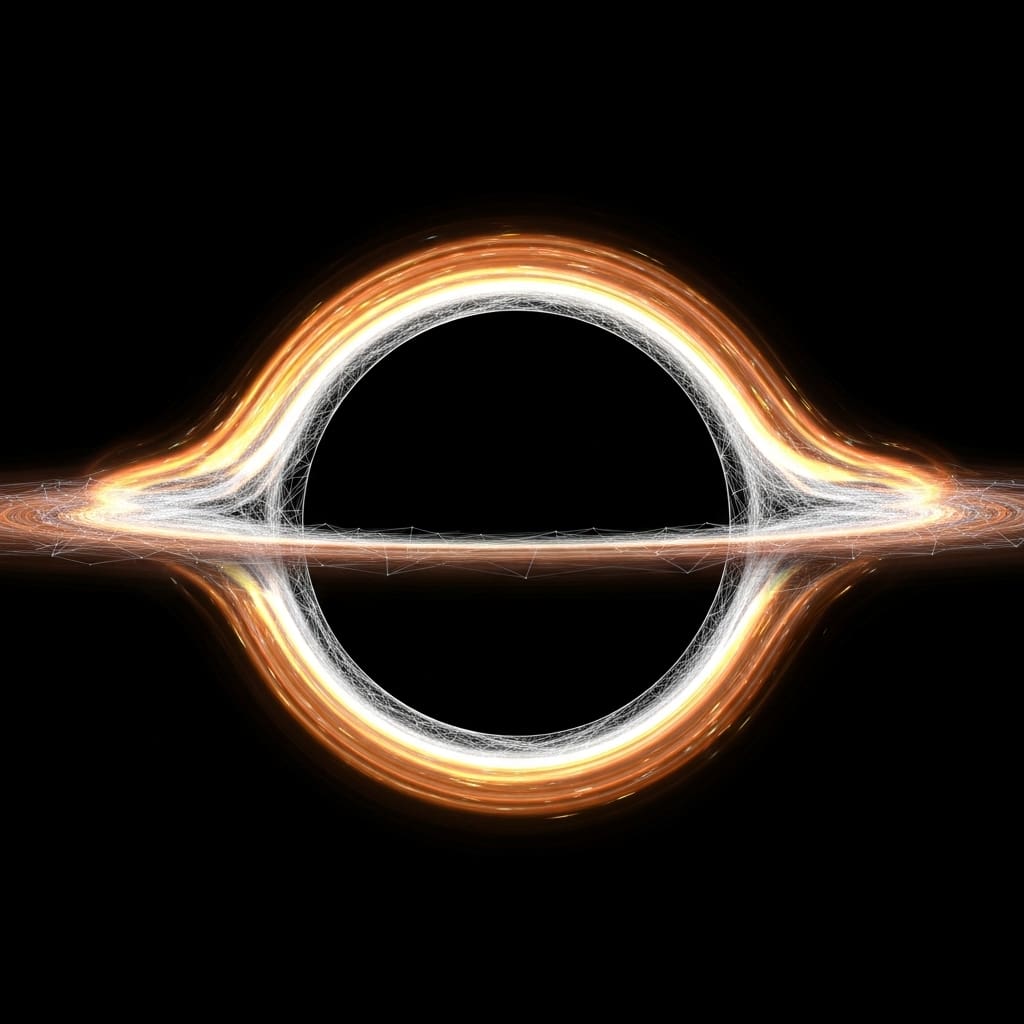
Understanding the shadow cast by a rotating, or Kerr, black hole is fundamental to testing Einstein’s theory of general relativity and interpreting observations from the Event Horizon Telescope. Arseny Pantsialei of the Institute of Physics, Maria Curie-Skłodowska University, along with co-authors, now present a novel mathematical formula to rapidly and accurately calculate the equivalent diameter of this shadow. This ‘surrogate’ model bypasses computationally expensive numerical simulations, instead relying on a compact polynomial expression to determine shadow size based on black hole spin and viewing angle. Achieving sub-percent accuracy across a wide range of parameters, this development promises to significantly accelerate parameter inference in black hole astrophysics and facilitate swift comparisons between theoretical models and observational data. The resulting equation offers a powerful tool for researchers seeking to unlock the secrets hidden within the darkness surrounding these enigmatic objects.
Kerr Black Hole Precession Surrogate Model Development
The research focused on developing a highly accurate surrogate model for gravitational wave dephasing due to the precession of Kerr black holes. This model aims to efficiently predict the precession frequency and phase evolution, crucial for parameter estimation in gravitational wave astronomy. The approach combines a leading-order analytical result for the equatorial branch with a compact 15-parameter polynomial correction to capture the remaining inclination dependence. Coefficients within this polynomial are determined using ordinary least squares regression on a deterministic reference grid derived from the Kerr critical curve area.
Across the practical domain of dimensionless spin parameter a∗ ∈ [0, 0.998] and inclination i ∈ (0◦, 90◦], with the polar point handled analytically, the surrogate achieves sub-percent accuracy. Evaluation on the training grid reveals a median absolute percent error of 0.0105%, with a maximum error of 0.782%.
Further validation on a denser, out-of-sample dataset, including inclinations down to 0.5◦, demonstrates a median error of 0.023%, a 95th-percentile error of 0.471%, and a worst-case error of 0.471%.
Black Hole Shadow Size Estimation Technique
The size of a black hole’s shadow is fundamentally determined by its geometry, specifically the paths of photons orbiting the black hole before escaping its gravitational pull. Researchers have focused on developing a method to quickly estimate the shadow size without relying on computationally intensive numerical ray tracing, which is crucial for analysing large datasets and comparing different models. The ability to rapidly assess shadow size is becoming increasingly important as next-generation arrays aim to resolve finer details like the photon ring and account for effects like Faraday rotation.
The study centres on the Kerr family of black holes and introduces a normalised size observable, denoted as y(a,i), representing the equivalent diameter Deq divided by 6√3M, effectively scaling lengths in units of the black hole’s mass M. This normalisation simplifies analysis and allows for a focus on the intrinsic properties of the shadow, with y approaching 1 in the Schwarzschild limit where the black hole is not rotating (a approaches zero). The primary goal is to create an accurate, closed-form approximation for y(a,i) across a range of spin parameters (a) and viewing inclinations (i), enabling efficient evaluation of shadow size across parameter grids. The methodology leverages the known behaviour of the Kerr shadow, particularly its well-defined limit when viewed face-on (i approaching zero).
In this scenario, the critical curve becomes exactly polar, providing a precise reference point for the approximation. The researchers developed an expression that achieves fast evaluations of the shadow size, with reported accuracy of 1.64%, avoiding the need for repeated numerical ray tracing. This is achieved through a mathematical formulation that captures the relationship between the black hole’s spin, viewing angle, and resulting shadow diameter. This surrogate model focuses solely on the geometry of the Kerr critical curve, acknowledging that connecting it to observable image features requires additional astrophysical modelling. While the research acknowledges that deviations from the Kerr metric (such as those involving charge or acceleration) may necessitate full ray tracing, the developed approximation significantly accelerates practical inference tasks. Specifically, it addresses the computational bottleneck of repeatedly evaluating a size summary across dense (a*,i) grids, a common requirement in modern black hole imaging analysis.
Kerr Black Hole Shadow Diameter via Surrogate Model
Scientists have developed a closed-form surrogate model to calculate the equivalent diameter of a Kerr black hole shadow with sub-percent accuracy. The research team focused on defining the diameter as equivalent to the area of the shadow’s critical curve, constructing a model that precisely matches the face-on, or polar, limit by isolating an analytical contribution from the spherical orbit branch. The remaining inclination dependence is then captured by a compact, 15-parameter polynomial within an exponential correction, allowing for rapid and accurate calculations. This breakthrough delivers a fast evaluation of shadow size without the need for computationally intensive numerical ray tracing.
Experiments revealed that, across a dimensionless spin range of 0 to 0.998 and inclinations from just above 0 degrees to 90 degrees, the surrogate achieves remarkable precision. On the training grid, the median absolute percent error was measured at only 0.0105 percent, with the most significant deviation recorded at 0.782 percent.
Further validation on a denser, out-of-sample dataset, including inclinations down to 0.5 degrees, confirmed the model’s robustness, yielding a median error of 0.023 percent, a 95th-percentile error of 0.471 percent, and a worst-case error of 1.64 percent.
These measurements confirm the model’s ability to consistently provide highly accurate results. The resulting expression allows for fast computations of the shadow size, proving convenient for repeated calculations in parameter inference and rapid model comparisons. Scientists determined the coefficients of the model through ordinary least squares applied to a deterministic reference grid generated from the Kerr critical curve area, ensuring reproducibility with independent implementations. The work approximates a single geometric descriptor, the equivalent diameter, and does not attempt to model complex phenomena like radiative transfer or scattering, positioning it as a practical analytic subroutine within broader inference or forward-model pipelines.
Researchers emphasize that the surrogate is not intended to replace full imaging or ray-tracing pipelines when detailed morphology is required, but rather to serve as a geometric component that can be coupled to more complex models. The team acknowledges a limitation: the model cannot fully disentangle spin and inclination, as distinct pairs of these parameters can yield the same equivalent diameter, necessitating supplementary observables for complete analysis. However, the study provides a valuable tool for horizon-scale radio imaging and related fields, offering a fast and accurate method for evaluating a key black hole property.
Kerr Shadow Diameter via Polynomial Surrogate
This work presents a novel closed-form surrogate model for calculating the equivalent diameter of a Kerr black hole shadow, a crucial geometric property often required in astrophysical modelling. By explicitly separating the analytically tractable face-on case, researchers developed a compact polynomial representation, combined with an exponential correction, to accurately capture inclination dependence. This approach avoids the computational expense of numerical ray tracing while maintaining high precision. The resulting surrogate achieves sub-percent accuracy across a broad range of spin parameters and inclinations, with a median absolute error of only 0.
The authors acknowledge that the model’s accuracy is limited by the range of parameters used in the training data, specifically dimensionless spin up to 0.998 and inclinations above a minimal value. Future research could extend the model’s validity to more extreme parameter regimes and explore its application within comprehensive forward models for black hole imaging and parameter estimation, offering a valuable tool for ongoing investigations of these enigmatic objects.
👉 More information
🗞 A Closed-Form Surrogate for the Equivalent Diameter of the Kerr Shadow
🧠 ArXiv: https://arxiv.org/abs/2601.09655