Uncertainty poses a significant challenge to modern energy systems, demanding increasingly sophisticated methods for optimising power grids with fluctuating renewable sources and variable demand. David Ribes and Tatiana Gonzalez Grandon, both from NTNU, investigate how quantum annealing can address this complexity, specifically within the context of the chance constrained unit commitment problem. Their research demonstrates the potential of hybrid quantum-classical solvers to tackle large-scale energy optimisation, achieving competitive performance against conventional methods when dealing with a substantial number of possible future scenarios. While current quantum hardware presents limitations for fully embracing stochastic optimisation, this work identifies specific areas where near-term quantum annealers can already offer a valuable advantage, paving the way for more resilient and efficient energy systems.
This problem involves determining the optimal combination of power generators to activate and their output levels to meet electricity demand over a given period, while minimizing costs. A key difficulty arises from the inherent uncertainty in electricity demand, which researchers model as a random variable. This stochastic element significantly increases the complexity of finding an optimal solution. The team investigated using quantum annealing, a technique that leverages quantum mechanics to find the best solution to complex optimization problems, implemented on D-Wave quantum annealers.
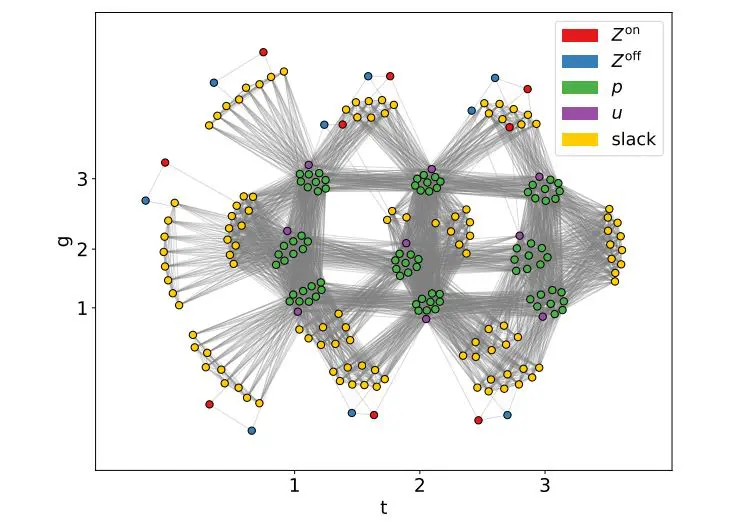
This approach involves translating the UCP into a specific mathematical form, known as a Quadratic Unconstrained Binary Optimization (QUBO) problem, suitable for the D-Wave hardware. This translation requires careful consideration of the hardware’s limitations, including the number of qubits and its specific connectivity structure. The research introduces binary slack variables to convert inequality constraints into equality constraints within the QUBO formulation. Scientists utilize the Chimera or Zephyr topology, the specific connectivity structure of the qubits on D-Wave processors, and employ techniques like the Monte Carlo method and simulated annealing for comparison. The findings demonstrate successful formulation of the stochastic UCP as a QUBO problem and implementation on a D-Wave quantum annealer, addressing the challenges of embedding the QUBO onto the hardware and benchmarking the performance against classical solvers. This work demonstrates the potential of quantum computing to address complex real-world problems, while also highlighting the practical challenges and limitations of current quantum hardware.
Quantum Annealing for Stochastic Power System Planning
Scientists developed a new methodology to assess the applicability of quantum annealing platforms to the chance constrained Unit Commitment Problem, a critical challenge in modern power system planning. The study reformulated the stochastic UCP as a mixed integer linear program, enabling solutions using both a DWave hybrid quantum-classical solver and the classical Gurobi algorithm. Researchers employed a scenario approximation technique, constructing problem instances with a substantial 15,000 scenarios to realistically model uncertainty in renewable generation and fluctuating demand. This large scenario set allowed for a rigorous assessment of computational performance under conditions representative of real-world power systems.
The team systematically compared the performance of the hybrid solver and Gurobi, establishing that Gurobi remained superior for smaller problem instances. However, under strict runtime limits, the hybrid solver proved competitive when addressing the large scenario sets, demonstrating its potential for tackling computationally demanding problems. Scientists also investigated Quadratic Unconstrained Binary Optimization (QUBO) reformulations, a standard approach for mapping optimization problems onto quantum annealers. Despite this effort, current quantum annealers proved incapable of accommodating the stochastic nature of the UCP due to hardware limitations, and even deterministic cases suffered from embedding overhead, a consequence of mapping the problem onto the annealer’s architecture.
This work delineates the boundaries of current quantum annealing technology, identifying scenarios where hybrid quantum-classical methods can already provide competitive solutions and highlighting the fundamental limitations that remain. By rigorously testing both the hybrid solver and QUBO formulations against a realistic power system optimization problem, the study provides valuable insights into the potential and challenges of applying quantum computing to address complex stochastic optimization tasks. The methodology establishes a benchmark for future research, paving the way for the development of more effective quantum algorithms and hardware for tackling uncertainty in critical infrastructure systems.
Hybrid Quantum-Classical Solution for Power System Optimisation
Scientists achieved significant progress in solving complex power system optimization problems using a hybrid quantum-classical approach, specifically addressing the chance constrained unit commitment problem (UCP). This work demonstrates the potential of leveraging quantum annealing for stochastic optimization, a critical area given the increasing integration of renewable energy sources and fluctuating demand. Researchers reformulated the UCP as a mixed integer linear program and successfully solved instances with up to 15,000 scenarios using a DWave hybrid solver alongside the classical Gurobi solver. While Gurobi outperformed the hybrid solver on smaller instances, the hybrid approach proved competitive under strict runtime limits for large-scale problems.
The study meticulously investigated the impact of different correlation structures within the stochastic demand vector, assessing how these dependencies affect optimization performance. Experiments revealed that the hybrid solver could produce feasible solutions close to those obtained with classical benchmarks, even under practical runtime constraints. Researchers also explored QUBO reformulations of the UCP, but current annealing hardware limitations prevented embedding realistic stochastic instances, and deterministic cases suffered from embedding overhead. Detailed analysis involved solving instances with 3 generators over 3 time periods, utilizing parameters specified in accompanying tables.
The team modeled stochastic demand as a normal distribution, examining correlation regimes ranging from no correlation to strong correlations (0. 6, 0. 7, 0. 8) between successive time periods. The probabilistic constraint, requiring demand to be met with a specified probability, was approximated using scenario-based methods. These results establish a methodological foundation for future quantum-inspired approaches to power system optimization under uncertainty, paving the way for more robust and efficient energy management systems.
Hybrid Quantum Solver for Power Grid Optimisation
This work investigates the application of quantum annealing to the chance constrained unit commitment problem, a complex optimization challenge central to modern power grid management. Researchers reformulated the problem as a mixed integer linear program and tested a hybrid classical solver, combining quantum annealing with the Gurobi algorithm. Results demonstrate that this hybrid approach achieves competitive performance against Gurobi alone when solving large instances with numerous scenarios, particularly under strict time constraints. While Gurobi remains superior for smaller problems, the hybrid solver offers a promising avenue for tackling the increasing scale and complexity of power system optimization.
The study also explored direct implementation on quantum annealers using QUBO reformulations, but current hardware limitations prevent effective solutions for stochastic problems. Embedding overhead further hindered performance even in deterministic cases. This research clearly delineates the current capabilities and limitations of quantum-inspired methods for this specific power system challenge. The authors acknowledge that the performance of the hybrid solver is sensitive to the tuning of adaptive penalty parameters. Future work will likely focus on refining these parameters and exploring alternative methods for addressing the computational demands of large-scale stochastic optimization in power systems.
🗞 Towards Quantum Stochastic Optimization for Energy Systems under Uncertainty: Joint Chance Constraints with Quantum Annealing
🧠 ArXiv: https://arxiv.org/abs/2512.03925