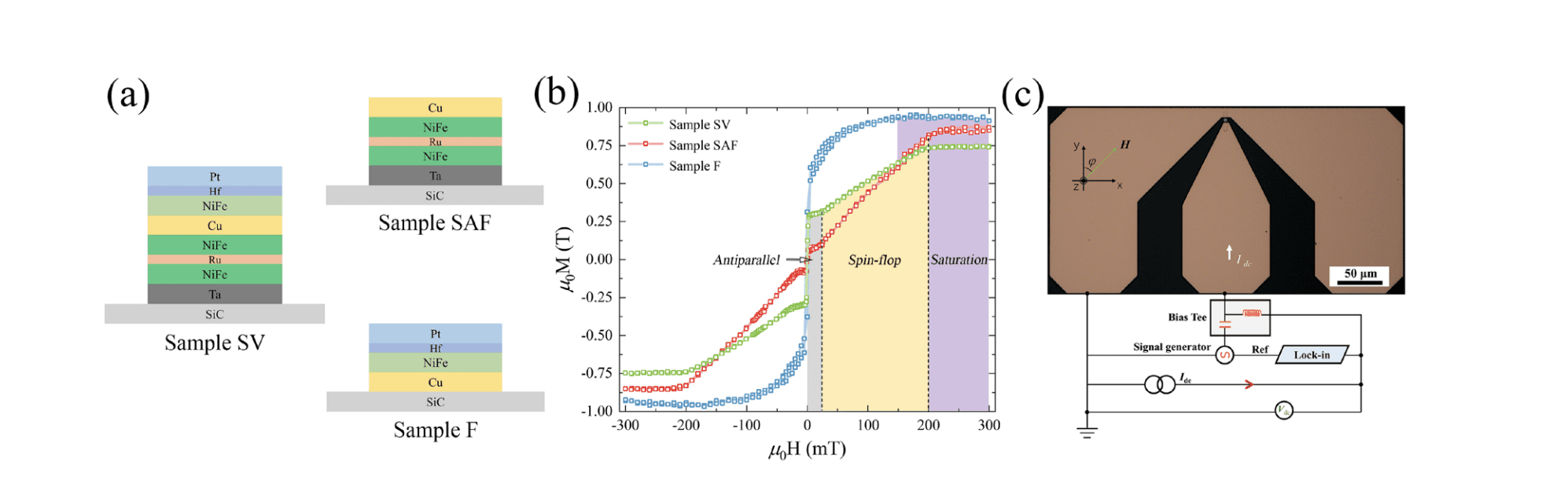
Spintronic oscillators hold promise for next-generation radio frequency (RF) communication, but their performance is limited by energy loss within the device. Chunhao Li, Xiaotian Zhao, and Wenlong Cai, along with Long Liu, Wei Liu, and Zhidong Zhang, have overcome a key obstacle by demonstrating efficient detection of spin hall nano-oscillator dynamics at room temperature. The researchers engineered a novel synthetic antiferromagnetic spin-valve heterostructure that leverages giant magnetoresistance, achieving a remarkable signal strength independent of external magnetic fields or current direction. This breakthrough enables high-power spintronic oscillators with significantly reduced energy loss, paving the way for more efficient and powerful RF technologies and potentially revolutionising wireless communication.
Efficient Spintronic Oscillators Via Giant Magnetoresistance
Researchers have engineered a novel synthetic antiferromagnetic spin-valve (SAF-SV) heterostructure to create more efficient spintronic oscillators, addressing limitations in traditional designs. This new device overcomes power scaling challenges and holds promise for future non-von Neumann computing architectures. The team successfully demonstrated room-temperature detection of spin Hall nano-oscillator dynamics, a crucial step towards practical applications, stemming from careful material selection and precise control over magnetic properties. The device incorporates a hafnium layer that effectively suppresses spin pumping, resulting in ultralow energy loss and enhanced oscillation efficiency.
The free layer operates independently from the synthetic antiferromagnetic reference layer, while maintaining strong magnetic coupling, critical for stable oscillation. This decoupling maximizes performance, and stable auto-oscillation was achieved with a relatively low bias current, exhibiting dual-mode oscillations suggesting potential for advanced signal processing. The core of the device is a multilayer heterostructure carefully deposited onto a silicon carbide substrate. The SAF-SV architecture utilizes a complex stack of materials designed to optimize spin transport and oscillation. Researchers employed techniques like spin-torque ferromagnetic resonance and magnetoresistance measurements to characterize the device’s performance, with silicon carbide substrates and aluminum nitride capping layers enhancing thermal management and contributing to stable auto-oscillation. This work represents a significant advancement in spintronics, paving the way for more efficient and scalable spintronic oscillators. The team plans to further investigate the power spectral density, understand the origin of auto-oscillation modes, and optimize material structures to achieve even higher output power, offering a promising pathway towards advanced computing technologies and efficient microwave signal generation.
Thin-Film Deposition and Nanostructure Patterning
Researchers meticulously crafted a synthetic antiferromagnetic spin-valve (SAF-SV) heterostructure to overcome power limitations in conventional spintronic oscillators. They employed a precise thin-film deposition process to create devices with precisely controlled magnetic properties, depositing all metal thin films onto high-resistance silicon carbide substrates using DC magnetron sputtering, maintaining a high vacuum environment and carefully controlling argon gas pressure. Deposition rates were meticulously monitored to ensure uniform layer growth and consistent device characteristics. Following multilayer film growth, the team patterned strips and nano-bridge constriction structures using electron beam lithography and Ar-ion etching, creating the nanoscale geometries essential for oscillator functionality.
A lift-off process was then used to deposit a coplanar waveguide consisting of tantalum and copper, defining the electrical pathway for signal transmission, and a layer of aluminum nitride was reactively sputtered onto the device to enhance thermal management and prevent current shunting. Electrical characterization was performed at room temperature using a custom-built probe stage equipped with ground-signal-ground probes, allowing for precise measurements of magnetoresistance and spin-torque ferromagnetic resonance. The measurement system integrated a signal generator, lock-in amplifier, current source, nanovoltmeter, and electromagnet, with careful separation of DC and RF signals, and power spectral density was measured using a high-frequency spectrum analyzer to detect subtle oscillation signals. The resulting SAF-SV heterostructure demonstrated a remarkable giant magnetoresistance ratio of 0. 568%, exhibiting independence from current and magnetic field orientation. This innovative approach establishes a new paradigm for high-power, room-temperature spintronic oscillators, offering significant potential for coherent RF communication applications.
Stable Spin-Flop State Enables Efficient Detection
Researchers have developed a novel synthetic antiferromagnetic spin-valve (SAF-SV) heterostructure that overcomes fundamental power limitations in conventional spin Hall nano-oscillators. This innovative device, constructed with layers of tantalum, nickel iron, ruthenium, copper, hafnium, and platinum, achieves a giant magnetoresistance ratio of 0. 568%, demonstrating complete independence from the orientation of magnetic fields or electrical currents, enabling efficient detection of spin Hall nano-oscillator dynamics at room temperature, a crucial step towards practical applications. The team discovered that the SAF-SV structure maintains a stable spin-flop state even under varying magnetic fields, unlike previous designs, and this stability does not significantly impact the ferromagnetic free layer.
Experiments revealed that the ferromagnetic resonance linewidth of the free layer is effectively modulated by direct current passing through the platinum layer, while remaining decoupled from the synthetic antiferromagnetic layer, providing precise control over the free layer’s resonance critical for generating stable oscillations. Furthermore, the researchers successfully mitigated Joule heating, a common problem in these devices, through the use of high-thermal-conductivity silicon carbide substrates and aluminum nitride capping layers, maximizing microwave output power. Notably, stable auto-oscillation peaks were observed at a bias current of 0. 82 mA, with the oscillation frequency tunable by external magnetic fields and potential dual-mode behavior at low fields. These findings establish a new paradigm for high-power, room-temperature spintronic oscillators, offering significant potential for coherent radio frequency communication and other advanced applications.
Room Temperature Detection of Spin Hall Oscillations
This work demonstrates a new synthetic antiferromagnetic spin-valve heterostructure capable of efficient detection of spin Hall nano-oscillator dynamics at room temperature. By employing a nickel-iron-based synthetic antiferromagnet and a copper spacer, the researchers achieved a giant magnetoresistance ratio of 0. 568%, independent of magnetic field or current orientation, representing a significant improvement over conventional devices limited by low anisotropic magnetoresistance. The study confirms that the ferromagnetic free layer and the synthetic antiferromagnet operate independently, each capable of magnetic resonance under microwave current.
Importantly, the team observed stable auto-oscillation at a relatively low bias current of 0. 82 mA, with oscillation frequency tunable by an external magnetic field, suggesting potential for dual-mode behavior. Analysis of the data reveals a low Gilbert damping factor and indicates that the introduction of a hafnium layer may suppress spin-pumping, further reducing magnetic damping. The researchers estimate a significant spin Hall angle, demonstrating efficient spin-torque ferromagnetic resonance and paving the way for high-density microwave signal generation. The authors acknowledge that the observation of one particular precession mode was absent from their data, potentially due to signal strength. Future research could focus on optimizing the structure to enhance this signal or exploring alternative materials, establishing a promising new paradigm for high-power spintronic oscillators, offering potential applications in coherent radio frequency communication.
👉 More information
🗞 Room temperature giant magnetoresistance detection of spin hall nano-oscillator dynamics in synthetic antiferromagnetic Spin-Valve
🧠 ArXiv: https://arxiv.org/abs/2508.18770