

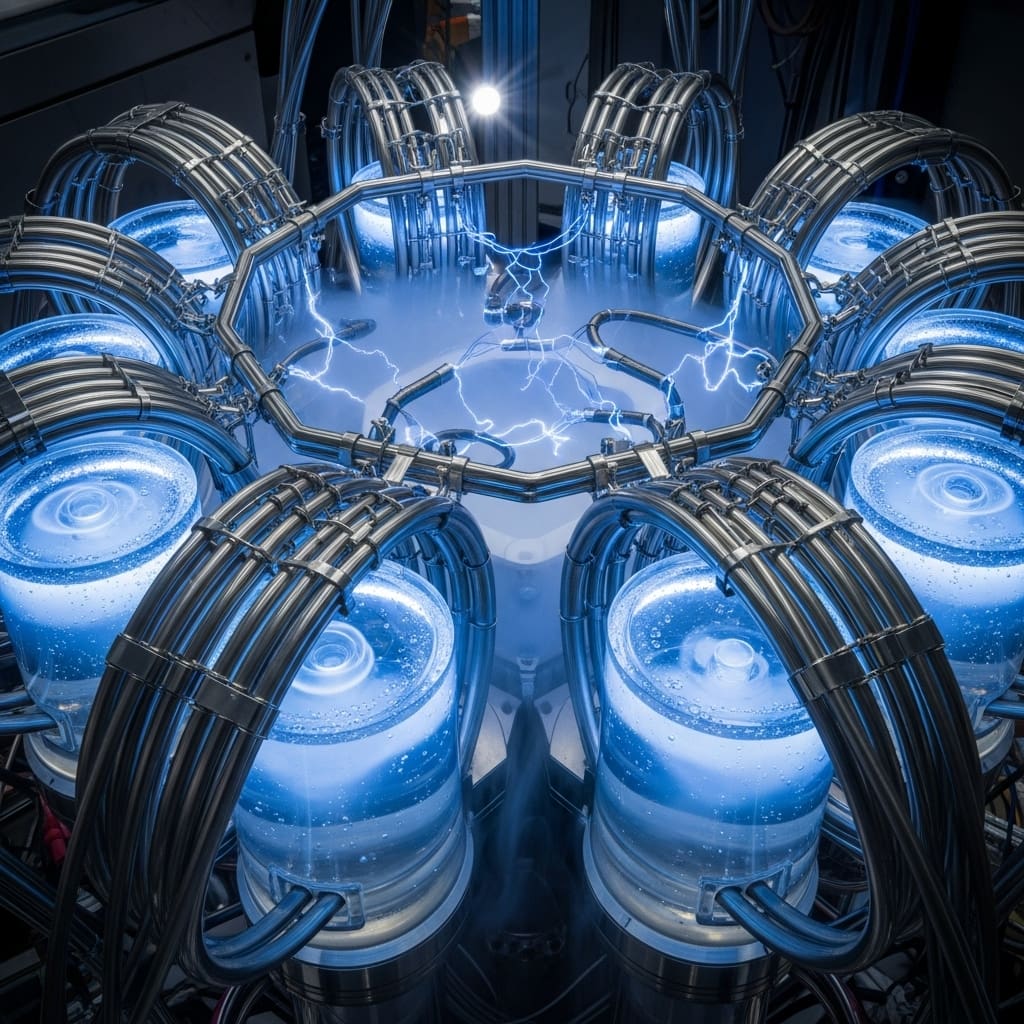
The subtle warping of spacetime predicted by Einstein’s theory of general relativity, known as frame-dragging, remains a challenging phenomenon to measure directly, particularly on Earth. Now, Kai-Isaak Ellers from University of California, Berkeley, Marios Christodoulou from Austrian Academy of Sciences, and K. C. Schwab, alongside K. Birgitta Whaley from University of California, Berkeley, present a novel approach using a superfluid helium gyrometer to detect this effect in a laboratory setting. Their work demonstrates the potential for unprecedented sensitivity to rotation, capable of resolving frame-dragging to within 0. 2% in just one second, and corresponding to the measurement of incredibly small time differences. This achievement represents a significant step towards directly verifying fundamental predictions of general relativity and opens new avenues for precision measurements of gravitational phenomena.
Superfluid Helium Gyroscope with Josephson Detection
This research develops a highly sensitive gyroscope, a device that measures rotation, by harnessing the unique properties of superfluid helium-4 and Josephson junctions. The core principle involves leveraging superfluidity, the ability of helium-4 to flow without viscosity, to minimize energy loss and enable extremely precise measurements. A Josephson junction, sensitive to changes in quantum phase, acts as a detector of subtle rotations within the superfluid. By minimizing noise sources, the team aims to achieve unprecedented sensitivity in rotation detection. Superfluid helium-4 serves as the working fluid, its zero viscosity crucial for precise rotation sensing.
A Josephson junction, a superconducting device, allows current to flow without resistance under specific conditions and is extremely sensitive to changes in the quantum phase of the superfluid. This junction acts as a transducer, converting rotation-induced changes in the superfluid flow into a measurable signal. The system incorporates a sensing loop, a closed loop of superfluid helium that amplifies the rotation-induced flow, and utilizes a nanoporous membrane to control the superfluid flow. The research details the theoretical basis, design considerations, and noise analysis of the gyroscope. The team employs a Hamiltonian approach to describe the dynamics of the superfluid and the Josephson junction, treating the system as a quantum mechanical system.
They derive an expression for the superfluid current based on the quantum phase and the vector potential, incorporating the Thomas phase, a quantum mechanical effect arising from the gyroscope’s rotation. The analysis focuses on identifying and quantifying noise sources, including thermal fluctuations and dissipation, with higher quality factors indicating lower dissipation and higher sensitivity. Key concepts include the Hamiltonian, which describes the total energy of the system, the superfluid current, the quantum phase, and the Josephson junction critical current. This research has the potential to lead to extremely sensitive gyroscopes with applications in inertial navigation systems, geophysics, and fundamental physics, enabling more precise measurements of Earth’s rotation and gravity field.
Superfluid Gyrometer Detects Earth’s Frame-Dragging
Scientists have achieved a breakthrough in precision measurement by demonstrating a laboratory-scale experiment capable of detecting the general relativistic frame-dragging effect on Earth. This work utilizes a novel superfluid helium-based gyrometer, a device designed to measure minute rotations with unprecedented sensitivity. The core of the experiment is a loop of superfluid helium interrupted by a Josephson junction, functioning as a hydrodynamic Helmholtz resonator. Specifically, they predict a noise spectral density enabling the resolution of the frame-dragging rate to 0. 2% within one second of measurement, corresponding to a rotational sensitivity capable of detecting a full revolution in 4 billion years.
Measurements confirm this extreme sensitivity corresponds to the detection of proper time differences as small as s, pushing the boundaries of time measurement. Further analysis reveals the connection between the observed quantum phases and proper time dilation, demonstrating how subtle differences in the flow of time can be detected through the gyrometer’s measurements. The team established that the device measures the total rotational flux through the loop, isolating contributions from Earth’s rotation, the frame-dragging effect, and other gravitational influences. This allows for the potential to independently measure each effect, crucial for rigorous tests of general relativity against alternative theories of gravity. The experimental protocol opens new avenues for exploring fundamental physics and refining our understanding of spacetime.
Superfluid Gyroscope Measures Frame-Dragging Effect
This research presents a novel approach to measuring the general relativistic frame-dragging effect, a subtle prediction of Einstein’s theory of relativity, using a laboratory-scale experiment. Scientists have developed a superfluid helium-based gyroscope, leveraging the unique quantum properties of superfluids to create an exceptionally sensitive rotational sensor. The device functions as a Josephson junction, enabling the precise measurement of minute changes in orientation caused by the Earth’s rotation and the associated frame-dragging effect. Notably, the sensitivity of this device is comparable to that required for experiments probing the fundamental connection between gravity and quantum entanglement. While acknowledging that the experiment is currently a theoretical design, the authors highlight the practical advantages of using compact, quantum-based gyroscopes as complementary tools to existing technologies for measuring relativistic effects. Future work will focus on the practical realization of this device, paving the way for a new generation of precision measurements in fundamental physics.
👉 More information
🗞 Quantum Sensing of Gravitational Frame-Dragging with a Superfluid He Gyrometer
🧠 ArXiv: https://arxiv.org/abs/2510.20772