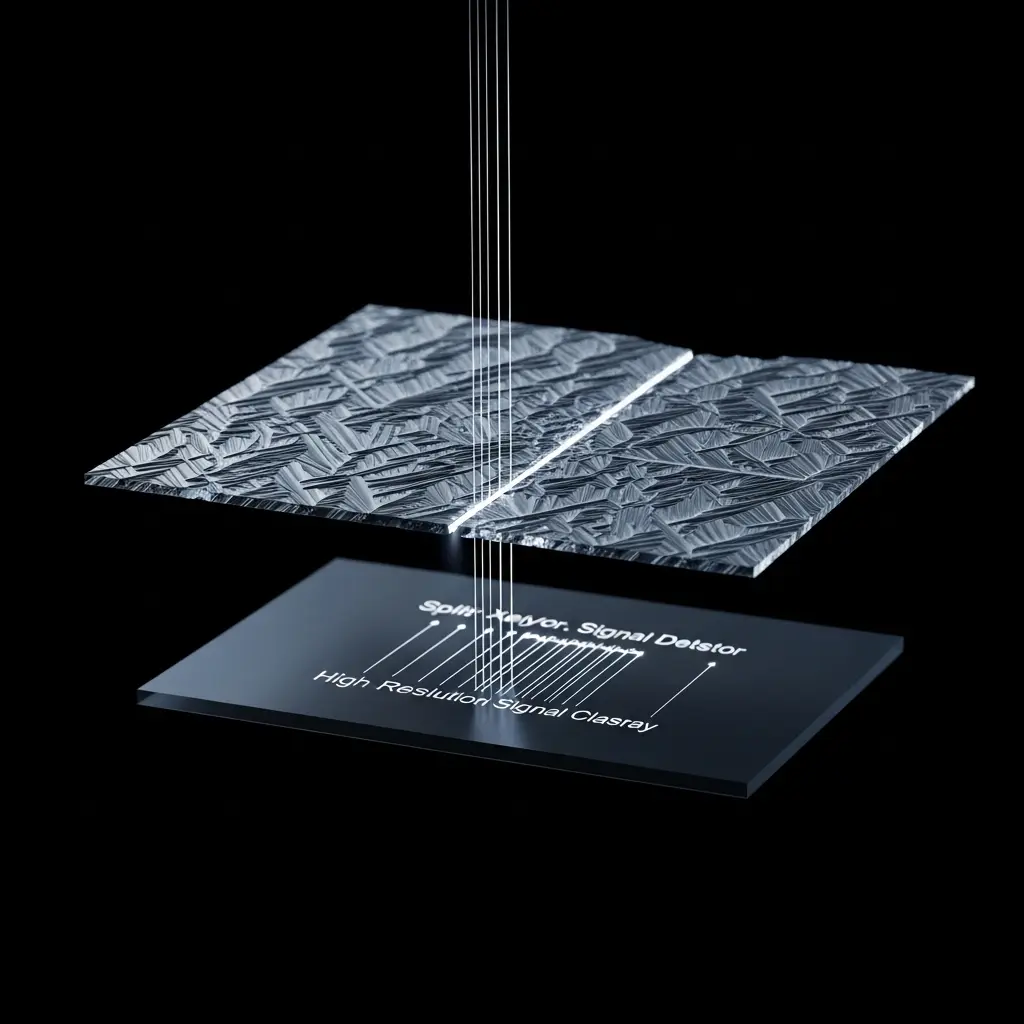
Scientists are continually pushing the boundaries of X-ray detection technology, and a new study details a significant advance in energy resolution achieved using aluminium-manganese Transition-Edge Sensors (TESs). Liangpeng Xie from the School of Physics and Materials, Nanchang University, Yifei Zhang and Zhouhui Liu from the State Key Laboratory of Particle Astrophysics, Institute of High Energy Physics, Chinese Academy of Sciences, along with Zhengwei Li and colleagues, demonstrate a novel annular AlMn TES capable of resolving X-ray energies with unprecedented accuracy. This collaborative research, involving scientists working between Nanchang University and the Institute of High Energy Physics, Chinese Academy of Sciences, has yielded a Full Width at Half Maximum (FWHM) of just 12.1 ±0.3 eV at 17.48 keV, representing the first demonstration of an AlMn TES attaining sub-0.1% energy resolution. This breakthrough establishes AlMn TESs as a viable alternative to traditional bilayer devices and promises to enhance the capabilities of future X-ray spectrometers for applications ranging from astrophysics to materials science.
Increased Resolution for Astrophysics and Materials Science
The development addresses a long-standing challenge in X-ray astronomy and materials science, where discerning subtle energy differences in X-rays is paramount. This improved resolution allows for more precise identification of materials and a deeper understanding of high-energy astrophysical phenomena. Researchers successfully created an annular-shaped sensor, a design chosen to optimise performance, and integrated it with a Superconducting Quantum Interference Device (SQUID) amplifier within a dilution refrigerator. By reversing the typical fabrication sequence and carefully controlling the annealing process, the team optimised the sensor’s critical temperature to achieve unprecedented energy resolution. The detector’s annular geometry features an inner radius of 28μm and an outer radius of 45μm, with a 300nm thick AlMn film deposited onto a Si3N4/SiO2 membrane. Fabrication involved depositing and patterning 120nm thick Niobium (Nb) electrodes via DC magnetron sputtering and dry etching. Subsequently, a new AlMn target with 2000 ppm Manganese was used for DC magnetron sputtering of the AlMn film. A crucial step was annealing the AlMn film on a hotplate at 230°C for 10 minutes, carefully tuning its critical temperature to approximately 100 mK based on a pre-calibrated temperature-annealing curve. To ensure stable operation and minimise external interference, a dedicated magnetic shield was designed and implemented. The detector’s normal resistance was calculated to be 8.3 mΩ, slightly exceeding the design prediction of 7.2 mΩ, while the superconducting critical temperature reached 98.4 mK, closely aligning with the anticipated 100 mK. Thermal conductivity, deduced to be 220 pW/K at 98.4 mK, was marginally higher than the modelled design value of 203 pW/K. Temperature sensitivity, αI, was measured at 13.7, and current sensitivity, βI, at 0.3, resulting in a loop gain, LI, of 2.2. The decay constant, τ−, was extracted as 1.15ms, yielding an intrinsic decay time, τ, of 3.0ms and a total heat capacity of 0.6 pJ/K. Voigt function fitting of the X-ray spectra yielded intrinsic FWHM values of 8.1 ±0.6 eV at 5.9 keV, 11.4 ±0.3 eV at 8.0 keV, and 12.1 ±0.3 eV at 17.48 ke.
Streamlined Fabrication Using Novel Alloy Films
The persistent challenge of detecting faint signals from the cosmos, or within complex materials, has long demanded ever more sensitive detectors. The beauty of this approach lies in its simplicity; utilising a single alloy film streamlines fabrication, potentially lowering costs and enabling larger-scale detector arrays. The demonstrated resolution is sufficient to resolve key spectral lines, offering a powerful tool for detailed analysis. Maintaining uniformity across larger detector arrays, and ensuring long-term stability of the alloy’s superconducting properties, are ongoing concerns. Furthermore, the performance achieved here is at cryogenic temperatures, necessitating complex and expensive cooling systems. Future work will likely focus on optimising the alloy composition to enhance performance at slightly warmer temperatures, and exploring novel readout schemes to further reduce noise.
Detailed Scientific Results and Further Reading
👉 More information🗞Beyond One-ThousandthEnergy Resolutionwith an AlMn TES
🗞 Beyond One-Thousandth Energy Resolution with an AlMn TES Detector
🧠 ArXiv: https://arxiv.org/abs/2602.11728