Quantum communication relies on the secure transmission of single photons, and researchers are increasingly turning to quantum dots as promising light sources for these systems. Lorenzo Carosini, Francesco Giorgino, and Patrik I. Sund, working at the University of Vienna’s Vienna Center for Quantum Science and Technology, alongside colleagues including Rene R. Hamel and Lee A. Rozema, have overcome a significant hurdle in this field by demonstrating quantum communication using quantum dots at wavelengths beyond the standard telecom bands. The team successfully transmitted all polarization states required for a secure communication protocol over a substantial distance using a specially engineered hollow-core fibre, achieving exceptionally low signal loss and maintaining the integrity of the single photons. This breakthrough paves the way for quantum networks that are not constrained by the limitations of conventional fibre optic technology, potentially extending the range and security of future communication systems.
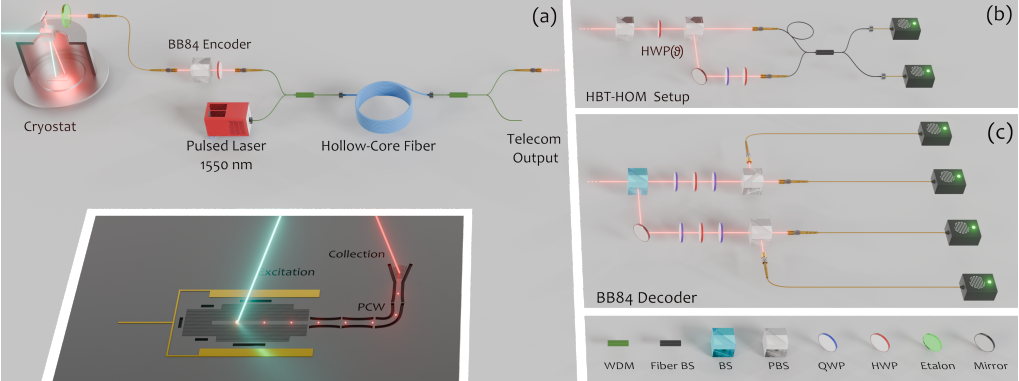
Standard optical fibres suffer significant signal loss at these crucial wavelengths, hindering the use of many quantum dot materials. The team overcomes this limitation by employing hollow-core fibres, which contain an air-filled core that minimises interaction with the signal and substantially reduces signal attenuation. By integrating quantum dots into a hollow-core fibre system, they established a free-space quantum key distribution link over a distance of 50 metres.
The quantum dots function as single-photon sources, generating the carriers of quantum information, while the hollow-core fibre efficiently transmits these photons. This result represents a significant advancement, extending the operational wavelengths for quantum communication beyond established telecom bands and showcasing the potential for utilising a wider range of quantum dot materials. A key component of this technology is the development of efficient and reliable sources of single photons, such as quantum dots, though achieving high efficiency and purity remains a challenge. Integrating these light sources and detectors onto photonic chips is essential for miniaturisation and practical implementation of QKD systems. Hollow-core fibres are also crucial, guiding light through air-filled cores to reduce signal loss and enable long-distance quantum communication. Researchers are exploring various methods of encoding quantum information, including time-bin and polarization encoding. Several challenges remain, including signal loss and source quality, prompting investigation into quantum repeaters to extend communication range.
Low-Loss Quantum Photon Transmission in Fiber
This research demonstrates a significant advance in quantum communication through the successful transmission of single photons via a specially engineered hollow-core fibre. Scientists achieved low-loss transmission at wavelengths suitable for quantum dot emitters, measuring a loss of 0. 65 dB/km and anticipating potential reductions to 0. 12 dB/km near 934nm. This addresses a key limitation of standard telecom fibres, which exhibit substantial losses at these wavelengths.
The team demonstrated the ability to transmit all four polarization states of a single photon from a quantum dot over a distance of 340 metres with a low quantum bit error rate of 0. 1%, preserving the integrity of the quantum signal. Importantly, the hollow-core fibre also supports strong classical signals at telecom wavelengths without introducing detrimental noise, enabling the possibility of simultaneous quantum and classical communication.
🗞 Quantum Communication with Quantum Dots Beyond Telecom Wavelengths via Hollow-Core Fibers
🧠 ArXiv: https://arxiv.org/abs/2509.11889