Understanding the behaviour of magnetic materials requires increasingly sophisticated computational methods, and a team led by Ki Won Jeong and Jae Yeon Seo at their respective institutions, alongside Sunghyun Lim et al., now presents a novel quantum simulation approach to tackle this challenge. They focus on CuSb2O6, a complex magnetic material where subtle interactions create unusual magnetic properties, specifically ultra-weak magnetic anisotropy. This research overcomes a significant hurdle in accurately modelling such materials by representing the spin interactions using a network of qubits, allowing for the faithful simulation of even the most delicate magnetic effects. The team’s simulations reveal an exceptionally small, yet crucial, magnetic anisotropy constant and predict a unique spin behaviour at high magnetic fields, demonstrating a pathway towards resource-efficient simulations of complex magnetism in real materials.
Simulating CuSb2O6 Anisotropy with Ancilla Qubits
This study pioneers a novel simulation framework to investigate magnetocrystalline anisotropy (MCA) within the complex magnetic material CuSb2O6, a spin-1/2 antiferromagnet. Researchers addressed the challenge of accurately representing MCA in quantum simulations by employing a unique four-qubit square lattice model, introducing paired ancilla qubits to encode the angle-dependent anisotropy. This innovative two-qubit representation per spin site overcomes limitations inherent in traditional methods, enabling faithful embedding of MCA terms into quantum circuits and allowing for precise modeling of the material’s magnetic behavior. Utilizing a variational eigensolver, the team determined an exceptionally small easy-axis MCA constant, measuring just 0.
00022% of the nearest-neighbor exchange interaction, yet sufficient to induce a spin-flop transition with spin reorientation and strong angular variation in magnetic torque. To accurately model the alignment of copper ions, the MCA constants were carefully set, smallest along one axis, intermediate along another, and largest along the third. The team validated the model’s ability to analyze the material’s magnetic response by fitting calculated isothermal magnetization data to experimental data at 2 Kelvin. Beyond the spin-flop transition, the study reveals a previously unrecognized half-saturated magnetic phase at ultra-high fields, stabilized by anisotropic next-nearest-neighbor interactions. Researchers demonstrated that stronger antiferromagnetic coupling between specific sites resists canting, delaying alignment and producing this unique intermediate state.
CuSb2O6 Magnetism and High-Field Spin Flop
This research provides a comprehensive understanding of the magnetic behavior of CuSb2O6, particularly focusing on the spin-flop transition and its behavior under high magnetic fields. It combines experimental measurements with quantum computational simulations using the Variational Quantum Eigensolver to understand the underlying magnetic interactions and energy balance. CuSb2O6 exhibits a spin-flop transition, where the magnetic moments rotate from aligning along one axis to another, driven by a balance between exchange energy, Zeeman energy, and magnetocrystalline anisotropy. Under very high magnetic fields, the material exhibits a half-saturated magnetic phase before reaching full saturation, attributed to the asymmetry of the next-nearest-neighbor exchange interactions.
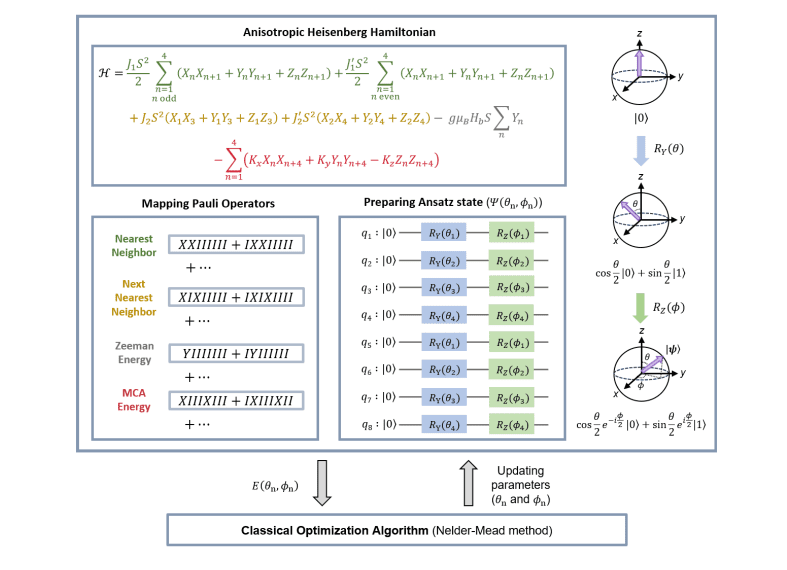
The research highlights the importance of balancing exchange, Zeeman, and MCA energies to understand the magnetic behavior of CuSb2O6. The dominant exchange interactions are nearest-neighbor and next-nearest-neighbor. The simulations used a Hamiltonian that includes terms for these interactions, Zeeman energy, and magnetocrystalline anisotropy. Each copper ion spin is mapped to two qubits to preserve the quadratic spin projections required for the MCA term. A variational circuit uses gates to prepare different spin configurations, optimized using an algorithm to minimize energy. The research uses techniques such as magnetization measurements and magnetic torque measurements, alongside single-crystal synthesis, to probe the material’s magnetic properties.
Quantum Simulation Reveals Subtle Magnetic Anisotropy
This research demonstrates a successful framework for simulating magnetocrystalline anisotropy, a crucial property of magnetic materials, using quantum simulation techniques. By modeling a spin-1/2 antiferromagnet, CuSb2O6, as a four-qubit square lattice with ancilla qubits, scientists accurately represented the complex interactions that define its magnetic behavior. The simulations revealed an exceptionally small, yet significant, easy-axis anisotropy constant, capable of inducing a spin-flop transition and a unique half-saturated magnetic phase at ultra-high fields. These findings validate the ability of quantum simulation to resolve subtle magnetic phenomena in real materials, offering a resource-efficient approach to include anisotropy in realistic models.
Validated through statevector simulations, this framework bridges the gap between theoretical predictions and experimental observations. The team acknowledges current limitations stemming from the noise inherent in existing quantum hardware, which obscures the subtle signals of anisotropy. Future research focuses on leveraging fault-tolerant quantum platforms with improved qubit coherence and lower error rates to extend simulations to larger systems and explore dynamic magnetic behavior, ultimately promising advancements in both fundamental magnetism and the design of spintronic materials.
👉 More information
🗞 Quantum simulation approach to ultra-weak magnetic anisotropy in a frustrated spin-1/2 antiferromagnet
🧠 ArXiv: https://arxiv.org/abs/2509.21974